Showing posts with label email marketing mistakes. Show all posts

Wednesday, August 15, 2018

3 Reasons Your Email Marketing Conversion Rates are Low


When it comes to sending emails, it’s not enough to craft a compelling message and send it to your subscribers’ inboxes. You need to make sure people are opening your emails and ultimately converting.

While high open rates are nice, you can’t sell anything if subscribers ignore what you’re offering and decide they’re not interested. It’s important to have people engaging with your content. If your goal is to send them to your website, you need high conversion rates, too.

If you have taken a look at your email analytics and seen that your messages haven’t driven enough conversions, don’t blame your emails. Three problems could be driving those lackluster results, and in this article, you will learn how to solve them once and for all.

1. You aren’t reeling people in

Imagine for a second you are one of your subscribers. You are relaxing in your house after another intense work day. You check your phone, and you see you have 200 unread emails.

If you are like most people, you will read most of the emails really fast and archive them, or you will delete them right away just by looking at the subject line and preheader text.

With so much competition in your subscriber’s inbox, your emails need to catch their attention fast. After you get people to open your emails, the rest of your email needs to hold that attention all the way up to the call-to-action.

Since you need to get their attention, you may think you need to get super creative in the way you design your emails. You may even think you need to offer discounts.

The problem is that with these ideas you will over-complicate things. Your emails don’t need better design or discounts (although they can help); they need to reel people in so they can become interested in your offers.

Instead of reinventing the wheel, you can tap into the core tenets of copywriting to assist you with this task. While copywriting is commonly associated with traditional advertising, their techniques can be used in any medium, including email.

While there are many things copywriting can help you with, the most important way it can help you increase your conversions is by improving your hooks. The hook is the element of your copy that stops your readers and makes them read whatever you have to say.

The hook starts before the recipient opens the email; it starts in the subject line, the “From” name, and the pre-header text. To improve the hooks of your emails, there’s one trick you can use that will help you hack through the process.

The trick is called the knowledge gap. When you use the knowledge gap, you start by making people curious about an idea.

Imagine you had one campaign where you are giving away a 24-hour $20 discount for one of your products — let’s say, men’s shorts.

Without the knowledge gap, you’d write a subject line along the following lines:


Special offer: $20 off in men’s shorts for the next 24 hours


While there’s nothing bad in stating your offer in the subject line, it’s not interesting.

People love discounts, but do you know what else they like? Stories. Your subscribers want to be entertained, even with your emails. With the knowledge gap, your subject would say:


You have 24 hours to save $20 — here’s how you do it.


In this case, the subject line opens with scarcity (a famous psychology principle of influence), continues with specificity, and finishes with a personal offer that ties the discount with the recipient.

Better yet, the subject line reads like a story. It makes me feel as if I was Jack Bauer from the TV series 24.


Now that you have piqued your subscriber’s interest, you’d need to continue the hook in the email, which could say:


  • $20 can buy you many things.
  • 4 frappuccinos.
  • A t-shirt.
  • A dinner out with your girlfriend.
  • What if you could save those $20 today?
  • Here’s how:
  • You can get our favorite men’s pants at $20 less than usual.
  • Tomorrow, the offer will be gone. And you know what? You’ll have to kiss goodbye to your new pants and the free t-shirt (or frappuccino, or romantic dinner out).
  • Not today. Today, you have the chance of getting the pants you deserve at a special price.
  • Get your pants now.

While such an email structure will depend greatly on your brand, your audience, and your style, it’s still a powerful and engaging way to communicate your offer.

The knowledge gap is what reels people into your emails and drives them right into your offer. Your subscribers won’t have to think deeply about your offers. They will be drawn towards them.

Open the knowledge gap, and you will open the floodgates to your conversions.

2. You are sending emails to the wrong people

Remember your subscriber we talked about before? Her problem was that she gets too many emails in her inbox. According to a survey done by MarketingSherpa, the main reason why people unsubscribe is that they get too many emails.

And the second reason? The emails they are getting are irrelevant.


You can’t make other brands send fewer emails, but you can make your emails more relevant.

What makes your emails more relevant isn’t just the way you structure your content with hooks as you just saw. The real problem behind irrelevant emails is this: each subscriber is unique.

If you treat your subscribers as one big list without segmenting them based on their unique characteristics — like demographics and behavior — you risk sending the right emails to the wrong people.

Even if you do everything right (i.e., beautiful design, well-crafted CTAs, great copy, etc.), your subscribers will feel alienated from your emails and will not convert.

The key to segmenting your list is through analysis. With the help of your email analytics tools, you can uncover key demographic data that can help you understand your audience better.

If you find most of the people on your list are young professionals, you know that you could use a more colloquial vocabulary and use graphics that are sleek and modern.

The same applies to any other demographic group, which can be segmented by:
  • Gender
  • Profession
  • Location (country, state, city, or neighborhood)
  • Position in the company
  • Experience
  • Age

Besides using demographic data, you can segment based on your subscribers’ past behavior. For example, you could send promotional emails to people who have purchased in the past, who have opened your last four emails, and who like you on Facebook.

Better yet, you can find that most of the people who click your emails belong to a specific demographic group and improve the targeting even more.

By understanding the demographics and behavior of your subscribers, you can create more relevant content that fits their needs and interests. Once your emails are more relevant, your conversions will increase.

3. You don’t know what works

If you like reading email marketing blogs like this one, you are aware of the importance of things like:

  • Using copywriting
  • Segmenting your list
  • Designing your emails
  • Making your CTAs more attractive
  • And so on

While all these ideas are important in making your email marketing campaigns more effective, they all share one problem: they aren’t suited to your current situation.

What this means is that even though using better copy can make your emails more interesting, they may not increase your conversions as much as, say, improving your email design.

You may think your copy isn’t very good, but your subscribers may have problems with your design. Therefore, if you fix the latter, you will increase your conversions. How do you find this out? Do you survey your subscribers? Do you flip a coin?

No, actually, you find out what you need to improve through A/B testing. Thanks to the use of email A/B testing, you can test different hypotheses and see which one drives the most conversions.

Start by developing a hypothesis around an idea you have about your email, your list, or your business.

Let’s say you thought the reason why you are losing money with your promotional emails is because you are sending it to people who aren’t loyal customers. With this hypothesis, you could send one promotional email to the people who have purchased from you more than once and spent more than $50 in the past 6 months, and one to those who haven’t.

Then, you’d compare the results and see which one has driven more conversions. If you find the former group brought a large number of conversions at a low cost, you know how you need to segment your promotional offers.

If you find that the results aren’t conclusive, then the problem may be in the offer itself or the products promoted. Interestingly enough, those two potential problems are the next hypothesis you should test.

Eventually, you’d come up with a list of rules to follow based on your experience and results. You will become a master of your conversions thanks to testing what works.


Wrap up


Increasing your email conversion rates isn’t rocket science. It only takes a bit of discipline to improve a few mistakes you are making that drive insufficient results.

Start by making your emails more interesting with the help of the knowledge gap trick. Then, send more relevant emails by segmenting your audience and finding the right people to email. Finally, see what really works by A/B testing your emails.


Source: https://www.business2community.com
Image Credit: MarketingSherpa


ABOUT WNFP
Westchester Networking for Professionals (WNFP) is a business organization focused on providing our members and guests with an extraordinary networking experience, bringing business professionals together for the sole purpose of generating new relationships and developing new business opportunities. Not a member, learn how you can become a member and join this awesome group of professionals to connect and grow your business.

Stay Connected with WNFP!
Join WNFP Communities!

Wednesday, July 18, 2018

How to Apologize After an Email Marketing Snafu

Things don’t always go as planned, and as a marketer, you’ll likely find yourself needing to apologize for mistakes. Email is no exception. It’s easy to send out a broken link, get a date wrong, or send an email to the wrong segment.

Most of us have been there. While it’s difficult to own up to a mistake, the best bet is always to mitigate the situation and apologize. Your subscribers are human, too. They know that mistakes happen, and if they’re happy with what you offer, they’ll usually give you the benefit of the doubt.

So, when you make a mistake in an email, how can you apologize? We’re here with tips for how to apologize after an email marketing blunder.


Stay cool and react as promptly as possible


You might be a little stressed from all the complaints you’ve received. Plus, you’re likely beating yourself up. Before you get to writing your apology email, center yourself and calm down. You want to be calm and rational when you write your email.

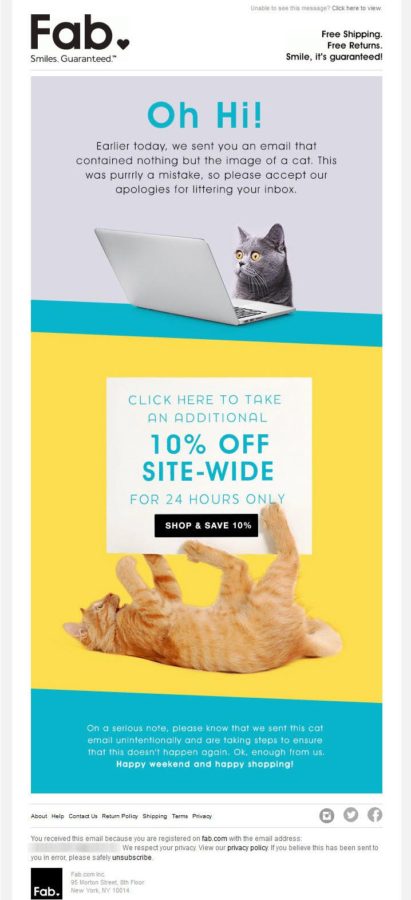
But as soon as you feel you’re in a proper state of mind, it’s time to get to work. Not sending out a timely response can cause even more confusion and frustration for your customers. For example, Fab sent out a casual and friendly apology email on the same day they made the mistake, pairing the message with a promo code.


Don’t play the blame game


It can be tempting to put the blame on someone, and maybe there is really is an individual person or specific entity that is responsible. But whatever you do, do not blame an individual or another company. It reflects poorly on your organization.

Focus your apology on how the incident should never have happened. You want to be seen as taking ownership, not trying to dodge responsibility. Your customers will respect you accepting responsibility much more than making excuses or finding a scapegoat for what happened.

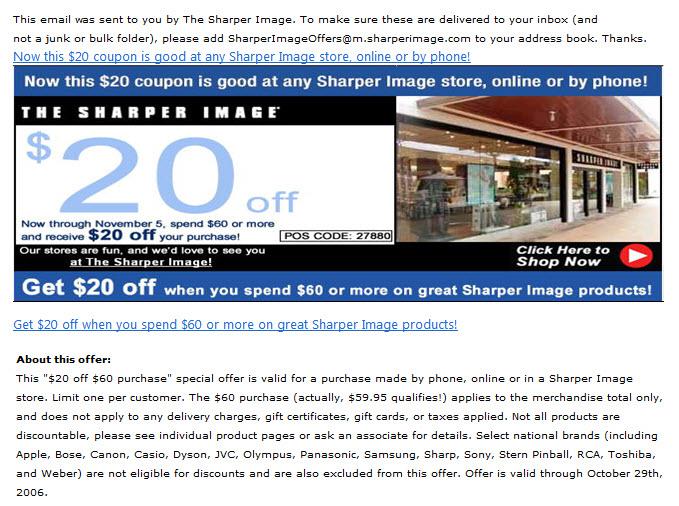
For example, The Sharper Image made a mistake by sending a coupon available only in San Antonio to every subscriber nationwide. They quickly realized it was a mistake, but they didn’t play the blame game and they sent a coupon to everyone as a way to apologize.


Personalize your messages


You want your customers to know they are receiving an apology from a real person. Ideally, send it out from a personal inbox, but you can also send it out from your team inbox as long as you sign it with an actual name.

“Never send out an apology email from an unattended email box. Never send out an apology from a ‘no-reply.’ Your customer is already unhappy, and an impersonal email they cannot even respond to will only make it worse,” advises Gary Mulligan, email marketer at BoomEssays.

For example, after Shutterfly sent an email congratulating new moms to everyone on their list, they sent out an apology using the subscriber’s first name and wrote the apology from John Boris, the Chief Marketing Officer.


Put yourself in your subscriber’s shoes


Empathizing with your customer is key to writing a proper apology email. Ask yourself, if you were the customer, what would you want to hear? What kind of information and updates are you looking for?

Also, think about how you would want the company to make things up to you. Your customer could be wondering why the incident happened, how it affects them, if it will affect them in the future, etc.

Accidents happen. Emphasize that it was not your intention to hurt anyone by your actions. Maybe the offense was preventable, and maybe it wasn’t. But it’s in the past now and what matters is your apology and letting your customers know you did not mean to offend them.


Give them a reason to forgive you


You’ve apologized for your offense, but now what will you do to make it up to them? Show your customers you care about upsetting them by providing them with a gift or, at the very least, explaining how you will avoid future mishaps.

You could offer them a coupon or a discount code. Reiterate your company values and why their business is important to you. Show them a little love by offering free shipping on their next purchase. Get that bad taste out of their mouth and remind them why they loved your business to begin with.

For example, Lucky Brand sent the following email after a technical glitch caused a poor web experience. The brand offered up a generous 30% discount to give subscribers a reason to forgive and forget.


Use humor if appropriate


Be careful with this one, as a poorly thought-out joke may be the reason for your apology in the first place. However, using humor can help lighten the mood after a gaffe.

When it comes to humor, consider your brand’s tone. Is it out of character for your brand to be humorous, or does it fit with who you are? Brand consistency is important when you are conducting damage control.

Before you engage with humor, consider the degree of seriousness of your offense. If the mistake was not terribly serious or if it was out of your control then humor may be a good tool for you. It shows your human side.

For example, Wistia sent an apology email after sending the wrong link with a familiar face — the company dog. Wistia made light of the situation with a joke and fun image.


Wrap up


Mistakes are going to happen; what’s important is how you react. Remember to keep your cool, respond promptly, avoid blaming, and personalize your messages. If you’re thoughtful, keep your cool, and have fun, mistakes will be easily forgotten and forgiven by your subscribers.


ADVERTISEMENT


Source: https://www.business2community.com
Image Credit: N/A


ABOUT WNFP
Westchester Networking for Professionals (WNFP) is a business organization focused on providing our members and guests with an extraordinary networking experience, bringing business professionals together for the sole purpose of generating new relationships and developing new business opportunities. Not a member, learn how you can become a member and join this awesome group of professionals to connect and grow your business.

Stay Connected with WNFP!
Join WNFP Communities!

Friday, June 8, 2018

3 Common Mistakes Seasonal Businesses Make with Email Marketing


It’s no secret that small businesses rely on email marketing to communicate with customers, but what if you’re a seasonal business? Does email marketing have the same results? Are there differences in best practices? Do seasonal businesses need to be sending emails all year long?

The short answer is yes.

If you’re a seasonal business, you might be making some email marketing mistakes that could be costing you big time, resulting in lost sales, poor email analytics, annoyed customers, and even the risk of being forgotten.

Keep your marketing thriving year-round with automated email marketing tools from Constant Contact.


Are you making any of these common mistakes?


1. Going quiet during the off season

The biggest problem with not sending emails during the off season is that your customers forget who you are and how much they love you! This could lead to unsubscribes or poor email results with future emails.

Example:
Heidi’s Hill is a small scale ski slope in rural New Hampshire. Since they are only open and operating during winter months, that is the only time they are using email marketing. This seems to be working for them, however, the email they send out at the end of fall and beginning of their season does not perform well, and business is off to a slow start.

The reason their email performed poorly is because their contacts have not been thinking about them for about 6 months, or have even forgotten about Heidi’s altogether. If this business had been keeping in touch with customers during the off season, customers would be anticipating the start of the ski season and excited to see Heidi’s emails pop into their inbox.

Tip: Try sending at least one email each month to keep your business top of mind throughout the off season. This takes a very small effort and will ensure your customers stay familiar with your business.


2. Sending too many emails once the season kicks off

Your re-opening should be a big event and be promoted with email marketing. However, if your customers haven’t heard from you at all during off season, all of a sudden seeing a ton of emails from you could be overwhelming. You risk annoying your contacts and even getting marked as spam.

Another issue that comes with only sending emails during the open season is that there is a shorter time frame to communicate all of your information. Emails end up getting stuffed to the brim with content that will most likely perform poorly due to lack of focus. Remember, email marketing should be like a marathon, not a sprint.

Tip: Easing into opening season by sending consistently far in advance is like greasing up the wheels before a big race. It’s a great way to prepare your customers for the promotions to come.

ADVERTISEMENT


3. Overlooking the value of consistent communication

As a best practice, consistency is very important in email marketing. Whether you send weekly, biweekly or monthly, just keep it consistent. This will build momentum, and your customers will come to anticipate and genuinely enjoy seeing you in their inbox, solidifying your relationship with them.

This relationship with your customers will not only knock your email results out of the park, it will keep you top of mind when they are ready to buy.

Tip: Create a schedule and stick to it! If you have a busy time frame coming up, plan ahead so your email marketing consistency won’t suffer.


Start thinking about how you can fix these common mistakes

If you’re seeing that your business is making these same mistakes, don’t worry, fixing them is easy. Email marketing keeps the conversation going all year, engaging your customers and setting yourself up for more success once your season starts.


Source: https://blogs.constantcontact.com
Image Credit: Constant Contact


ABOUT WNFP
Westchester Networking for Professionals (WNFP) is a business organization focused on providing our members and guests with an extraordinary networking experience, bringing business professionals together for the sole purpose of generating new relationships and developing new business opportunities. Not a member, learn how you can become a member and join this awesome group of professionals to connect and grow your business.

Stay Connected with WNFP!
Join WNFP Communities!
Business blogs
Business Blogs - Blog Rankings