“Don’t cross the streams!” That’s good advice when working with nuclear ghost-catching equipment strapped to your back, but it took breaking that rule for the Ghostbusters to defeat the Stay Puft Marshmallow Man. Crossing your social media streams and email marketing so your audience can move easily from one to the other will help grow your nonprofit organization’s reach on both channels. Using Constant Contact’s new email social block, you can start promoting your social channels and build an audience that will spread the word about your nonprofit for you. Connect email to social and build other audiences Building an email list builds an audience for your nonprofit organization, but building a social audience helps to support your email efforts. The more you build up your social channels, the more likely you’ll be able to drive traffic to sign up for your email list, and vice versa. Social and email should work together to grow your organization’s reach and audiences. Adding social links to your email helps potential donors or volunteers find your social platforms, and also helps them share your email with their social network, reaching new people that may also be interested in your cause. Give readers a backup option call to action Adding social media buttons to your email not only brings your channels closer together, it also gives readers a third option, something other than clicking through to your site or closing the email. Even if they don’t click your call to action button to sign up as a volunteer or donate, they may decide to look at your social media channels, giving you another chance to target them later. When designing your email, place a social media block below your call to action button. You could also add a small banner that says, ‘Spread the Word to your Friends,’ above the social links to provide context and help push them to action. Direct readers to a specific action on social Like deciding what to write in your nonprofit email, your social links should be specific and point readers towards a single action. Your social links should either direct readers to follow you on your social channels, or help them share your email message on their social media channels with a share button. If you’re promoting your fundraising event in an email and the reader decides not to donate or sign up to volunteer, linking your social media channels can help them stay up to date with reminders to get involved later. If your cause needs petition signatures, as another example, it may be better for readers to share your email message on their own social media channels, to build your audience and spread the word faster. Help your email and social media marketing work together
Combining your marketing efforts on social media and email will help grow your nonprofit organization’s reach on both channels. With a bigger reach, you’ll have more firepower when promoting a fundraising event, getting signatures for local causes or zapping the Stay Puft Marshmallow Man in the streets of New York City.
Source: https://blogs.constantcontact.com/ Image Credit: Constant Contact ABOUT WNFP Westchester Networking for Professionals (WNFP) is a business organization focused on providing our members and guests with an extraordinary networking experience, bringing business professionals together for the sole purpose of generating new relationships and developing new business opportunities.
Not a member, learn how you can become a member and join this awesome group of professionals to connect and grow your business.
What do email marketing and rock n’ roll have in common? Probably more than you imagine.
Let’s start with some history. Email has been around since Ray Tomlinson sent the first person-to-person message back in 1971. Seven years later, a visionary named Gary Thuerk sent the first mass-marketing email to several hundred Arpanet users– which, amazingly, resulted in $13 million in orders for his employer, the Digital Equipment Corporation (DEC). Rock n’ roll is synonymous with the guitar, which can be traced back 4,000 years. But the first electric guitar wasn’t perfected until 1931, by Adolph Rickenbacker and George Beauchamp. It was used initially by Hawaiian and jazz musicians – and two decades later it got into the hands of rock ‘n roll’s pioneers. Rickenbacker and Beauchamp probably didn’t expect to change the world, but they did. Ditto Tomlinson and Thuerk. But today – 40 years after that first commercial email message – email is a dominant power player, with some 300 billion emails being sent every day. Like rock ‘n roll, which lives on to this day, email marketing keeps on making a big, exciting noise. And here are six reasons why that’s likely to be the case for a long time to come. 1. Email marketing is affordable “It’s relatively inexpensive to start and maintain email marketing campaigns,” writes Keran Smith on the Lyfe Marketing blog. “Tactics like segmentation and triggered campaigns help you get the most for your money, allowing you to grow your business without pouring all of your revenue back into digital marketing.” His bottom line: “Email marketing is one of the most cost-effective digital marketing strategies that you can use to reach and engage your target audience.” 2. Email marketing has an extraordinary ROI “Email marketing is the king of the marketing kingdom with a 4400% ROI and $44 for every $1 spent,” reports Campaign Monitor. There’s simply no other marketing investment that can beat that return. And eMarketer, reporting on a study undertaken last year, indicates that the ROI trendline is heading in the right direction. According to the study, “73% of in-house marketers worldwide said that email marketing provided a strong ROI in 2017, making it the marketing tactic that received the highest percentage of responses in the survey, even slightly in front of SEO. Back in 2008, SEO ranked higher than email.”
3. Email is bigger than social media (in terms of users) Joe Kindness, writing on the Agency Analytics blog, cites a study showing there were anticipated to be more than 3.7 billion email users by the end of last year. And social media? “Facebook, which is far and away the most popular social media platform, sees ‘only’ 1.9 billion unique visitors every month,” he reports. “Two of the other most popular networks, Instagram and Twitter, have 600 million and 317 million visitors every month, respectively.” 4. …and email is better than social media (in terms of reach) Kindness explains that even if a marketer has an equal number email and social media subscribers, odds are very good that only the marketer’s email messages will be seen. “Why is this? It has to do with social media algorithms,” he writes. “Users don’t see every single post, tweet, and pin from the people and businesses they follow, because there are simply too many updates to fit on an average news feed. On Facebook, for instance, you can only count on about 6% of your fan base seeing anything you post, according to Social Ogilvy.” 5. Email marketing does personalization incredibly well “Brands are using creative and diversified email personalization methods to increase brand engagement, foster customer loyalty, and, ultimately, work to please that 75 % of consumers that are more likely to buy from a brand that personalizes messages,” reports Campaign Monitor. While personalization used to mean seeing your name in the subject line, it’s now much more than that. “Personalization includes an array of awesome, data-driven techniques that bring in substantial ROI. These techniques include making recommendations based on past purchases, using dynamic content to fit consumer preferences, showing an understanding of purchasing history, and taking advantage of data to promote compelling offers.” 6. Email marketing has unrivaled cross-generational appeal “Across generations, there is a clear preference to receive communications from companies by email,” writes Kelsey Bernius at SendGrid, citing a survey that asked thousands of email users of different ages about how they use it and their perception of it as a communication channel. “Your emails are crucial for reaching and engaging with your audience – and this trend can be expected to continue,” Bernius writes. “Email should be the foundation of your marketing efforts.”
Rock on, email!
Source: https://www.business2community.com/
Image Credit: business2community.com ABOUT WNFP Westchester Networking for Professionals (WNFP) is a business organization focused on providing our members and guests with an extraordinary networking experience, bringing business professionals together for the sole purpose of generating new relationships and developing new business opportunities. Not a member, learn how you can become a member and join this awesome group of professionals to connect and grow your business.
There are so many ways of marketing your business these days, and email marketing is one of the best ways of doing this. You have to make sure you are focused on making your business as successful as possible, and this is important. Email marketing is one of the most essential ways of marketing your business effectively. Since the internet has been around we have had email marketing, and it is still as popular as ever. So, why do you need to make sure you have the best email marketing you can? Well, there are a lot of things you have to keep in mind when trying to do what is best for your business, and email marketing allows you to reach customers wherever they are in the world. It is so important to try to reach as many people as you can, and email allows you to do that more effectively. So, how can you make the most of email marketing? Craft the Perfect Email Crafting the perfect email is something of an artform these days, so it is very important that you make sure you work on this. The right content in an email can make a huge difference, and plays a really big role in making people engage more with your business. This is why it is so important to make sure you work on getting the content just as perfect as you possibly can moving forward. Difference Between Personalized & Group Emails The advantage of email these days is the fact that you can send personalised emails as well as group emails, and you can use these for a variety of different reasons. There are plenty of things to think about when it comes to the differences between the two, but it is essential to understand that the two are actually quite different in a fair few ways. Use them each for achieving different things, and making the most of the way you advertise your brand. Subject Lines
It is also essential to keep in mind the fact that email subject lines can play a massive role in attracting people to the business. There are so many excellent things that can be achieved with the right subject line. The best thing you can do is to follow the proven email subject line strategies in order to craft the most compelling and enticing subject line you possibly can. This is something that is so important to get right as soon as you can in the process.
It is clear that email is one of the strongest and most important marketing techniques you have at your disposal. Because of this, it can be very difficult to properly promote the brand without i, and when you do use it, it is important to make sure you get it right. This means it is essential when it comes to making the most of email marketing, and trying to attract more people to the business as effectively as you possibly can. Embrace this, and your business will be all the better as a result.
Source: https://www.theselfemployed.com/ Image Credit: theselfemployed.com and iContact ABOUT WNFP Westchester Networking for Professionals (WNFP) is a business organization focused on providing our members and guests with an extraordinary networking experience, bringing business professionals together for the sole purpose of generating new relationships and developing new business opportunities. Not a member, learn how you can become a member and join this awesome group of professionals to connect and grow your business.
When it comes to successful marketing strategies, did you know email marketing consistently ranks as one of the best tactics? Studies show email has a median ROI of 122 percent; this is more than four times higher than other top strategies, including social media. In addition, HubSpot reports 86 percent of consumers want to receive emails from companies they do business with at least once a month.
[WATCH VIDEO]
As you can tell, research backs up claims that email marketing is worth the investment. In addition to the hard numbers, there are additional reasons this tactic plays an important role in your overall content marketing strategy. As Forbes points out, email marketing can “fuel” your business’ strategy to increase website traffic and search engine optimization (SEO). How?
It’s cost efficient.
It provides a way to promote your blog posts, articles or other content.
It increases link shares by making it easy for subscribers to share your content on their social pages or website.
It encourages customer loyalty as well as brand awareness and reputation.
It increases your social media follower base by offering another way to remind subscribers to connect with your social channels.
How can you include email marketing as an effective component of your content strategy? Keep reading to find out! Before we move on though, I wanted to make sure you are aware of how the EU’s new GDPR laws may affect your business, even if you operate in the United States. As Erika’s article about how GDPR affects marketing explains: While this law only applies to members of the European Union, it’s still going to affect those of us that do business on this side of the pond thanks to our global economy. In terms of your email marketing, if you have even one person on your list that is an EU citizen, it’s important you’re aware of the regulations. And if you don’t, it’s beneficial to be informed for good measure. Make sure you check out her post for specifics about how to comply with the regulations.
How to Create Effective Email Marketing Messages
Before you begin your email marketing campaign, make sure you have a clear understanding of your budget and goals. Once you’ve clearly established them, you can tackle the question of how you’ll achieve your goals.
ADVERTISEMENT
Effective Email Marketing Tactics
When it comes to the most effective email marketing tactics, Campaign Monitor reports the most important tactics are (in order):
Personalization
List Segmentation
Automated Campaigns (see 15 examples of automated emails you can send on the Social Media Hat)
Testing and Optimization
Responsive Design
Entrepreneur backs up the importance of personalization too, sharing that, “More than half of consumers and 65 percent of B2B buyers surveyed were likely to switch brands if a company didn’t make an effort to personalize its communications to them.” Whether you’re putting together an email marketing strategy for a small business, a medium-sized company or a major organization, personalization matters. How can you do this? As Entrepreneur recommends, “Get to know your subscribers better, and increase personalization by including polls in your emails. Not only is this an easy way for small businesses to learn more about their subscribers, it leads to more engaging emails and gives subscribers a chance to voice their preferences proactively.” How are you segmenting your email marketing lists?
As you get to know your subscribers better, you can segment your lists better. Kissmetrics recommends separating them based on your target audience’s variables, such as:
Demographics (e.g. age, gender, job title, etc.)
Email Engagement (open rate and clickthrough rate)
Geographic Area
Past Purchases
Amount Spent with Your Business
Website Behavior
Time Since Last Purchase
Once you have subscribers divided into specific lists, you can send more targeted, personalized emails based on their information. For example, if you have the lists segmented by geographical location, you could send an email letting one group of subscribers know about an upcoming event in their area. Clearly, this can be a lot to manage. The good news is you can also subscribe to a third-party email marketing management platform (such as MailChimp or Constant Contact) to take advantage of tools and services they offer to assist with personalization, as well as list segmentation, automation, testing and responsive design. Speaking of MailChimp, their blog shares a lot of helpful advice based on research into what’s worked well for their customers. In addition to the tactics above, the email marketing platform recommends:
Using landing pages to provide, “A clear call to action and an easy space to make purchases.” This tactic has helped their customers increase their list growth rates by about 36 percent.
Incorporating social media into your email marketing. MailChimp provides tools to incorporate Facebook and Instagram ads directly into your email campaign.
If it’s appropriate for your brand voice, incorporate emojis into your emails.
Rely on clear, high-quality visuals. As MailChimp explains, “What we do know is that when it comes to the relationship between click rate and the ratio of text to images in campaigns, keeping the amount of copy per image lower leads to success.”
Email Marketing Specifics: Creating Your Messages
How much time do you spend crafting your email marketing subject lines?
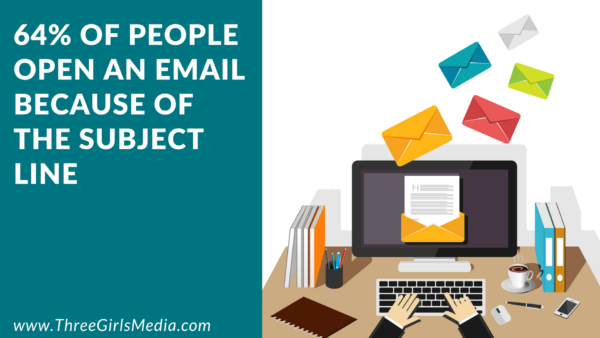
Email marketing statistic next to computer with envelopes coming out. How much time do you spend crafting your email marketing subject lines? Now that you have an idea of what tactics you want to include in your email marketing strategy, it’s time to get down to actually creating messages for your subscribers. As Natalie Petersen shared in her recent post about content development, your e-newsletter should include these elements:
An enticing subject line. 64 percent of people say they open an email because of the subject line, so spend time on it and make sure it’s enticing.
A strong visual appearance. In addition to choosing colors and an overall feel that matches your brand, include high-res images throughout the newsletter.
Concise, helpful content. Make your email easy to read and provide something of value to your readers. If you want to share an article that’s more than a couple of paragraphs, post it on your blog and link to it from the newsletter. Also, a brief introduction at the top of the email is a fantastic way to give your readers a quick look at what the issue includes and infuse a bit of your personality.
Grammatically correct text. Text that’s rife with errors can be confusing, plus it makes you look less professional. If possible, have a co-worker or friend proofread the text for you and double check your work.
A call to action. What do you want your readers to do after reading your newsletter? Share it with their friends? Contact you to for a free consultation? Make it clear how you’d like them to respond – after all, if you never ask they’ll never do it!
What type of content should you include? The biggest key here is to know your target subscriber. What messages will they want to receive from you? How will you provide them value? For example, if you have a younger target audience, research into millennials’ preferences will help guide your email content. As this infographic shares:
63 percent of millennials actually prefer to communicate with retailers via email.
59 percent will take action from emails containing a site-wide or product category-wide promotional offers.
The majority of millennials want to engage with retailers via email for discounts and promotional offers.
71 percent will take action from an email containing their preferred content (e.g. discount codes and free shipping)
The majority of millennials will pull up an email when browsing in a physical store to access coupons.
10 Common Email Marketing Mistakes
As you begin (or revisit) your email marketing campaign, make sure you avoid these all-too-common e-newsletter mistakes:
How often do you review your email marketing analytics?
1. You forget to look at the analytics. How will you be able to measure success without objective data? Each time a newsletter is distributed, take a look at how many recipients open it, which links they click, if they forward it, etc. As you look at this information, try to notice any trends you see emerging. Do your readers seem to like a particular type of content more than another? Is the open rate higher or lower when you send it in the afternoon as opposed to the morning? Pay attention to these tendencies and adjust your email marketing campaign accordingly.
2.Your emails aren’t mobile friendly. If your newsletter doesn’t load on mobile devices, or is formatted in a way that’s hard to read, readers won’t take your email seriously. Ensure images, email size and videos that you send are compatible with mobile devices so that potential customers can find your emails.
3. You lack consistency. Sporadically sending out emails to subscribers may frustrate them and then cause them to forget they asked to receive your messages and then unsubscribe when they see them. Instead, implement your email marketing on a consistent schedule and stick to it. You also want to be consistent with the content you share in your emails so subscribers will know what to expect and be more interested in opening them.
4. You over communicate. Your subscribers follow you for a reason, but if you spam them with too many emails they will unsubscribe. When you create your email marketing schedule, don’t over load it with too many messages going out too frequently.
5. You ignore design.
Do your email marketing messages fit your branding?
While a generic template or no HTML at all can be tempting, ignoring a custom-design means you’re losing brand identity. Custom templates allow you to showcase your business in a unique way and make it stand out from the rest of the emails people receive.
6. Your headlines are dull. You want your marketing emails to be opened at the very least. Create a compelling subject line that grabs the attention of your recipients. Subject lines that lack pizazz can be easily categorized as spam to potential customers.
7. You forget to customize the preview text. This is the preview of what shows up in recipients’ inboxes. As HubSpot explains, “If your email client supports preview text, also known as pre-header text, you can optimize it for every email you send. Allowing this text to auto-populate is a lost opportunity to grab attention or delight your recipients.” Most email marketing platforms include a place for you to customize this space.
8. Your emails are too long. When it comes to email marketing, the shorter the content, the better. Each paragraph of your email should be about 3 to 4 lines at the most. Your potential customers are in a hurry and usually scan through emails. Ensure that your first sentence has the most important information so they won’t miss the crucial parts of your message.
9. You don’t repurpose content you’ve already created. There’s no need to reinvent the wheel every time you send a newsletter. Share your latest blog post or a fascinating article you shared on Facebook. Remember, it takes multiple impressions for consumers to remember a brand, so repeat your message in as many channels as possible.
10. You sound like a used car salesperson. Just because email marketing isn’t face to face doesn’t mean you can’t add a little personality to your messages. Avoid sounding like a used car salesperson by avoiding a full on sales pitch within your emails. Try adding a little humor, fun facts or anything else that may tickle the fancy of your potential customers.
Now you’re ready to get started with or revisit your email marketing campaign!
Source: https://www.business2community.com
Image Credit: N/A ABOUT WNFP Westchester Networking for Professionals (WNFP) is a business organization focused on providing our members and guests with an extraordinary networking experience, bringing business professionals together for the sole purpose of generating new relationships and developing new business opportunities.
Not a member, learn how you can become a member and join this awesome group of professionals to connect and grow your business.
It’s easy to send an email—and it can cost you basically nothing. Your company can send a limitless number of marketing emails, hoping for the best—but if that’s the approach you take, you’ll find that your emails fall on deaf ears. In fact, you’ll probably find that they never get opened at all.
Just because emails are perceived as cheap and mundane doesn’t mean you should be careless in how you send them. With the right approach, marketing emails can be more than just inbox filler. They can actually move your sales needle and improve your bottom line.
How? By accomplishing a few things:
First, your emails actually have to be opened and read.
Your emails need to go to the right people.
Your emails need to offer something of value.
Finally, your emails need to earn the trust of each recipient.
Maybe that sounds like a tall order, but with the right email marketing strategy, these goals are totally attainable. Here’s how.
Get Your Subject Line Right
Remember, your marketing emails won’t accomplish anything if they don’t get read. And that largely comes down to the subject line. Your subject line sets the tone and establishes the first impression for each email you send—and a good subject line will entice the recipient to explore your message. That’s how you get your emails to be opened and read.
So what does a good subject line look like? For one thing, it’s succinct. According to one study, the best length for an email subject line is four words. Does that mean every email you send needs to have a four-word subject line? No—but you should definitely shoot for brevity.
As for the substance of your subject lines, make sure you avoid clichés. Emoji and overtly salesy language tend not to grab anyone’s attention. Instead, convey the value of your message. What does it say, or what kind of offer does it include? How will the recipient be better off for opening your message?
That’s what you should convey in your subject line—in as brief and punchy a way as you can.
Recommended for youSign up for Email Marketing Webinar with Westchester Networking for Professionals
Send Your Emails to the Right People
Another key to getting your emails opened and read is to make sure they go to the right people. Before you hit send, know who you’re sending to.
Accomplish this by keeping a well-curated email list. There are different ways to do this. Maybe you have lists for low-quality and high-quality leads; for returning customers and new leads. At Grammar Chic, Inc., we have distinct aspects of our business—resume writing and content marketing, for example—where the subject matter overlap is pretty minimal. Thus, we maintain separate email lists, only sending resume-related stuff to jobseekers, not to our friends who work in marketing.
Well-curated email lists are key for ensuring that, when someone receives your message, it contains something that speaks to them.
ADVERTISEMENT
Make Your Emails Valuable
Finally, your emails must earn the trust of each recipient. To put it another way, you need to show that you respect your recipient’s time. Remember that the people who receive your emails probably receive a ton of messages over the course of the day. They have little patience for something that simply hogs space in their inbox. Rather than sending them a bunch of cursory messages day in and day out, send messages judiciously—and make sure each one really counts.
And to make a message count, you need to make sure it offers something of value. Value, of course, can come in many different forms—among them:
An offer for a white paper, guide, or other downloadable offer
A discount code or coupon
A first look at a new product or service, before it’s been unveiled anywhere else
Carefully curated, value-adding clips from your company blog
The bottom line? Don’t waste anyone’s time. Give them something that speaks to their needs and shows that you’re looking out for them—not just trying to hock your wares.
Write Emails That Improve Your Bottom Line
Good emails don’t just get read; they convert, in one way or another. As such, they can actually move your sales needle.
Source: https://www.business2community.com
Image Credit: Pixabay
ABOUT WNFP Westchester Networking for Professionals (WNFP) is a business organization focused on providing our members and guests with an extraordinary networking experience, bringing business professionals together for the sole purpose of generating new relationships and developing new business opportunities.
Not a member, learn how you can become a member and join this awesome group of professionals to connect and grow your business.
While writing a letter never grows old, emails have taken over the concept of sending both personal and professional messages to make communication quick and immediate. The average number of emails sent and received on a daily basis has reached 269 billion. This statistic is enough to tell you the potential of an email.
With the right choice of marketing channels, brands can not only chance upon the right set of target audience but also improve their chances of converting prospects into customers. Email marketing is the choicest channel to build awareness, grab attention and convert prospects. It helps you segment your marketing content, reach out individually and personalize your communication based on your relationship with the recipient.
In this blog post, we will uncover how email marketing helps to:
Improve brand recognition
Increase customer retention
Establish authority
Boost relationships
1. Improve brand recognition
Brand recognition is "the extent to which the general public (or an organization's target market) is able to identify a brand by its attributes." So when you send out emails to your subscribers, make sure to include your brand's logo and other visual signifiers in the email. The brand colors and graphics should be consistent in every email sent out, in order to help the audience instantly recognize an email sent out by your company. The brand attributes lead to increased awareness, which in turn attracts customers towards your brand's products and services. If they need to pick between two brands for the same product -- one they recognize, the other they've never heard of -- you can count on them picking the one they know.
The emails that can improve brand recognition include newsletters. A newsletter updates your customer on the current happenings and upcoming events and helps the brand stay top of mind with the customers.
This newsletter by Booz Allen Hamilton Inc. offers analytical insights to the recipients. It keeps the recipients updated on the latest happenings in the industry. There is an option to update your preferences so that you receive content that you are interested in. It is an excellent way to improve brand recognition.
click on image to enlarge
2. Increase customer retention
Customer retention focuses on strategies that help companies retain as many customers as possible for as long as possible. You certainly don't want to be a one-time purchase for your customer. Ideally, you want them to be loyal customers. A good email marketing strategy can get you there. If you send out the right type of emails at the right time with the right frequency, your customers will keep coming back to you. It is also possible that they become your brand advocates, taking it upon themselves to market your business for you.
When you send out an email, you remind your audience of your existence. These emails can be alerts informing them about new products or telling them about an ongoing sale. These emails are gentle reminders; you should send them to your subscribers frequently. Even when your subscribers are not invested in you, they will be reminded that you exist. When the times come that they are ready to buy a certain product/service offered by you, your brand will be part of their consideration. These emails could convert a "chance meeting" into a sale.
Send out "Haven't seen you in a long time" emails or re-engagement emails to your customers to improve retention and get them back. If you are in a business that requires them to re-order products, you can send out re-order emails to retain the customer. This will show them you care.
Sending out an email similar to the one sent by DuoLingo can help you increase conversion and retention.
click on image to enlarge
3. Establish authority
As a brand, your email marketing should showcase what you have achieved, and how well you know your industry. Offering valuable tips, sizeable information and even content that your audience requires at the moment can help you establish authority, which in turn improves your brand's value. If your email adds value, chances are that it will be forwarded to more people thus spreading good things about your brand.
Send them product information or specifications about the product they are considering to buy. You can even send them industry news if you want to establish authority. The email by Haworth offers a detailed overview of the products offered by them.
click on image to enlarge
4. Boost relationships
When you trust someone, entering into a relationship with them becomes a lot easier. The same is true for those prospects who are evaluating your brand. For you to win their trust, you should ideally invest in communicating with them and connecting with them about the right things. Email marketing can help you do that with ease.
Whether it is a new subscriber or someone who is already on-board as a customer, the emails that you send will help them get to know you better and eventually trust you. Emails help nurture relationships.
Welcome emails, as well as lead nurturing emails, can help foster relationships. They help the prospect onboard your brand and learn everything they want to, before moving from awareness to consideration stage.
This email by Allrecipes welcomes the subscriber. The brand asks the subscribers to send in their preferences and, accordingly, curates the recipes for them. The CTA allows the customer to set their taste preferences.
click on image to enlarge
Build your brand with these best practices
Set your brand's tone and voice
Your existing brand guidelines should be applied to your email marketing strategy as well in order to attract the right people. Your email's tone and voice should be consistent with your marketing communication for the right effect. If you are a serious brand, for example, your email communication should convey it.
Plan your content
The content of the email is an important aspect and should be planned in advance. If you are strategizing your email marketing, make sure you have set forth a plan for the content.
The content should be aligned with the type of email that is being sent to the customer. For example, if you are nurturing a lead in the consideration stage, the email content would differ from the content that is included in the welcome email.
The content should be concise and crisp and such that the reader gets complete information at a glance.
The subject line should convey what the email contains. Keep it simple and attractive. The content should offer value to the readers and should provide insights to the users.
Add a call-to-action
It is important to write an actionable email. If your prospect is learning about your brand, try taking them to the website. If your prospect is in the consideration stage, the content and the CTA should compel them to buy. Adding appropriate CTAs will help with conversions.
Seek permission
Never send an email without the prospect's consent. Your brand may suffer if you send out an email to a prospect/customer who does not wish to receive emails from you.
ADVERTISEMENT
Wrapping up
It is important to channel your marketing efforts in the right direction in order to build a consistent brand. Email marketing is a great way to welcome subscribers, nurture relationships with them, build trust and engage them. You should send out the right emails at the right time to attract attention and retain loyalty. It is also important to craft your email using standard practices to achieve your goals. So, next time you are planning to work on your branding, don't forget to optimize your email marketing strategy.
Source: https://www.entrepreneur.com
Image Credit: Shuttershock
ABOUT WNFP Westchester Networking for Professionals (WNFP) is a business organization focused on providing our members and guests with an extraordinary networking experience, bringing business professionals together for the sole purpose of generating new relationships and developing new business opportunities.
Not a member, learn how you can become a member and join this awesome group of professionals to connect and grow your business.
Do you know how to persuade? It’s a critical skill for an email marketer. Perhaps the most critical.
“You’ve created your campaign and attended to all the details of identifying your audience, created your offer, and toiled for hours and hours, honing copywriting and design,” writes Gary Hennerberg at Target Marketing. “But in the end, the tipping point for your success likely stems from the degree to which you emotionally persuade an individual to take action.”
In his groundbreaking 1984 book, “Influence: The Psychology of Persuasion,” Dr. Robert Cialdini identified what he termed “The Six Principles of Persuasion”: reciprocity, commitment/consistency, social proof, authority, liking and scarcity. He was onto something important: his book has sold more than three million copies and been translated into 30 languages.
If you haven’t been putting Cialdini’s principles to work in your email marketing, now is a good time to start. Read on to learn how you can leverage them in your campaigns.
Reciprocity
“Reciprocity is the obligation to give once you receive,” writes Mark Brown at Emailaudience,
Brown illustrates the power of reciprocity by citing a study linking mints that accompanied diners’ checks with higher tips. “The waiters in the experiments enjoyed double the tip amount for one mint (3%), quadruple the amount for two mints (14%) and went as high as 23% when the waiter provided extra gifts unexpectedly,” he writes.
The bottom line: “In every email that asks users to take an action – whether it be clicking on a link, buying a product or sharing information – you should offer a small gift or offering. These gifts can be downloads, discounts or even entertaining videos, however, they should be seen as having some kind of inherent value in order to be effective.”
Commitment/Consistency
This principle posits that once people make a commitment, they behave in a manner consistent with that commitment.
Asking recipients to sign-up to receive free content is an example of gaining commitment. Once they do that, they are very likely to take the subsequent steps needed to obtain your offer.
“You’re persuading people to commit to your content, so that they start behaving in alignment with their choice of committing to you,” writes Neil Patel. “The returns garnered by the commitment and consistency principle could be something as subtle as liking and sharing your content on social media or something as large as following your CTAs.”
Social proof
Social proof drives conformity by compelling people to behave in alignment with the actions of others. Social proof gets results. It’s why email marketers use testimonials, endorsements, awards, product reviews, press coverage, and other forms of validation in their messages.
“Put simply, people trust people, not ads or self-promotion,” writes Daniel Kohn on the Kissmetrics blog. “We want to see or hear or read about others using, enjoying, and succeeding with a product or service before committing to it ourselves.”
Authority
“The principle of authority says most of us realize we can’t be experts at everything,” write Jacob McMillen at The Daily Egg. “Our best bet is to rely on the testimony of experts. Accordingly, we allow experts and those considered the ‘authority’ on any given topic to influence us.
“You can put the principle of authority to work in email marketing by citing professionals to back up any claims you make, by pointing to research conducted on your product or service by prestigious organizations and by showcasing awards and other recognition your company has earned.
ADVERTISEMENT
Liking
“It’s hard to say ‘no’ to someone we like or consider a friend, because we want to make a good impression and preserve the friendship,” writes Alexis Rodrigo at Vero. When it comes to leveraging this principle in email marketing, “The key is to get your subscribers to like you in the first place,” Rodrigo advises.
“To start, your emails should sound human. Write conversationally – think business conversation, not street talk – avoiding jargon and legalese.”More tips: “Show the human side to your company or organization. Let subscribers know who’s writing to them, and show an agreeable photo of the author. Get the people who make up your business to share who they are through personal anecdotes or stories that relate to the rest of your email.”
Scarcity
“The feeling of being in competition for scarce resources has powerfully motivating properties,” Cialdini wrote.“Scarcity triggers an emotion response because we find it hard to resist wanting things that are scarce,” writes Sarah Jamieson at Persuasionworks. “Scarcity also increases desire.If we know we can’t have something, we want it even more.”
Jamieson suggests email marketers leverage the persuasive power of scarcity by stressing that quantities are limited, that the product is only available to members of an “exclusive” group, or that a deadline is looming.
Source: https://www.business2community.com/ ABOUT WNFP Westchester Networking for Professionals (WNFP) is a business organization focused on providing our members and guests with an extraordinary networking experience, bringing business professionals together for the sole purpose of generating new relationships and developing new business opportunities.
Not a member, learn how you canbecome a member and join this awesome group of professionals to connect and grow your business.
Without the regular contributions of passionate supporters, nonprofits wouldn’t be able to achieve their goals. However, receiving regular donations means cultivating relationships with existing donors and creating a strong donor retention strategy.
Retaining donors is a serious concern for many nonprofits, and according to a recent study, only 46% of donors have given to the same organization two years in a row. That means there’s likely room to amp up your retention strategy, leading to a lot more donations down the line.
From fundraising events to social media outreach, there are several ways organizations go about improving their donor retention. One of the best ways to boost retention is with email marketing. Using the right strategies, your organization can level up your outreach to keep donors interested in supporting your cause.
In this post, we’ll show you five ways you can improve donor retention using email marketing.
One of the cardinal rules of email marketing is to make your messages personal and targeted. What’s more, personalizing your emails can help boost donor retention. When donors feel like your organization knows them personally, they’re much more likely to feel that your organization appreciates their support.
Using email marketing software is a great first step in ensuring that your emails are personalized. Organizations can take their personalization one step further by utilizing their nonprofit CRM or donor database software.
Let’s face it: your CRM holds a lot of information about your donors. Everything from their name and preferred contact information to their giving history and interests is conveniently stored in your donor profiles.
Put this information to use by segmenting your email outreach so that donors only receive emails that are relevant to them.
For example, if you have a group of donors who like outdoor activities and staying fit, they should be the first people you invite to participate in your walkathons and marathons.
Alternatively, first-time donors should receive more information about the history, mission, and past achievements of your organization whereas recurring donors are likely already familiar with that information.
Moreover, using both your email marketing and CRM software can help you evaluate what types of messages are most effective.
Organizations can gain a better understanding of what emails lead to more donations and event registrations by tracking metrics like:
Click-through rate
Total donations raised per email
Behavioral tracking using heat maps and recordings
Takeaway: Segmenting your donors based on giving history, interests, and location ensures that they receive emails that have information valuable to them. As a result, donors are more likely to read your emails and stay involved in supporting your nonprofit.
2. Write emails that are donor-centric.
A common mistake that many organizations make when writing emails is focusing on the achievements your organization has made rather than focusing on how their donors’ contributions made those achievements possible.
In other words, whether you’re writing an end-of-year appeal or sending a newsletter, no matter what type of email you’re sending it’s important to show your donors you wouldn’t be able to accomplish anything without their support.
The key to keeping your emails donor-centric is to:
Personalize your letter. Like we mentioned in the previous section personalization can have a huge effect on a donor’s motivation to contribute. Make sure that all your emails address the recipient by name.
Use the word “you” more often in your message. Using a recent email, tally up the number of times you use the words “you” and “we.” The language in your email should be focused on your donors because it shows that you appreciate their support.
Appeal to the donor in your opening paragraph. A vital step in encouraging donors to contribute is by creating a connection that appeals to the donor’s passions. If your school is trying to raise money, reach out to alumni and let them know that contributing will help provide new students with the same enjoyable experience they had.
In addition to the tips mentioned above, your organization should make a point to mention the support and contributions donors have already made. This shows that you’re aware of all the help your donors have given.
Takeaway: Focusing on your donors shows them that you value their support and not just their money. And when donors feel truly appreciated, they’re more likely to stick around.
3. Update donors about fundraising opportunities.
One of the challenges of retaining donors is that your supporters aren’t always aware of all the fundraising events and campaigns your organization is hosting.
By sending donors emails that keep them up-to-date on all the fundraising and volunteer opportunities your organization has, the more opportunities your donors have to get involved.
Plus, boosting donor engagement is a proven way to improve your donor retention. The more involved your donors are, the more connections they’ll build with people working at your organization.
As such, donors will become more passionate about your cause, especially if they’re volunteering, attending events, and seeing your organization in action.
Cultivating a community of donors with a passion for your cause and strong connections to your organization’s team is the winning formula for retaining your supporters
Keep donors updated on fundraising opportunities in your email outreach by:
Letting them know about upcoming events.
Reminding them about ongoing crowdfunding or peer-to-peer fundraising campaigns.
Encouraging them to volunteer at events.
If you’re not sure how to frame your email messages, Fundraising Letters has a comprehensive list of templates for every occasion.
Takeaway: Having donors participate in events and volunteer for your cause is the cornerstone of any successful stewardship plan. Use email to spread the word about your engagement opportunities.
4. Let donors know how their funds were used.
Generally, after donors give to your nonprofit, they’ll receive a thank-you letter (sometimes in an email or via direct mail) and the engagement usually ends until your organization will make another appeal. When organizations make that second appeal, they may find donors don’t want to give again. Even if donors are passionate about your cause, they may not contribute because they don’t know how their funds were used the first time.
After a donor gives to your organization, the engagement shouldn’t stop at the thank-you letter. It’s crucial that you let your donors know how their money was used.
For example, if you launched a crowdfunding campaign to update the facilities at your animal shelter, you should send the donors that contributed emails updating them on the progress of your project.
These emails can include:
Photos and videos of your nonprofit in action. In our animal shelter example, the organization could send photos of the updated facilities and explain how the changes improved the living conditions of the animals.
A breakdown of how the money was used. Include a pie chart that shows how each portion of your fundraising goal was used. For instance, the animal shelter may show that 50% of the funds raised went to building materials and equipment and 30% went to labor costs.
Of course, if you’re sending out updates, your organization will need to keep a record of which donors contributed to what campaigns so that no is left out of the loop.
Using comprehensive fundraising software and your email marketing tool, you can keep donations organized and use segmented lists to send emails to the right donors.
Takeaway: Don’t let your engagement end after the thank-you letter. Make sure to keep donors up-to-date on the progression of your nonprofit’s project.
5. Include a clear call-to-action.
When your organization creates an email, you likely have a goal or multiple objectives you’d like your reader to complete. Creating these goals is not only useful for assessing the effectiveness of your emails but also creating the copy and designing the message itself.
In order to help donors complete your main objective, your organization needs to have a clear call-to-action that leads donors to their next steps.
Depending on the email you’re sending, your call-to-action could:
Direct donors to your online donation form.
Encourage donors to RSVP for your event.
Motivate donors to share your fundraising campaign with their peers.
Ask donors to volunteer for an upcoming fundraising event.
Once, you’ve determined what your call-to-action is going to be, you need to make it clear to your donors what you want them to do.
Towards the beginning of your email, make a direct ask so that donors know exactly what your organization needs to be successful.
Additionally, place your call-to-action in a prominent location and make it stand out. For instance, if you want people to make a contribution, don’t just include a link to your donation form. Instead, create a “Donate Now” button that’s placed at the top of your email.
For more tips on how to improve your calls-to-action, check out this article.
Takeaway: Just like any fundraising campaign, your emails need a clear call-to-action that lets donors know exactly what you need to reach your goals.
Wrap up
Improving your donor retention doesn’t have to be a struggle. With these five tips, you can amp up your email marketing and encourage donors to keep giving.
ABOUT WNFP Westchester Networking for Professionals (WNFP) is a business organization focused on providing our members and guests with an extraordinary networking experience, bringing business professionals together for the sole purpose of generating new relationships and developing new business opportunities.
Not a member, learn how you can become a member and join this awesome group of professionals to connect and grow your business.
Keep reading to earn how to increase your email marketing results!
Building brand awareness is one of the biggest challenges for small businesses and startups. They often don’t have the means and channels big business have at their disposition and can’t afford to spend thousands, and often millions, on huge marketing campaigns that might not even bear fruit. However, email marketing is one of the best ways to build brand awareness easily and on the cheap. Here are a few tips on how to boost your brand’s visibility through email marketing.
Too many newsletters come off as self-serving and are nothing but glorified ads. Users are already bombarded left and right with advertising messages, the last place they want to see them is in their inbox.
The best and only way to build a solid audience is by offering value first and foremost. The large majority of your messages should be purely informational in nature and involve no selling whatsoever. The first message should ideally be a free resource, such as a free guide, course or any other resource of value. A discount or freebie will also be welcomed and will help establish trust. Your subscribers will then value your list and look for other discounts later on and you’ll be able to use your list to promote your brand or advertise product launches once you’ve provided enough value.
Compartmentalize Your List
Another mistake that a lot of email marketers do is send one size fits all messages to members of their list. If you want to successfully build your brand and retain subscribers, you have to make sure that you list is well compartmentalized depending on factors like where the subscribers came from and what your prior interactions were with them.
If someone subscribed after they made a purchase for instance, sending a message on the product they bought would not only be useless but will look unprofessional as well. A follow up email asking for their opinion would be better. Also, if you happen to have gathered a list independently through an email checker service like theemailfinder.co, your approach should be different as well. You should work first on establishing trust and keep the selling to a minimum. If the subscriber came from your social media page, then you could showcase social media specific promotions or direct them to raffles or contests you might be holding.
Remember to Remain Consistent
Consistency is essential with any email marketing campaign. The frequency of your emails as well as their format should be consistent if you want to build your brand image and build a relationship with your list. In some industries, converting a client could take years, and consistency is key if you want to keep your brand at the top of your audience’s mind when they do decide to make a purchase decision.
Email marketing is one of the most cost-effective ways to build brand awareness. When used correctly, it allows you to reach your customers directly and build a long-lasting relationship, as long as you focus on providing genuine value.
ABOUT WNFP Westchester Networking for Professionals (WNFP) is a business organization focused on providing our members and guests with an extraordinary networking experience, bringing business professionals together for the sole purpose of generating new relationships and developing new business opportunities.
Not a member, learn how you can become a member and join this awesome group of professionals to connect and grow your business.