Showing posts with label business marketing. Show all posts

Monday, December 10, 2018

5 Small Business Marketing Trends to Watch in 2019


With limited time and resources, marketing remains a challenge on Main Street.

You may want to improve your marketing, but the running the business will always take priority.

In 2019, small businesses must make marketing a priority to stand out and grow their customer base.

Here’s a look at five of the most important marketing trends to pay attention to in the New Year.

Trend #1: Voice Demands Greater Attention
As consumers increasingly turn to voice search, small businesses must understand how to get their businesses found.

According to ComScore, 50% of all searches will be voice searches by 2020.

Here’s some other insight as you prepare your small business for the boom in voice.

Trend #2: A Stronger Focus on Social Media
In 2018, 92% of small businesses invested more time and money in at least one social media platform, according to a survey by The Manifest.

The year ahead builds on this groundwork.

Social media presents great potential for small businesses to engage their audience in new and meaningful ways.

Watch for Instagram to especially grow in the coming year. Ad revenues for the social media site are projected to triple to $11 billion in 2019, according to Forbes.


Trend #3: Content Marketing Grows in Importance
Most (80%) of small businesses don’t invest in content marketing, according to research from Clutch.

However, great content marketing can be the best source of high-quality leads, according to HubSpot.

In 2019, small businesses can win by approaching content with a multimedia mindset.

If you don’t have a blog that adds customer value, you’re missing out. See what works with your audience and refine your strategy as you go.

Trend #4: Location-Based Marketing Takes Off
Main Street has a huge opportunity in 2019 to hone in on specific audiences using location-based marketing.

Nearly two-thirds of marketers use location data for targeting promotions, according to Factual, and more than eight in 10 marketers say location-based marketing helped them grow their customer base.

Statista data reveals that this year, 242 million people accessed location-based services on their mobile devices, up from 220 million in the previous year.

Small businesses can succeed in the coming year by taking advantage of the growth of geo-location.

Trend #5: The Cloud Expands
If your small business hasn’t yet adopted cloud technologies, 2019 is the year to make the move.

Deloitte researchshows that small businesses using cloud services grow 26% faster than those who don’t. These companies also bring in substantially more profits.

Explore the tools that could work for your small business, such as cloud-based phone systems. You could end up saving time and money every day while running your business more efficiently.

Make Your Marketing Work for You in 2019
Don’t think of marketing as a giant, daunting task. Instead, approach it one tactic at a time.

Stay on top of trends, try new things and retire what isn’t working anymore.


When you take the time to consider what’s coming in 2019, you can get ahead of your competition and set your small business up for success


Source: https://quickbooks.intuit.com


ABOUT WNFP
Westchester Networking for Professionals (WNFP) is a business organization focused on providing our members and guests with an extraordinary networking experience, bringing business professionals together for the sole purpose of generating new relationships and developing new business opportunities. Not a member, learn how you can become a member and join this awesome group of professionals to connect and grow your business.

Stay Connected with WNFP!
Join WNFP Communities!

Saturday, May 5, 2018

What is the Difference Between Advertising and Marketing?


The difference between small business advertising and marketing is that advertising is a paid media placement to promote your business, i.e. buying an ad. Advertising is a specific technique and one part of marketing. Marketing in small business is a much broader set of activities to promote your product or service.

Advertising might be a TV commercial, a radio spot, a quarter-page magazine ad, a newspaper classified, a billboard or an Internet display ad.

Marketing in small business includes social media, free business listings, strategic product pricing, publicity, email marketing, content marketing, search engine optimization and more. It also includes advertising.

While advertising shares similarities with some other forms of promotion, advertising is usually more within your control. Small business advertising may better drive the results you need. Small business advertising also amplifies the impact of other forms of marketing, by making sure more people see your messages.


Advertising and Marketing


Here are scenarios to illustrate the difference between small business advertising and marketing in a small business:


Advertising: You develop a creative advertisement about your new product. Then you pay to place that ad where you’d like it to appear. You have complete control over the message of your small business advertising. You also have control over where it appears.


PR and publicity: You announce a new product with the help of a publicity agency. A media outlet covers it. Unlike with small business advertising, you have no control over where or whether your story will appear. Nor do you have control over what they write in response to your press release and interview.


A sales event: You run a special sales promotion in your store for the new product. You carefully craft the promotion and pricing to make it seem like a good deal. But you still are faced with getting the message out about the special sales event. This is where small business advertising comes in — to better drive results. So you create ads that draw attention to the sale, to get people to the store to ask for your product. Without advertising to highlight your event, it may not be as successful.


Social media: You put the word out about your new product through your social channels such as Facebook, Instagram and Twitter. However, only your followers and a limited number of others see your social updates. Those who see the update love the authenticity and some buy the product.


Content marketing: You write and publish content on your blog or on other sites, as a method to develop thought leadership, develop a personal brand, highlight your company brand, improve your position in search engines and develop a dialogue with customers.


Marketing in Small Business


The above five scenarios are all part of marketing in small business.

Often it’s not a case of advertising OR marketing. Rather, you can get better results by combining advertising and other types of marketing for a one-two punch.

Here’s an example of how content marketing and social media combined with advertising will bring a bigger impact. You write an awesome blog post. You share it on social media to get visibility there. But sadly, only a handful see your social media update or blog post. So you decide to promote your social media post. You boost or promote your update (i.e., place a social media ad) to get your message more widely seen by thousands, get more social shares and drive more sales.

Small Business Advertising


Some refer to combining advertising with other content marketing techniques as a “POEM.” POEM stands for Paid, Owned and Earned Media. In a content marketing setting, owned media is the blog post you write. Paid media is the boost for the social media post. Earned media refers to the sharing others do after seeing your social media share more widely. See more examples of using Paid, Earned and Owned Media.

Do you now see the difference between advertising and marketing in small business? And do you see how small business advertising can amplify other marketing techniques?


Source: https://smallbiztrends.com
Image Credit: Shuttershock


ABOUT WNFP
Westchester Networking for Professionals (WNFP) is a business organization focused on providing our members and guests with an extraordinary networking experience, bringing business professionals together for the sole purpose of generating new relationships and developing new business opportunities. Not a member, learn how you can become a member and join this awesome group of professionals to connect and grow your business.

Stay Connected with WNFP!
Join WNFP Communities!

Saturday, April 28, 2018

Branding Boot Camp: How to Build a Tactical Marketing Plan [WATCH VIDEO]


ICYMI, I had a branding issue when I first met marketing expert Kathleen Griffith. In part one of our special series, I learned about fragmentation. Griffith encouraged me to pick one area of my business to focus on and she gave tips on how you can get do that, too. Then we delved into what I needed to develop a brand strategy and the importance of knowing your company's core values. In this episode, Griffith walks me through how to build a tactical marketing plan and has homework assignments that may help you as well.


Source: https://www.entrepreneur.com


ABOUT WNFP
Westchester Networking for Professionals (WNFP) is a business organization focused on providing our members and guests with an extraordinary networking experience, bringing business professionals together for the sole purpose of generating new relationships and developing new business opportunities. Not a member, learn how you can become a member and join this awesome group of professionals to connect and grow your business.

Stay Connected with WNFP!
Join WNFP Communities!

Thursday, October 20, 2016

10 Small But Small Essential Ways to Boost Your Business


Giving your business a boost doesn’t have to be difficult or incredibly time consuming. In fact, there are some essential elements of building successful businesses that can sometimes get overlooked. These suggestions from members of our small business community include some small but important things you can do to boost your business right away.

Include These Essential Features of a Small Business Website

Your small business website serves as the online face of your business. And it can also provide any number of important functions. While each small business website should be different, there are some essential elements that can make them great, like the ones outlined in this post on Techlofy by Prince Kumar.

Entice Customers to Binge Watch Your Product Videos

Videos can really enhance your product pages with additional information, views and storytelling elements. But for them to really work, you need to get customers to actually watch them. This post on the Kissmetrics blog by Shayla Price includes some tips for getting people to binge watch your product videos.

Find a Fundable Startup Market Opportunity

There’s a lot that goes into finding a great startup opportunity. But one of the essential elements of any idea is its ability to get funded. Martin Zwilling of Startup Professionals Musings explains more in this post about finding fundable startup opportunities. And BizSugar members discuss the post further here.

Use a Digital Marketing Strategy to Increase Marketing Impact

A digital marketing strategy can help you keep all of your online and mobile marketing goals organized so that you’ll be better equipped to actually reach them. For that reason, Erik Newton of the BrightEdge blog suggests that using a digital marketing strategy can increase your marketing impact overall.

Achieve the Ideal State of Marketing

Marketing is an essential part of running any successful business. The actual activities that go into marketing can vary from business to business. But there are some elements you can include to find the ideal state of marketing for your business. Scott Rayden discusses the idea in this Marketing Land post.

Get Mind-Blowing Traffic From Pinterest

Pinterest has been steadily gaining popularity among consumers for a few years now. And that popularity means that it can be a great tool for businesses looking to attract online consumers. This Mostly Blogging post by Janice Wald includes some thoughts on the potential power of Pinterest. 

And the BizSugar community also weighs in here.

Learn How to Write Effective Web Content

Communicating with your customers online is becoming increasingly important. And content marketing can help you get those messages out effectively. But you need to understand how to write content that’s actually effective first. Jireh Gibson shares some tips in this Media Shower post.

Nurture Email Leads in Your Digital Marketing Funnel

Once you gather leads from your website or opt-in forms, you need to have a plan for actually converting those leads into customers. Nurturing leads is a huge part of that, as Mike Gingerich discusses in this post. He also offers tips for how to actually craft your emails.

Get Started With Facebook Instant Articles

Facebook has become such a huge part of how many businesses interact with their customers. So new or changing features like Facebook Instant Articles can have a big impact. In this post, Rebekah Radice explains Facebook Instant Articles and how they can help small businesses. You can also see discussion about the post over on BizSugar.

Take a Weekend Business Break

Hard work is an essential ingredient for any small business. But working hard constantly without ever taking any breaks can be draining and ultimately hurt your business in the long run. In this CorpNet post, Nellie Akalp challenges entrepreneurs to take a break over the long weekend, and explains why that is important.


http://bit.ly/advertise_online


Source: http://www.smallbiztrends.com
Photo Credit: Shuttershock

ABOUT WNFP
Westchester Networking for Professionals (WNFP) is a business networking association dedicated to helping small businesses and entrepreneurs develop, expand and grow. We offer affordable opportunities to help create a positive impact and advancement in your business interests and personal quality of life to take you to the next level.
Stay Connected with WNFP!
Join WNFP Communities!

Wednesday, August 17, 2016

16 Basic Marketing Tools Every Single Company Should Know


Modern marketing involves seemingly endless amounts of data generated by a smorgasbord of digital channels. In fact, the ocean of marketing data available is so vast that it's hard to know what to focus on, particularly when a company is young. Fortunately, a wealth of inexpensive and easy-to-use cloud platforms exists to help sift through and make sense of all the noise. Take some pointers from Nikhil Hasija, CEO of Seattle-based Azuqua, a company helping businesses like General Motors, GE, and Starbucks connect cloud apps and data, doing things such as linking Twitter to Marketo to Salesforce to Zendesk to Jira. Here are his words regarding the best digital tools any company should start with.

Website Content Management System (CMS)
Every company needs a website, but it's amazing how many companies create a website without a content management system. There is absolutely no reason to waste precious resources updating website copy. I use WordPress because it doesn't require engineering talent, there is a huge community of users to tap for help, it offers millions of themes to choose from, as well as a huge ecosystem of consultants, agencies, and developers.

Web Analytics
For most startups, the free tier of Google Analytics is enough. However, once you have more traffic, you may want to try advanced, yet more expensive, tracking tools like Kissmetrics, Mixpanel, Omniture, or Webtrends. No matter which tool you use, web analytics is absolutely critical for running experiments, and improving the impact of your content.

Customer Relationship Management (CRM)
If you have leads coming in, you need to start managing them. Salesforce is the most common CRM system, but it has grown bloated over the years, to the point where it is actually pretty difficult for a startup to get it up and running. The good thing about Salesforce is that every sales and marketing person knows how to use it. The downside is that it's more complex than it needs to be. I'm a big fan of Pipedrive as an alternative.

Marketing Automation
Once you start spending money on acquiring leads through things like paid media or events, you'll want to track and optimize your spend to ensure those leads mature and drive revenue. This means you need a system to create landing pages and gate content, send out newsletters, and create nurture campaigns. If you are focused on email marketing and newsletters, tools like MailChimp, SendGrid, and Constant Contact will suffice. However, they don't really generate leads. Marketo or HubSpot are much better for this. The biggest issue many companies have with marketing automation is that managing the tool becomes a full-time job. Azuqua--my company--addresses this issue.

Design Tools
Every marketing team needs design work. Marketing is inherently visual, especially in the digital age. While larger companies have design teams dedicated to marketing collateral or agency vendors focused on creative, small teams need to do much of this in-house. Many teams still use Photoshop, but Sketch is quickly overtaking Photoshop in popularity with startups because it's lighter, easier to use, and covers the functionality that non-design professionals need 95 percent of the time. I also recommend Canva to easily create social media creative and Unsplash to find free, high-res stock images.


What marketing tools are your favorites, and why? Sound off in the comments.


Source: http://www.inc.com/
Image Credit: Getty Images


ABOUT WNFP
Westchester Networking for Professionals (WNFP) is a business networking association dedicated to helping small businesses and entrepreneurs develop, expand and grow. We offer affordable opportunities to help create a positive impact and advancement in your business interests and personal quality of life to take you to the next level.
Stay Connected with WNFP!
Join WNFP Communities!

Thursday, June 23, 2016

7 Email Marketing Best Practices


The content of your email message is important, but your design is the first element that recipients will see. If you want readers to see your message instead of clicking to the next email, it’s essential to please their eyes and pique their curiosity. Here are a few keys to a winning email design:

1. Make it mobile friendly.
Two out of three emails are opened on a mobile device. Make sure that your email design is based on elements that work well in that environment. Those include large text, small file sizes for images, simplified layouts with plenty of white space, and touch-friendly buttons inside. If you use an image-based header, utilize responsive design to ensure that it shows up well on all screens.

2. Don't rely too heavily on images.
While some Web services load images automatically, many of your recipients will not see images unless they specifically enable this. For these readers, most images will result in a lot of blank white space. Always use alt tags and title tags to ensure that descriptions are still showing up when images don't. And, keep important information in the text of your email so that people don't miss it if images are not appearing. Read your email without the images to make sure that it still communicates well when all you see is text.

3. Make links easy to see and click.
You don't want to annoy recipients by making them hunt for links. At the very least, links should appear in a contrasting color (blue is the classic). Also consider underlining and bolding text links so that they show up easily. Use a combination of image-based buttons and text-based links so that all prospects can see where to click to get to your site. Having multiple links throughout the email makes it easier for prospects to do exactly what you want them to do.

4. Make sure you are CAN-SPAM compliant.
The CAN-SPAM act of 2003 requires that businesses make it simple for readers to stop receiving commercial mailings from you. Include clear instructions in the footer of your email that tell the recipient how to opt out of further mailings. The text should be large and easy to read. Failing to do this can get your message marked as spam. At the least, you can risk getting sent straight to the junk mail box. In worst-case scenarios, you can be fined for failure to comply.


5. Keep emails short and to the point.
When sending a commercial email, keep it under 300 words. Long emails look unwieldy to the reader and are more likely to get deleted than read. Deliver the hook quickly and follow up as succinctly as possible. Use subheads and bullet points to make it as “scannable” as possible.

6. Skip the spam-oriented words.
Spam filters often look for specific words to determine whether a message should go into the inbox or not. Some of the top spam words that have been identified are:
  • $$$, cash, money, cheap
  • Work at home, online biz opportunity, make money
  • Buy, clearance, order, shop
  • Free, f r e e, no cost

Exclamation points and all caps are also common triggers. What’s more, even when these words get past the filter, they can still turn off readers. While it can be hard to avoid every spam word, minimize them wherever possible to increase your chances of getting through. Get creative and find ways to share your message.

7. Test every mailing.
Before any mailing is released to your larger list, send it to a smaller test list to check your results. Open emails in both desktop and mobile browsers -- to ensure that your message looks good across platforms. Garbled messages with weird line breaks and broken images make a poor first impression. Make sure you can get your foot in the door with a professional look from the start.


Email can be one of the most effective tools in your digital marketing kit. However, efficient and pleasing design is vital. Ensure emails are easy to read and pleasant to look at, and you'll see a higher open rate, more click-thrus and happier recipients staying on your list.


Image Credit: Shutterstock.com
Source: https://www.malaysiamarketing.my

ABOUT WNFP
Westchester Networking for Professionals (WNFP) is a business networking association dedicated to helping small businesses and entrepreneurs develop, expand and grow. We offer affordable opportunities to help create a positive impact and advancement in your business interests and personal quality of life to take you to the next level.
Stay Connected with WNFP!
Join WNFP Communities!

Friday, March 18, 2016

What to Say in Any Email (A Simple 3-Step Persuasive Formula)


Ugh.

Is it that time already?

You know, that time you dread when you have to figure out what to say in your next email.

That time when you think up five other things you could be doing instead.

Sure, the act of writing your email can be the hardest part of email marketing. But it doesn’t have to be.

If you’ve been following along with our Virtual Workshop Series for Retailers: How to Increase Sales with Email Marketing, you already have a plan for the email(s) you’re going to send.

You know what you need to write about. And now you’ll see how to actually do it.

In the next session, How to Write an Email in 15 Minutes or Less, we’ll walk you through the seven essential elements of an email so you can overcome procrastination, write your email in minutes, and get it out to your contacts on time, every time.

Here’s a look at the simple persuasive formula you’ll learn as part of the workshop.

If you have kids, you’ve probably already used this formula without even knowing it.

Here’s a typical conversation with my twin girls…

Me: Girls, I was thinking we could watch a movie tonight.

Girls: What movie?

Me: That new one you wanted to see with Jack Black is on iTunes.

Girls: Yay!

Me: I’ll just need you to clean up your stuff in the living room. Then we can watch it.

Girls: Okay.

Essentially, in this conversation I’ve said, “Here’s an idea I have, this is why you’ll like it, and this is what I need you to do to get it.”

Let’s take a look at how this formula applies to email.

When it comes to what to say in your email, especially when you’re sending a time-based promotion, this same idea allows you to create a quick and persuasive email in minutes.

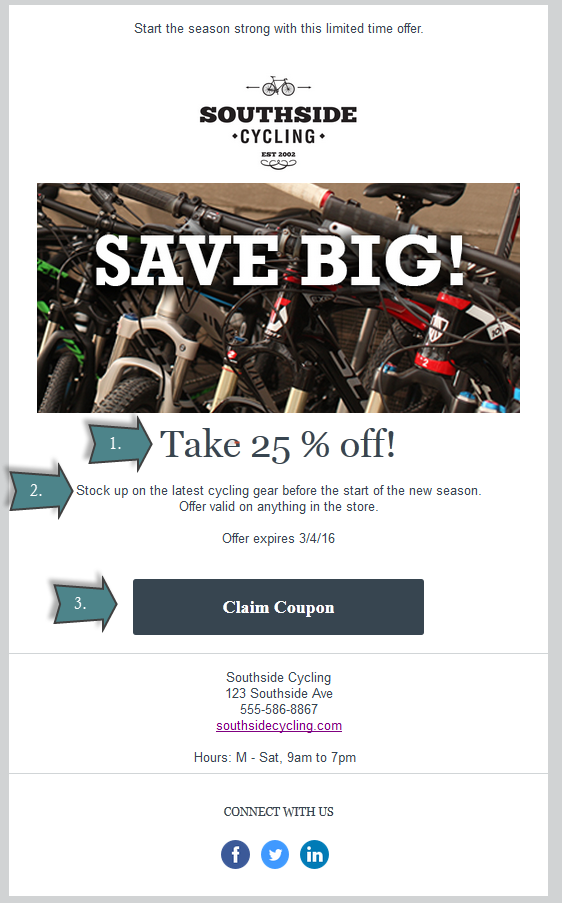
Just answer the following questions to create your email content:

1. What are you offering? — Headline

2. How will it help the reader? — Message body

3. What should they do next? — Call to action

Take a look at this email example:


Pretty simple, right?


source:www.constantcontact.com

ABOUT WNFP
Westchester Networking for Professionals (WNFP) is an organization consisting of professionals and entrepreneurs which focuses on the success of our Members. We help our Members establish lasting relationships and generate new business opportunities towards the growth of their business.
Stay Connected with WNFP!

Business blogs
Business Blogs - Blog Rankings