Showing posts with label 2018 email marketing trends. Show all posts

Wednesday, May 23, 2018

How to Make Your Emails More Relevant and Effective


As an email marketer, it’s your job to recognize and pay attention to the needs of your subscribers. When someone signs up for your email list, it’s because they expect to get something worthwhile in return from you. To succeed in email marketing, you have to live up to the promises you make to your subscribers.

Crafting the right email for your subscribers is very important. Without a solid strategy in place, you risk sending emails to your subscribers that don’t meet the mark. Backed by data and a lot of insights, the team at EmailMonks has created a list of 6 questions that will help you create more effective and relevant emails and a better overall experience for the subscribers on your list.

The goal with this list is to help you bridge the gap between what you want to achieve as a marketer, and what your subscribers are hoping to receive from you.

Here are the 6 questions you should consider when crafting and sending emails to subscribers:


1. Is the reply-to email validated?


Picture this scenario: your email has a “from name” and a neat subject line. But for some reason, it’s not getting the open rate you expected it to get. Can you guess why? The problem may lie in the reply email address that you have listed. These days, in order to succeed with email marketing, you need to invest in personalization whenever possible. That means using first names in subject lines and the body of the email, segmenting your list, and using an email address from an actual human being as your reply email in the campaigns you send.

Imagine you are the customer. You receive an email from the brand you have subscribed to. The content makes you want to reply or ask a question. You click on reply-to, type in your email and send. As you wait by for days expecting an answer, the email has been sent to a no-reply email address. Because of this experience, you’re led to believe that the brand is not customer friendly, and you unsubscribe from the list.

In this example, the reply email address you chose to use as a business left a bad taste in the mouth of your subscriber. Instead of using email marketing as an opportunity to nurture a relationship, your email has led to an increase in unsubscribes. .


How do you handle this situation?

If you don’t want to receive emails on the ‘from address”, create an “info@” email address, which is quite common. Use it in place of the no-reply addresses, and send your emails.

When your subscribers can see that your reply email address is functional or comes from an actual person, they are much more likely to reply to your emails. Worried about managing the engagement that you’ll get from using a real email address as opposed to a no-reply email address? You can set an autoresponder to the emails received, which gives you some time to see the email and respond with the actual answer.


2. What’s the opening line?


89% of marketers say that email is their primary channel for lead generation. With this in mind, it’s vital that you send email campaigns that your subscribers actually want to open.

Subject lines play a significant role in whether or not a subscriber will open an email.

Not convinced? Consider this:

35% of email recipients open email based on subject line alone.

So as a marketer, the question you need to ask yourself is this: how can you write subject lines that drive action and persuade your subscribers to actually open the emails you send?

As it turns out, personalization is key.

Subject lines personalized with recipient’s first name, can lift open rates by 20%!

Saying thanks can also help.

If you use the words ‘thank you’ in your email subject lines, engagement can skyrocket to 62%.

Adding emojis to your subject line can also increase the open rates for your email. With emojis, you can to say more with fewer characters.
3. Have you segmented the list yet?


To boost the effectiveness of your campaign, you should also consider taking the time to segment your list.

Your business caters to different audience types who are dwelling in various lifecycle stages. As a result, the kind of content they expect can differ. If you blast the same email to your entire list, you risk sending emails to people that aren’t relevant, which can lead to an increase in unsubscribes. This is why you should segment your audience according to their preferences.

Consider this:

51% of marketers say that email list segmentation is the most effective personalization tactics.

There are various benefits associated with segmentation of email lists.

Marketers have found a 760% increase in email revenue from segmented campaigns.

So how can you get started with segmentation? Kick things off by choosing to segment your list based on demographics or audience behaviour. At the end of the day, you can find success by ensuring your segmentation strategy is in line with the needs, expectations, and desires of your audience.


4. Have you included the CTA?


An email is incomplete without a call-to-action. If your audience is not compelled to take any action, you may not be able to achieve your marketing goals.

There are a lot of factors that can make a CTA ineffective in an email campaign. Sometimes the button is too small or, the color is off-putting. In some cases, instead of being led to the discounts page, the subscriber mistakenly reaches the home or main page of the website. This can irk your subscriber, and drive them to engage less with the campaigns you send to them in the future.

Here are tips to create the perfect CTA for your email:


Keep it as precise, clear and straightforward as possible

Use action words to compel the audience to click on it


Use colors that ensure the CTA button stands out

Reduce friction or confusion by only including one CTA in your email (emails with a single CTA have shown to increase clicks 371% and sales 1617%)

5. When are you sending your emails?


Reaching out to the customer at the right time is crucial for the success of your email campaign. If you send an email when your subscribers are sleeping, you might lose out on a possible conversion. That’s why you need to identify the right time and day to send your emails.

Many businesses believe that the best day and time to send out an email is Tuesday at 10 am. While this time of day and day of the week does tend to be effective for a lot of business and brands, it’s important to consider your specific audience and situation when deciding when to send out your campaigns.

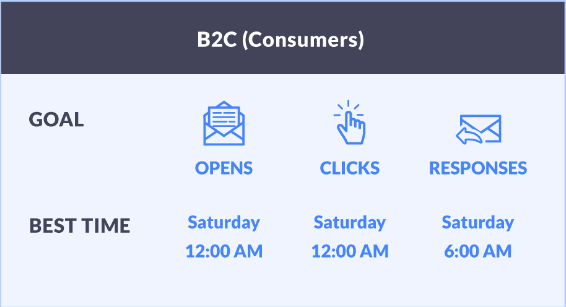
It’s also worth noting that the best time to send emails can differ depending on whether you’re operating as a B2C or B2C business.

The image below gives the best time and day to email B2B and B2C subscribers:


Here are a few tips to help you identify the time and day best suited to your audience:

Analyze the send and open rate data for your emails for a period of six months

Check the times and days for the following:
  • When subscribers opened the email
  • When subscribers clicked on the links in the email
  • When subscribers responded to the emails

Does your segmented list open the emails during holidays and weekends? What motivates them to click on your emails during these days?

With the answers to these questions, you should be able to determine the perfect send time and day for your subscriber list.

6. Have you personalized your emails?


Consider this fact about personalization in marketing:

60% of marketers struggle to personalize content in real-time, yet 77% believe real-time personalization is crucial.

You have already segmented the email list; you should now send content that you believe will prove to be useful to each individual on your list. If the email content you send is relevant, you’ll have a much better chance driving more conversions for your business.

To send relevant emails, you need to invest in personalization. Here’s why:

Personalized messages based on behaviour are 3x better than batch and blast.

Wrapping up


If you don’t give the subscriber what they are looking for at the right time, you might just lose out on a possible conversion.

As a marketer, you need to have a firm understanding of what each of your subscribers are looking for, and why they have subscribed to your email list. Knowing this information will help put you on the right path toward building more effective email marketing campaigns for your business.

How do you stay relevant to your subscribers? Share your ideas in the comments section below.


Source: https://www.business2community.com
Image Credit: Propeller


ABOUT WNFP
Westchester Networking for Professionals (WNFP) is a business organization focused on providing our members and guests with an extraordinary networking experience, bringing business professionals together for the sole purpose of generating new relationships and developing new business opportunities. Not a member, learn how you can become a member and join this awesome group of professionals to connect and grow your business.

Stay Connected with WNFP!
Join WNFP Communities!

Monday, May 21, 2018

4 Ways Successful Email Marketing Campaigns Are Like Happy Marriages


Attraction. Courtship. Engagement. An event that signifies the beginning of a new union. And then: a long, mutually satisfying relationship.

We’re talking about a happy marriage, right?

Exactly. And about a successful email marketing campaign.

At first blush, they don’t seem to have much in common. But the similarities become clearer the more you compare them. “Like a marriage, email marketing is based on a relationship between two interested parties: a brand and a consumer,” writes Jason Warnock at Marketing Land. And, as in marriage, to be successful, an email marketing relationship must be built on a foundation of respect and be carefully nurtured.

Here are four additional attributes they share:


You need permission to get things started


Navigating the early stages of a relationship is tricky. Accurately assessing your intended’s receptivity to taking things to the next level requires patience and sensitivity to verbal and non-verbal cues. If you try to rush things, you are sure to be shut down.

In this regard, email marketing is much less complicated. You either have the OK to send your messages, or you don’t. If you rush things without permission your message will be ignored or caught up in a spam trap, and your reputation might suffer.
Permission is “Implied” or “expressed.”

“You have implied permission to email somebody if you have an existing business relationship with them,” writes Campaign Monitor. “This could mean they are a current customer, donate to your charity, or are an active member of your website, club or community.”

Without that implied permission, you will need a specific OK to send campaigns: “Express permission is granted when somebody specifically gives you permission to send them email campaigns, likely by entering their email address in a subscribe form on your website or entering their details into your in-store newsletter subscribe form.”


Engagement is a critical step


The next milestone on the road to marriage is engagement, which, according to Priceonomics, these days usually happens after about three years of dating. Email marketers are also looking eagerly to engagement – in a different sense of the word – but hope it can happen more quickly.

While engagement in its matrimonial meaning is usually signified by a shiny bauble on the bride-to-be’s left hand, email marketers must look to their metrics for visible signifiers of email marketing engagement.

“A subscriber who is positively engaged is someone who opens and clicks your campaigns or interacts with your brand online,” reports Mailchimp. “Engaged subscribers are likely to open your emails, and continue to purchase, donate, or support your organization or brand.”

In email marketing there is also a phenomenon called negative engagement, which is signaled by unsubscribes, getting flagged as spam and direct complaints. There have been instances of negative engagement on the road to marriage, too, although they are rare.


A special moment seals the deal


During a wedding ceremony, the bride and groom must state their intention – usually in response to a call to action from the officiant.

The email marketing equivalent of the bride and groom saying “I do” and slipping rings on each other is when a recipient clicks on a call to action. Both signify that a commitment has been made.

Crafting a successful call to action for an email marketing message, like crafting wedding vows, requires an investment in time and effort. And both tasks can be challenging to do well.

“Thirty-five percent of marketers say creating a meaningful CTA is one of the most challenging aspects of email marketing, according to a recent study,” reports Andrea Robbins on Business 2 Community. “To create a meaningful CTA, it should contain short, specific directions that guide the subscriber to make a purchase, download an eBook, or RSVP for an event. Buttons are visually appealing and draw the eye of subscribers, especially those reading your email on a smartphone. Make the button size noticeable and use a color that makes the button pop.”


And then it’s on to ‘happily ever after’ (hopefully)


Unlike weddings, in which vows are just exchanged once, that initial click on a CTA is, ideally, only the first of many. But, like a marriage needs nurturing to succeed, it’s important that email marketers not lose focus on the customer after that first sale takes place. The honeymoon period begins with the crafting of transactional messages that keep the customer informed once the order is placed.

“Transactional emails (like order confirmation and shipping confirmation emails) are often neglected by eCommerce marketers in favor of newsletters and promotional campaigns, however, they actually present a significant opportunity,” writes Aaron Beashel at Campaign Monitor. “In fact, 64% of consumers actually consider these the most valuable emails in their inbox, and they typically have 8x higher open and click-through rates than promotional emails.”


Source: https://www.business2community.com


ABOUT WNFP
Westchester Networking for Professionals (WNFP) is a business organization focused on providing our members and guests with an extraordinary networking experience, bringing business professionals together for the sole purpose of generating new relationships and developing new business opportunities. Not a member, learn how you can become a member and join this awesome group of professionals to connect and grow your business.

Stay Connected with WNFP!
Join WNFP Communities!

Monday, May 14, 2018

Is Email Marketing Right For Your Business


Email marketing is a great way to stay in touch with current customers as well as engage with new prospects. However, it may not be the best approach for your brand. How do you decide if email marketing is right for you? Here are a few things to consider.

First, Do I Know You?


Where did you get their email address from? If you are doing a cold introduction, make sure you acknowledge it and give your prospect a chance to unsubscribe. No one likes spam, and you want to make sure that your message is not labeled as such, There are many reputable vendors to purchase lists from as well as generating your own, but we’ll talk about that in a later blog post.


Second, What Is The Reason For Your Call?


Think about your goal for the emails. Email marketing is a lot like blogging, you want to provide good quality information on a consistent basis. Don’t try to push a sale or set an exploding offer. I say that because that definitely shortens the life of your email campaign. Pressing for an immediate decision may lead to a high number of unsubscribes from your list.


Third, How Are You Sending Emails?


Using your personal email may lead to getting your domain blacklisted. Additionally, without an easy way for people to unsubscribe, and you keeping up with it, there is a chance for larger fines and problems.

Finally, How Are Your Emails Being Designed?


An email is a lot like your website or a landing page. It needs to display well on all device sizes, have clear imagery and text, and have a clear path for your prospect to follow. If you make people work too hard to purchase, they may just keep walking.

These are just a few things to consider as you start an email marketing campaign. Over the next few weeks, we’ll be digging into several of these questions, as well as offering recommendations on ideas and tools to enhance your campaign.

If you have a specific question, be sure to post it in the comments below and we’ll respond.


Source: https://www.business2community.com
Image Credit: geralt | Pixabay


ABOUT WNFP
Westchester Networking for Professionals (WNFP) is a business organization focused on providing our members and guests with an extraordinary networking experience, bringing business professionals together for the sole purpose of generating new relationships and developing new business opportunities. Not a member, learn how you can become a member and join this awesome group of professionals to connect and grow your business.

Stay Connected with WNFP!
Join WNFP Communities!

Thursday, May 10, 2018

15 Biggest Email Marketing Turnoffs for New Customers


Email marketing remains one of the best ways to communicate with your audience. However, nobody likes their inbox spammed with too many messages that provide no value, so here are some of the biggest email marketing turnoffs any business should keep in mind when approaching new customers.


1. Template Emails


There is nothing worse than making the investment, as a client, into a new product and service and receiving a template email correspondence. Your first email to a new customer should be personal and offering next steps, gratitude for their business and a way to contact you with any questions or issues. Make the customer feel like you personally care about them. – Jennifer Mellon, Trustify

2. Excessive Emailing


In an effort to better understand your users’ needs and provide an exceptional customer experience, it’s easy to break a cardinal rule when it comes to email marketing: overkill. Excessive emailing frustrates new users and leads to unsubscribes and churn. Be sure to coordinate your engagement outreach, survey gathering and abandoned cart emails so they don’t get in the way of your good intentions. – Matt Bendett, Peerspace

3. Misleading Emails


Some businesses still send out messages with misleading subject lines, implying that the recipient has won something or that they can get something for free. When they open the email, it turns out they have to buy something. Anything in the subject line or message that’s not completely honest will only ruin your credibility. You can send compelling messages without such tactics. – Shawn Porat, Scorely

4. An Immediate Sales Pitch


Email marketing is still one of the most effective ways to reach an audience and grow a brand. However, subscribers are very smart. If someone is willing to give you their email address, you need to provide them with value and appreciate the relationship. This is where autoresponders can really come into play. If you want to lose a new subscriber right away, try to sell them in your welcome email. – Zac Johnson,Blogger

5. Poor Format


Most people prefer to skim through content and email is no different. It’s critical to avoid big chunks of text. Instead, use short sentences and lots of line breaks. Make sure your first sentence captures the reader and then get to the point quickly. You only have a few seconds to get your message across. – Ajay Paghdal, OutreachMama

6. Lack of Substance


The difference between an email that new customers will read versus one that will be filtered into their spam folder is substance. Even if you send emails with pertinent information and exclusive offers, customers will be discouraged to take advantage if it looks like generic promotional spam. Adding some interesting copy will help make a better impact with customers. – Bryce Welker, CPA Exam Guy


7. Communication Without Permission


One of the biggest turnoffs to a new customer is to be suddenly bombarded with emails. Instead, initial emails should be informative and set expectations, i.e. we will be sending you an email once a month to let you know about our offers and to share news you might find useful. That way, the customer feels you care about their time and their understanding of how you communicate with them. – Peter Boyd, PaperStreet Web Design

8. Inconsistency


Many times, people will dive into email marketing overpromising and underdelivering. They will tell their new customers to expect a weekly newsletter from them, only to deliver a couple of newsletters a year. To make sure you’re keeping your promise, use email service providers to automate the weekly newsletter and keep customers posted on what they want to see from you. – Jared Atchison, WPForms

9. No Welcome Email


Think about this: you just gave your favorite website your email address to send you relevant news, and you go to your inbox to see if they sent you something yet. Nothing. Not even a welcome email. Welcome emails get viewed the most and they are an opportunity to set the stage and expectations for future emails. – Syed Balkhi, OptinMonster

10. Feeling Taken From Rather Than Given to


New customers are trusting you with their info, and it’s crucial not to break that trust. Lack of email etiquette/boundaries, and communicating without offering something of value, are just a few of the things that turn new customers off. Companies should be mindful of this and always aim at sending communication that their customers (especially new ones) cannot wait to open. – Dalia MacPhee, DALIA MACPHEE

11. Offering Too Many Products


We receive the best returns on email marketing when the email focuses on a single product. Using a single email as a broad spread of products does not generate nearly as much interest as focusing on the details, benefits, pricing and turnaround of a single product. Each email is targeted to a list of customers who would be most likely to consume the advertised product. – Carmine Silano, CheerSounds Music

12. A Poorly Written Subject Line


Thanks to Twitter, we all know how to craft a good message with limited characters. A good marketing email should tell who you are and what you want, as well as why the recipient is receiving it. This way, the customer will be able to know what they are about to open and will be more inclined to do so. – Ryan Bradley, Koester & Bradley, LLP

13. No Clear Ask


Despite the spam potential, I’m generally open to receiving marketing emails, especially for new software products. This helps me stay on top of the new trends. Unfortunately, many of the emails I receive have no clear value or ask. I don’t really know what they are offering and what they want from me. This should be clear for the recipient. – Brian Samson, True North

14. Tacky Taglines


Nothing turns someone off in an email marketing campaign more than a super pitch as a headline and pure sale copy. Inherently, there is an understanding between a recipient and sender of sales intent. However, the sender needs to offer information useful to the recipient that opens a dialogue. You should start building a relationship through useful content, then transition naturally to a sale. – Matthew Capala, Alphametic

15. Automation Overkill


I think it’s great to find tools that help you use your time wisely, but when used incorrectly, automation can be detrimental to the customer experience. There’s nothing worse than knowing when the next “just checking in” message will arrive in your inbox, and when it’s clear to the customer that they are on an automated list, automation serves as a waste of everyone’s time. – Kevin Yamazaki, Sidebench


Source: https://www.business2community.com


ABOUT WNFP
Westchester Networking for Professionals (WNFP) is a business organization focused on providing our members and guests with an extraordinary networking experience, bringing business professionals together for the sole purpose of generating new relationships and developing new business opportunities. Not a member, learn how you can become a member and join this awesome group of professionals to connect and grow your business.

Stay Connected with WNFP!
Join WNFP Communities!

Tuesday, May 8, 2018

4 Easy and Effective Email Marketing Tips for Your Small Business


Email marketing allows you to reach a highly targeted audience at a low cost. In fact, experts at Campaign Monitor, an email marketing company, estimate that an effective email marketing message has the potential to result in $38 in revenue, for just $1 of marketing investment.

Here are some email marketing conversion tips all small businesses can use:


1. Include descriptive tags with your images.


Online publication MarketingCharts cites data revealing that the average person receives more than 400 commercial emails a month. Emails that include images can help your small business stand out in an already-crowded inbox, especially if you choose those that evoke an emotional response to a product, a promotional campaign concept or your brand.

However, email marketing now comes with a “catch 22,” given that at least half of all email messages are checked on a mobile device, according to experts at Litmus, an email analytics company. While mobile devices may positively boost response to time-sensitive messages, small screens aren’t always conducive to images. If a recipient opens your email only to see that images have been blocked, you could be banished to his or her spam box indefinitely. The more often that happens, the harder it is to form a reputation as a sender whose emails are recognized as legitimate: According to the experts at Sender Score, 28 percent of the email messages that are sent reach a user’s inbox.

Descriptive ATL tags can help you improve conversion, and decrease the risk of images in email marketing. Nonprofit organization WebAIM point out that ALT tag copy that is applicable in both context and functionality ensures the meaning of an image translates, even if the recipient can’t see the picture. Review the ALT tags for images on your site and in your email campaigns for relevancy, using descriptive words that will make the customer want to take action.

2. Don’t send messages that aren’t targeted.


While you may not have robust data on prospects, you can learn a little more about what they respond to with each message you send. Diligently track open and click-through rates with each campaign, including the optimal times to send messages based on response and headline tests. Place email recipients in segments based on your findings to build an effective drip campaign that is personalized and relevant based on their activity. Internet Retailer reports that retailer totes Isotoner improved its email marketing campaign revenue by a whopping 7,000 percent when it used analytics based on past email activity, site search history and past purchases to deliver highly targeted email messages.

3. Don’t ask for too much.


Segment your email marketing campaigns so that each recipient is served the most relevant offer based on his or her preferences, and that he or she is presented with one clear message, call to action and a seamless checkout experience -- whether on a desktop or mobile device. Prefill special offers the email message may include so customers aren’t required to key special discount codes that are part of your email offer at checkout. Partner with a reputable mobile payment provider for a secure and branded checkout experience to eliminate concerns with payment security, or require the customer to take additional steps to complete the transaction. For example, Mobile Commerce Daily reports that despite the popularity of PayPal by retailers in online sales, evidence suggests that it kills conversion by nearly 15 percent (particularly when consumers are shopping on a mobile device), because it requires additional steps to make a purchase.

4. Use emails to form a lasting relationship.


Email campaigns should build upon one another, and acknowledge what you know about the customer, based on his or her past activity. In fact, marketing firm Epsilon cites data indicating that “triggered” emails targeted based on a recipient’s engagement with past messages have open rates that are 76 percent higher than those with generic messaging. If you cannot convince your customers to click on your message, you can’t convert them, regardless of your pricing or product quality.

Email marketing is an affordable way to communicate with prospects and customers, gain valuable insights about their preferences and increase sales. However, it requires strategy to convert message recipients into buyers. Follow these steps to improve the ROI you realize from every email you send.


Source: https://www.entrepreneur.com
Image Credit: Shuttershock


ABOUT WNFP
Westchester Networking for Professionals (WNFP) is a business organization focused on providing our members and guests with an extraordinary networking experience, bringing business professionals together for the sole purpose of generating new relationships and developing new business opportunities. Not a member, learn how you can become a member and join this awesome group of professionals to connect and grow your business.

Stay Connected with WNFP!
Join WNFP Communities!

Thursday, May 3, 2018

How to Boost Deliverability and Win at Email Marketing


In my last piece for Entrepreneur.com, I went over the basics of email deliverability -- what it is, the key metrics to understand and some of the tools to use to understand how your deliverability is being scored by the major inbox providers. Hopefully, you have adopted the use of some of those tools and have fairly good insight into your deliverability rating. Now that you understand your goals for deliverability and how to measure the effectiveness of any of your efforts it is time to get into the actual tactics and actions you can take to improve your inbox placement.


The basics of list maintenance


There are hundreds of actions that may have an adverse impact on your deliverability -- particularly when you are accelerating your list growth through using tools like ReferralCandy to build incentive-based referral programs or DojoMojo to run giveaways and sweepstakes (full disclosure: I am a founder of DojoMojo), which are powerful growth engines but can also result in the acquisition of many less-qualified emails that require active maintenance.

Fortunately there are numerous methods you can adopt to improve your reputation. The key is to identify which of these efforts are likely to have the highest return on investment in the form of making sure that your emails get in front of your target audience. When confronted with our own list issues, these were some of the actions -- among the nearly countless ones we tried -- that yielded the highest return for us.


Prune your list regularly.


Think of your email list as a garden that requires constant nurturing. While many delicious fruits and vegetables may grow therein, weeds will also spring up from time to time. Left untended, the weeds will overrun your garden and ravage your otherwise healthy plants. But, if you actively prune those weeds so your vegetables and fruits have space and can grow, your garden will become more vibrant than ever.


In much the same way with email, you need to be diligent about removing unengaged users from your list. I hear all too often that brands are reluctant to remove users from their list in the vain hope that they will someday become engaged. Trust me: If someone has not opened an email from you in six months, he likely never will. Not only are you paying your email service provider (ESP) to have that person in your list but you are harming your ability to reach your already engaged existing audience. Worse yet, any future emails you acquire will as a result be even less likely to see your communications. Since success is defined as having an engaged email list, and not simply a massive one, it's important to be proactive about ridding your list of unengaged users regularly.


Make it incredibly easy for a user to unsubscribe.


This should go without saying but bears repeating. Ensure that each message you send includes a working unsubscribe within the email. Some ESPs like Mailchimp automatically generate these links and include them in the footer of each email, while others like Sendgrid do not. If you're using an ESP that doesn't include the link by default, be sure you add one in yourself, and make sure that it's simple and easy-to-see. You never want to thwart people who want to unsubscribe from your list by complicating the process, which is unsurprisingly one of the fastest ways to get into hot water with the inbox providers.


Don't include the words "click here" in an email.


"Click here" is a phrase that can often trigger spam filters. In fact, many unsubscribe links read as "Click here to unsubscribe from messages like this," which somewhat ironically can cause spam triggers. Be sure to use copy in unsubscribe links that avoids the spam-triggering terminology and utilizes alternate phrases and action words.


Make sure all images have an alt tag.


Alt tags allow the inbox providers to read images. Many senders will leave the alt tags blank, but that ultimately translates as an empty space to the inbox provider, prompting your message to end up in the spam folder since the content appears to be blank. Always add alt tags to each image that give a brief description of what the image is displaying. This not only allows the inbox providers to better understand what you are sending, but also displays this text if the images are unable to render properly in the user's inbox.


Perform list hygiene and verification.


There are a number of third-party services that, for a fee, will run emails through verification and hygiene filters to ensure that an email is both real and unassociated with any known spam traps, blacklists or other risky domains. While this method differs from the others on this list in that it comes with a monetary cost, using a third-party software can be incredibly powerful particularly in cases where your reputation is already damaged. There are a number of good providers to evaluate including companies like Webbula and BriteVerify.


Focus on communicating with engaged users.


While you may not want to immediately remove users who have not engaged with your last several emails from your list in the hopes that you can re-engage them in the near future, you should be careful not to target them in your communication, either. Instead, focus on messaging your engaged base to ensure your deliverability metrics remain well above industry averages. This of course signals to the inbox providers that you are a good sender, which will gradually improve your deliverability ratings. Then, when you are ready with a specific re-engagement campaign for dormant users still in your list, you can prepare very specific content with them in mind.


Low-hanging engineering fruit


There are quite a few best practices worth undertaking here, but as almost every business owner will attest, engineering hours are among the most precious resources. With that in mind, here are the most impactful initiatives that require the least amount of effort. Fortunately, most of these require a single set up and relatively little maintenance.

Email signing with Google apps. This ensures that your emails are electronically signed to legitimize emails in a way that can be verified by recipients using a public-key. A short overview of how to undertake this process can be found here.

Set up Sender Policy Framework (SPF). SPF configuration ensures that spammers cannot send from your domain.

Set up DomainKeys Identified Mail (DKIM).
DKIM allows an organization, as the handler of the message, to take responsibility for its message. Having DKIM set up validates the domain's identity through cryptographic authentication.


Domain-based Message Authentication, Reporting & Conformance (DMARC). DMARC aims to create a collaborative system fo senders and receivers to improve mail authentication practices and reject unauthenticated messages. The process for registering your domain with DMARC is fairly straightforward and easy.

Ensure that WHOIS information is up to date. WHOIS information identifies your domain as the sender. This is where you're able to assign a name and address to your domain through your hosting service (for instance a provider like Amazon Web Services). Even if this was already set up, you'll want to double check and make sure that the information isn't outdated.


[WATCH VIDEO]
One of Facebook's First Employees Explains Why Email Marketing Is Better Than Social Media Marketing


Deliverability is hardly something that can be improved overnight, especially if you've already damaged your reputation. By following these steps and staying disciplined in your sending practices and principles, however, it is possible to see positive changes in both your open and click-through rates after experiencing even the most drastic slip. The secret is to be as patient as you are diligent and proactive, and to give your efforts time to result in stronger deliverability, more engagement and, in the end, successful conversions. Your email list can and should be the most reliable and cost-effective user acquisition tool in your repertoire, so take advantage of these tips to make sure that that remains true for your business.


Source: https://www.entrepreneur.com
Image Credit: tolgart | Getty Images


ABOUT WNFP
Westchester Networking for Professionals (WNFP) is a business organization focused on providing our members and guests with an extraordinary networking experience, bringing business professionals together for the sole purpose of generating new relationships and developing new business opportunities. Not a member, learn how you can become a member and join this awesome group of professionals to connect and grow your business.

Stay Connected with WNFP!
Join WNFP Communities!

Wednesday, May 2, 2018

The Best Tool to Plan Your Email Marketing Automation


Imagine this: Your best marketing content is delivered automatically to your audience at the perfect time. You don’t need to lift a finger. You watch revenue flow into your bank account. Your business grows. You optimize your automation. More revenue flows into your bank account each month. Now, you’re saving hours and making more money . . . and it’s automatic. That’s the power of marketing automation. However, there’s one hurdle which often prevents people from using automation –– the fear that it’ll be too difficult to get started. In fact, 50% of marketers think it’s difficult to implement marketing automation, according to the market research firms Three Deep and Ascend 2. After all, automation can get pretty complex. But, there’s a tool that can make it much more simple –– an automation map.

What is an automation map?


An automation map is a visual representation of your automation flow. Just like a map, it can give you direction, and help you plan ahead and avoid missteps as you create an automated series. Email automation can have a lot of moving pieces. Your automation map will help you take all of that into account and plan ahead. Plus, you can build upon your map as you add more emails and complexity to your automation. 


They help us review the flow and content of simple series and plan every step of complex, branching automation series. By glancing at an automation map, I can quickly see whether or not my email automation leads subscribers all the way through the marketing funnel. I can determine whether or not my series contains dead ends. And I can see if I’m segmenting my audience in the best way possible. Whether you’re just getting started with automation or an expert, an automation map can provide guidance and level up your efforts.

How to map your series


Before you start mapping, you should decide what tools you’d like to use to map your series. I recommend either hand drawing your series with a pencil and paper or planning your series out digitally with a tool like Google Draw. Which you choose all depends on your preferences. Once you’ve chosen your preferred tool, you’re ready to map your series. Every automation map is comprised of 4 simple elements:

1. The emails in the series


You might have a 4-email automation series or a 20-email automation series. Either way, the goal of the emails within your series is to lead your subscribers through the marketing funnel or persuade them to take a certain action. You can review your automation map to see if your content and emails will accomplish this.

2. Time delays between those emails


Whether it’s minutes, hours, days, or weeks, you should include a time delay between nearly every email. Time delays will deliver your emails at the perfect time, rather than all at once. So, what is the perfect time? That depends on your audience and the expectations you set on your sign up form and welcome email. If you’re unsure, survey your audience to ask them what they prefer. Or, test different time delays to see what works best for your audience.

3. Tags or labels you’ll use to segment your subscribers


Most email marketing and automation platforms can apply tags or labels to your subscribers when they perform certain actions, receive an email, or subscribe to a list. These tags can help you segment your audience into groups based off their tags. You can then send automated emails to those groups specifically. For example, let’s say you set up your email marketing platform to apply a tag to a subscriber when they click on a survey link in one of your automated emails. You could then resend the survey email to anyone who does not have that tag. That way, you could give non-responders another chance to answer your survey without sending an irrelevant email to those who already responded to your survey.

4. The various paths or journeys your subscribers might take


Action-based or behavioral email automation is when you send automated emails to people based off their actions. If you’re using action-based automation in your automated series, your subscribers will go down different paths or journeys depending on what they do. A subscriber who clicks one email may receive another email targeted to them. While a subscriber who opens a different email, may receive a 3-part email series based off that open. Your automation map should outline the different paths your subscriber could possibly take. This way, you can avoid sending too many emails to the same subscriber on the same day. And, you can preview your subscriber’s possible experiences. An automation map becomes extremely important when you start using action-based automation. You might think you have a brilliant idea for an action-based automation series. But, once you map it out, you might discover it would lead to a terrible experience for a particular segment of subscribers –– like getting 3 emails on one day.

An automation map in action


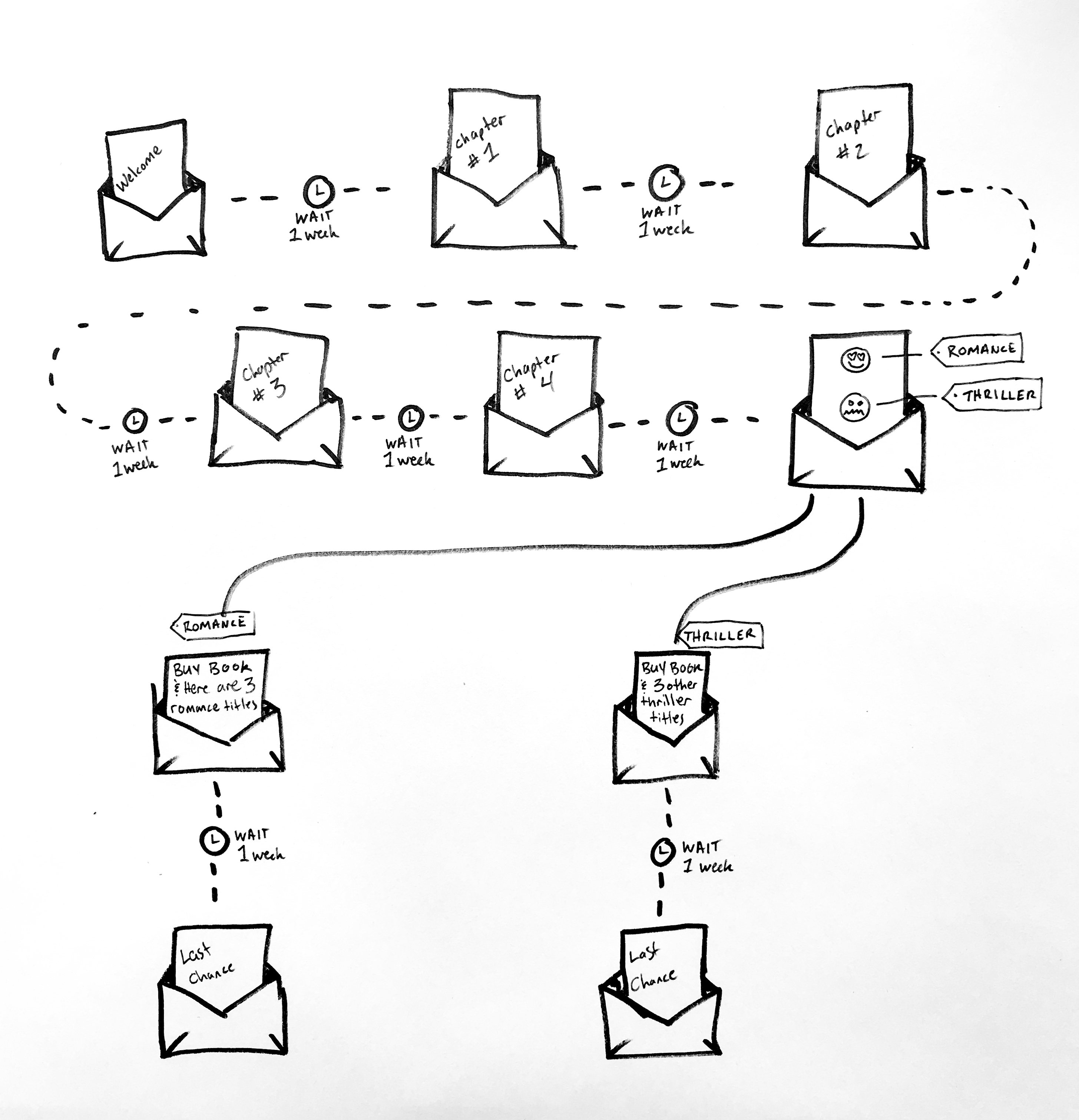
To help you see how automation maps work, we’re going to look at an example. Let’s say you’re an author who wants to promote his brand-new novel through automation. You decide to send a chapter every week for four weeks to your subscribers. At the end of the four-week automated campaign, you’ll promote a link to buy your entire novel. If you were hand drawing it, your automation flow might be mapped out something like this:


The same automation map created in Google Draw might look like this:


Pretty simple, right? But with this map, you know exactly what your time delays are, and you know exactly which emails will launch and to whom they’ll send. Now, let’s say you want to take it a step further with action-based automation. You’ll still offer your novel for purchase after you sends the fourth chapter, but you’ll also ask a question of your audience. Which genre do they prefer? Romance or Thriller. Depending on which option the subscriber clicks on, they are automatically tagged with either “Romance” or “Thriller.” You’ve now segmented your audience into two groups, and you can target those segments with his other book titles that fall in those particular genres. You could then send 2 different automated series to those segments. For those who chose “Romance,” you could ask them to buy your new romance book. For those who chose “Thriller,” you can promote your new thriller book. Here’s an example of what your automation map might look like for this action-based series:


As you map your own series, ask yourself these questions:


Should you apply a tag at the beginning and/or end of your series? (Doing so can help you identify who is currently within a series and who has finished a series.)


What’s the right time delay between each email? Am I sending too many emails? Am I sending too few?


Which emails slot into the different stages of the marketing funnel (awareness, consideration, conversion, loyalty, and advocacy)?


Is there an email I can add to the series that’ll make my user more likely to convert?


Not sure what to write in your automated emails? This free course will help.

Before you can launch an automated series, you need to write your emails. If you have writer’s block or need direction, our free “What to Write in Your Emails” course can help.


Source: https://www.business2community.com


ABOUT WNFP
Westchester Networking for Professionals (WNFP) is a business organization focused on providing our members and guests with an extraordinary networking experience, bringing business professionals together for the sole purpose of generating new relationships and developing new business opportunities. Not a member, learn how you can become a member and join this awesome group of professionals to connect and grow your business.

Stay Connected with WNFP!
Join WNFP Communities!

Tuesday, May 1, 2018

4 Tips to Spruce Up Your Email Marketing Efforts This Spring


It may not feel like spring just yet (especially if you’re based in the northeast U.S.), but it’s still a good time to do some email marketing spring cleaning.

Not only will you feel a sense of accomplishment but making even small changes can have a big impact on your results. And getting these tasks out of the way now will pay off later by ensuring you’ll have time to relax this summer.

With that in mind, here are four suggestions for this your on-the-job spring cleaning:


1. Scrub your mailing lists


If you haven’t paid attention to your lists over the long winter, start with this.

“Clean email lists produce fewer bounces, which improves your sender reputation because it signals to ISPs that you’re committed to respecting recipients’ inboxes instead of spamming them,” writes Jeff Cox at SendInBlue. “This translates to improved deliverability across your entire subscriber base.”

Laura Buxton, at Braze, writes that a list-cleaning effort begins by identifying customers from whom you haven’t heard for half a year. “Users that haven’t opened an email from you in the last six months should be removed from your email list,” she writes. “You can still target these users with re-engagement campaigns but be mindful that continuing to target them can indicate to ISPs that your emails don’t deserve to be in recipient inboxes. So, make sure you’ve got a really compelling pitch before you send them that last-chance email.”


2. Dust off some compelling new subject lines


Subject lines drive open rates, which means you can’t just recycle a few of your all-time favorites and expect to get the results you want. This is a great time of year to determine which of your subject lines performed best, learn from them and come up with new ones that will perform better.

“No matter what they say, people do judge emails by their subject lines,” writes Olivia Allen on the Hubspot blog. “In fact, 47% of email recipients decide whether or not to open an email based on subject line alone. That’s why it’s so important to craft subject lines that are compelling enough to get people to click through.”

Allen provides 17 tips for creating high-impact subject lines, a list that includes using action-orientated verbs and posing compelling questions and using numbers – and don’t forget to test!


3. Polish your writing’s ‘urgency quotient’


Every word in every message needs to play a role in getting recipients to click on your CTA. Review some of your recent messages – does your body copy tell a compelling story? Does the wording of your CTAs themselves convey urgency? Are you doing everything you can with your writing to drive action?

If a sense of urgency is doing anything less than absolutely popping off the screen, now’s the perfect time to see what you can do to inject some FOMO into your writing.

“While web writing is generally passive, email content should be straightforward and drive action,” writes Joanna Milliken at Marketing Land. “Apply this approach when you’re trying to get someone to click on an offer or register for an event, and when you’re trying to deliver more value to a consumer over email. The call to action for a reader is particularly important. Removing articles, such as ‘the’ or ‘a,’ can drive your message home: ‘Read e-book’ or ‘Buy jeans’ sounds more pressing than “Read the e-book” or ‘Buy the jeans.’”


4. Sharpen your content’s mobile-readiness


“Without question, the emails your company sends will be read on mobile devices,” writes Gabriel Shaoolian at Forbes. “This is true even for B2B companies that target users in the workplace. One of the number-one activities people use their phones for is email, and we all know that today’s modern workers check email at all hours, even long after they’ve left the office. Users won’t be forgiving of lackluster mobile email performance — they’ll trash your message and move on.”

We certainly don’t want that! Fortunately, we can prevent it.

“It isn’t difficult to make sure your emails are optimized for mobile and, in fact, many email marketing services offer responsive templates that make the job easy,” Shaoolian writes. “Remember that what looks like a short paragraph on desktop will take up considerably more screen space on mobile. Use a stacked layout, which is far easier for mobile readers to follow than a column layout. Don’t forget that CTAs should be easy to click with a mouse and a thumb.”


Source: https://www.business2community.com


ABOUT WNFP
Westchester Networking for Professionals (WNFP) is a business organization focused on providing our members and guests with an extraordinary networking experience, bringing business professionals together for the sole purpose of generating new relationships and developing new business opportunities. Not a member, learn how you can become a member and join this awesome group of professionals to connect and grow your business.

Stay Connected with WNFP!
Join WNFP Communities!

Saturday, April 28, 2018

Branding Boot Camp: How to Build a Tactical Marketing Plan [WATCH VIDEO]


ICYMI, I had a branding issue when I first met marketing expert Kathleen Griffith. In part one of our special series, I learned about fragmentation. Griffith encouraged me to pick one area of my business to focus on and she gave tips on how you can get do that, too. Then we delved into what I needed to develop a brand strategy and the importance of knowing your company's core values. In this episode, Griffith walks me through how to build a tactical marketing plan and has homework assignments that may help you as well.


Source: https://www.entrepreneur.com


ABOUT WNFP
Westchester Networking for Professionals (WNFP) is a business organization focused on providing our members and guests with an extraordinary networking experience, bringing business professionals together for the sole purpose of generating new relationships and developing new business opportunities. Not a member, learn how you can become a member and join this awesome group of professionals to connect and grow your business.

Stay Connected with WNFP!
Join WNFP Communities!

Thursday, April 19, 2018

11 Quick Email Marketing Tips That Will Increase Your Response Rates

Despite the rumors, email marketing is definitely not dead. In fact, among savvy marketers, it is actually rated one of the most effective marketing strategies. Take a look at this chart from Smart Insights and Get Response.


So take a look at your email marketing tactics and evaluate how you can improve. These tips will help.

1. Use your name in the “from address” of your email marketing campaigns. Using your business name results in fewer opens because it isn’t as friendly and personal.

2. Make it worth it for your audience to open and read your emails. Always include a surprise in every three or four emails so they get used to the idea that you may give something away in your emails that no one else is going to get. This can be something as simple as a free audio download.

3. It’s all about stand-out headlines. Focus on crafting headlines that let your readers know what’s inside and why they should open without being dishonest. Your text should deliver everything your headline promises.

4. Segmentation is imperative for good email marketing because that’s the only way you can freely mention the right product, the right service, and the right topic to them at the right time. If you’re new to this tactic, read 50 Smart Ways to Segment Your Email List Like a Pro from Optin Monster. Then enlist the help of your virtual assistant to implement it.

5. Check out your competition’s email marketing list. Sign up for their freebies and watch how they do things. Don’t copy them, but do figure out how they do it, identify the gaps, and note the topics.


6. Work on building a real relationship with your email list members. Let them reply directly to the emails you send, and then answer them. They like knowing a real person is behind the emails rather than nothing at all. Check your email marketing software, many of them default to a generic reply to address. You can change this for each email.

7. Evaluate your writing style. Email writing should be a little more laid back than most people think. Email should be personal, brief, and exciting to read. Show your enthusiasm with your word choice. Try talking your emails using voice to text to get the rhythm right. Be sure to edit if you do this! The spoken word doesn’t always translate well directly to written language.

8. Get personal in your email. Share your experiences and give details that you normally would not give on your site. Trusting your readers with a little-known fact will make them feel special and that your friendship is mutual.

9. In your high school English class, you were probably taught to write in the third person, rather than using you and I. However, you should talk directly to each individual, using the word “you” to allude to your more personal relationship, which helps persuade your readers to take the action based on your relationship and their trust.

10. Tell stories to your audience that leads them to make the conclusion to buy what you’re recommending to them. Stories can be case studies, your own story, or client stories. When they see real-life examples, they’ll be much more connected to the content.

11. Include your CTA link in more than one spot in your email. If you mention the product or solution, link to it, don’t wait until the end. That way the moment your reader is ready to click through, they can do so. Make sure they land directly on a landing page specific to the CTA.


Source: https://www.business2community.com
Image Credit: Smart Insights | Get Response


ABOUT WNFP
Westchester Networking for Professionals (WNFP) is a business organization focused on providing our members and guests with an extraordinary networking experience, bringing business professionals together for the sole purpose of generating new relationships and developing new business opportunities. Not a member, learn how you can become a member and join this awesome group of professionals to connect and grow your business.

Stay Connected with WNFP!

Join WNFP Communities!

Wednesday, April 18, 2018

9 Reasons Why No One Wants to Open Your Marketing Emails


As email marketing continues to grow in popularity, there's little sign that marketers know what they're doing. Below are nine marketing emails I received in the past week, all of which make basic, fatal errors.

Quick note on terminology: the "teaser" is the first 20 or so words in the email, which typically appear in the recipient's Inbox display. Other than the Subject line, the teaser is what causes the recipient to open the email.

Note: all of the email below were sent to me unsolicited, so I'm not bothering to edit out the names or the contact information. Just to be clear, with the exception of #9 (which is phishing SPAM), their product may very well be fabulous.

ADVERTISEMENT


1. Apologizing for your email.


click image to enlarge


This example is particularly egregious since it comes from a large sales training firm. They've not only wasted the first half of their teaser repeating their corporate name but wasted the second half with the unsubscribe explanation. Doh!

2. Puzzling Subject line and teaser.


click image to enlarge

When it comes to email marketing, mysterious is the enemy of good. No decision-maker opens an email out of mere curiosity. Unless your email seems immediately relevant, most (sane) people will delete or ignore it.

3. Repeating the Subject line in the teaser.


click image to enlarge

I see this all the time: wasting the first half of the teaser repeating the information that's in the Subject line. Once is enough. Ideally the teaser should expand on the Subject line to help provide a compelling case to open the email.

4. Putting the date in the teaser (twice).


click image to enlarge

Seriously? Every email system in the world displays the date when the email was received. Nobody cares when it was sent. Also note that the first part of the teaser is wasted repeating the identity. Dumb.

5. A self-centered teaser.


click image to enlarge

Dude, I don't care what you want and I especially don't care if you're available to assist me (as always?). In email marketing you must establish your relevance before bringing yourself into the scenario.

6. An incomprehensible Subject line.


click image to enlarge

Say whut?

7. A questionable sender's email address.


click image to enlarge


Wow. AOL. Is that still a thing? Also, what's the craziness of putting the contact information at the top? If you're serious about email marketing, get a serious email address. Not Gmail or Hotmail and certainly not this refugee from the 1990s.

8. "Click to Webpage" in your teaser.


click image to enlarge


Unfortunately, several email marketing programs default with this ridiculous question in the teaser. It not only wastes the teaser but sounds like it's something from when email was something new and unreliable.

9. Recipient's name in the Subject line.


click image to enlarge


Probably the best way to make certain your email will be deleted. Only SPAMmers do this. Please note that the message is indeed SPAM, but I frequently see legitimate email marketers trying this hackneyed, counterproductive personalization.


Source: https://www.inc.com
Image Credit: Getty Images


ABOUT WNFP
Westchester Networking for Professionals (WNFP) is a business organization focused on providing our members and guests with an extraordinary networking experience, bringing business professionals together for the sole purpose of generating new relationships and developing new business opportunities. Not a member, learn how you can become a member and join this awesome group of professionals to connect and grow your business.

Stay Connected with WNFP!
Join WNFP Communities!
Business blogs
Business Blogs - Blog Rankings