Friday, November 11, 2016

Six Ways To Make Networking Feel Less Forced


Traditional networking advice dictates that before you pitch to someone, you should go out of your way to provide them as much value as you can. While networking should never just be an all-out pitch fest, trying to bend over backwards to help someone you’ve just met can come across as off-putting.

Serving before you sell is important, yes. But going to extremes should really only be reserved for people who you know feel comfortable receiving such favors. That said, there are plenty of ways to work your network so you can make your network work for you – without making anyone feel remotely uncomfortable.

Make One New Introduction A Week

Most likely, everyone in your network does not know everyone else in your personal network. It’s also highly likely that the people who don’t know each other could benefit from meeting. Making those introductions is a great way to become known as a connector and someone who’s readily willing to help out (without creating any feelings of unease or discomfort).

The introductions might turn into something productive, and they might not. That’s not the point as much as it is staying top-of-mind as an influential member of other peoples’ networks.

Use A CRM To Stay In Touch

You probably already use a CRM to manage your lists of customers, potential customers, leads, etc. And you should continue to do so. But most CRMs have a setting where you can add a contact and set how often you want to be in touch with that person. For most people in your network,especially if you want to make sure that you’ll stay top-of-mind, it’s a good idea to keep in touch once every 30 days. Have your CRM notify you if and when you’re overdue.

Make Your Business Card Stand Out

In a world where being ignored – even by a complete stranger — hurts our self-esteem, being noticed is a huge boost that helps us feel important and worthwhile. 

Once you’ve had a great conversation with someone important, don’t let them forget who you are. In general, once everyone has left an event, they’re going to have a huge stack of business cards. I know I have a hard time remembering who each business card belongs to, and what conversation we had. That’s why on my business cards, I have a headshot and a few words describing what my company does.


As simple as this may sound, it’s paid huge dividends for me and has helped me land deals that otherwise wouldn’t have happened.

Ask For Introductions

If you’re at an event where you don’t know many people, ask one or two people in the room you do know for an introduction. The people you already know will make sure it’s someone that actually makes sense for you to talk to. You’d be surprised how much people are willing to help if you just ask them sincerely. I’ve had people introduce me to CXO-level executives of Fortune 500 companies just because I asked them nicely.

Send Gifts

Sending someone in your network a gift is a gesture that goes far and beyond a typed-out “thanks” on LinkedIn. It catches people off guard. Books, flowers, or relatively inexpensive food delivery are all good options. 

When you do something truly unexpected, you’ll be remembered no matter what. But when you do something that’s both unexpected and providesvalue to the person, you’ll be remembered in only the most positive light, and they’ll look to repay the favor from a place of kindness rather than obligation.

If you’re in the software business like myself, you’re rarely dealing with anything physically tangible, so getting something I can touch really stands out. I’ve had companies who have tried winning me over as a customer send me handwritten notes, t-shirts, boxes of energy drinks for the team, coffee, etc. And each time it puts a smile on my face. As a result, I feel much more connected to that company, leading to a much higher chance of me working with them because I know they’re willing to go above and beyond for their customers.

Forget “Working The Room”

There’s a fair amount of networking advice that tells you to plan your exits before you even start talking to people so you can work the room and get your business cards out to as many people as possible. And while you might have to plan your exit so you can make a quick escape if you get caught talking to someone unhelpful, this piece of advice is best if forgotten — especially if you’re the kind of person who wants the people you meet to remember you for a long time.

Establishing a solid, meaningful relationship with just one person is better than having a mini pitch-fest with 10 different people who won’t care about you two days from now. 

Trying too hard to provide value to someone you’ve just met upfront is off-putting. People appreciate help. But if you’re overly eager, it will raise suspicion and make them wonder what the catch is. So instead of going too far out of your way (which would take up a ton of your time and energy anyway), try these approaches to become remembered as a connector, a value provider, and an influencer.


Source: www.forbes.com
Image Credit: Shuttershock


ABOUT WNFP
Westchester Networking for Professionals (WNFP) is a business networking association dedicated to helping small businesses and entrepreneurs develop, expand and grow. We offer affordable opportunities to help create a positive impact and advancement in your business interests and personal quality of life to take you to the next level.
Stay Connected with WNFP!
Join WNFP Communities!

Thursday, November 10, 2016

6 Naked Truths About Relationships No One Wants to Admit (and How They Affect Your Business)

A happy relationship is a happy business leader.


The expression "naked truth" comes from a fable in which Truth and Falsehood went bathing. Falsehood went and dressed in Truth's clothes, and Truth, refusing to take another's clothes, went naked.

When there's conflict in your life, you don't make good decisions. You don't sleep well, and you end up stressed. You obsessively check your phone waiting for a response. Your mind isn't in whatever it is you're doing because you're too busy weighing pros and cons, playing "what if."

Relationships have a far greater impact on our pursuits and responsibilities than we might want to comfortably admit. We like to pretend that we can consolidate and separate, but the truth is that's very, very hard. The best leaders know how to manage their emotions and push through, but that doesn't mean they are still operating at peak performance. And with that, even the best leaders can only go so long without needing to either take a step back or make a drastic change.

Relationships, whether they be intimate or friendly, can be draining if not nurtured and taken care of properly.

1. Your Relationship Affects Your Mood
Bad mood, bad productivity. If you're upset, you are going to be upset with your work. If you're anxious, you're going to have trouble focusing. If you're sad, you are going to struggle to be energetic with your pursuits. That's just how it goes. So it's your responsibility to take care of the relationships in your life, and be diligent about resolving issues that arise in the moment--instead of letting them linger.

2. Clear Expectations Need To Be Set
Relationships tend to falter because of one fundamental issue: unmet expectations. If you set the bar low, and you deliver on that expectation, you still win. If you set the bar high and don't deliver, you are far worse off. Part of maintaining a positive relationship (with anyone) is setting clear expectations--especially with intimate partners. Do not make it seem like they are the center of your world when you are trying to launch a startup and working 18 hour days. Make that clear from the beginning.

3. Deception Never Lasts
Who you are is who you attract. And if you are attracting people into your life by being your false self, then at some point the jig is going to be up. You can only maintain that "alter ego" for so long--and when it crumbles, it's going to hurt you far worse than if you had just been honest from the beginning. (This can apply to any number of things. Apply as you see fit.)

4. A Relationship Can Be A Support System
A relationship as an entrepreneur, business owner, or just plain driven individual can be one of the most helpful things you could possibly have. They are someone you can confide in, with no connection to your otherwise complicated and logical pursuits. However, the thing to be wary of is to not make the other person feel like an "object" you use to vocalize all your stress and challenges. There has to be some give and take.

5. An Outsider's Perspective
When your friends, family, and significant other all live outside your direct realm of business or interest, they inherently provide an outsider's perspective that many times can be helpful. They ask simple questions, they provide you an opportunity to explain what you're working on in its most basic form, and they can often point things out you aren't able to see yourself (because you're "in it").

6. Relationships Are Mirrors
This is often one of the hardest things for people to admit. Whatever you dislike in someone else, you struggle with yourself. Whatever irks you the most, that's your issue--not theirs. Whatever frustrates you, or pushes your buttons, or makes you flare up in anger, that is a trigger of something inside you. If it wasn't, then their actions wouldn't affect you at all. Period. So when something triggers you, it's your responsibility to take the time to figure out what that issue is and move past it.


Source: www.inc.com
Image Credit: Getty Images


ABOUT WNFP
Westchester Networking for Professionals (WNFP) is a business networking association dedicated to helping small businesses and entrepreneurs develop, expand and grow. We offer affordable opportunities to help create a positive impact and advancement in your business interests and personal quality of life to take you to the next level.
Stay Connected with WNFP!
Join WNFP Communities!

Wednesday, November 9, 2016

5 Email Marketing Tips For Small Businesses


Email marketing has always been the most powerful marketing channel for businesses across various industries and sizes. Even with the popularity of social media, email marketing remains the favourite pick for marketers, as 60% of them believe it produces a positive ROI. Not just for marketers, but studies also show that 72% of consumers prefer email over other communication channels.

For small businesses, email marketing is the best way to begin a marketing campaign simply because of its cost effectiveness and mass outreach. Apart from this, there are some compelling stats to help you understand why it’s necessary to optimize your email marketing techniques.

According to Adobe – 70% of Americans check their mobile device while watching TV, from bed (52%), on vacation (50%), while on the phone (43%), from the bathroom (42%) and even while driving (18%). Email is the least intrusive way to reach people on their mobiles.

With more than 1,000 billion emails being sent every day, you need to learn what it takes to do business in your contacts’ inbox by driving traffic and making some really good conversions. Keeping this in mind, we have gathered some of the best practices of email marketing that have proven results in increased ROI, especially for small businesses.


#1. Building A Strong Email List

Your email marketing requires a strong database. No doubt!
Successful email campaigns are backed up by a quality and targeted email list. When you have a list of potential customers, this is a sure shot to increase customer engagement, thereby resulting in higher conversion rates. Moreover, you begin to reach out to a wider audience and it’s easier to promote your brand regularly.


Tips:

 – SMBs that are beginning to build their email list can start with their known customers and prospects.
 – Provide attractive incentives or free content and don’t forget to choose a smart email service provider.

Did you know social media is an effective tool for collecting email addresses? Check out this instructional video on how to collect email addresses on Twitter!

 – Once you begin to accumulate an email list, many marketers forget to update their list. Remember, your database becomes outdated by 22.5% every year. Make sure you refresh and keep your database updated periodically.

#2. Integrating Social Media

Although social media can be a strong rival to email marketing, marketers can make the best use of social media to study customers and segment them based on their interests. Studies show that while 86% of marketers use email marketing, 72% of them use social media.

It’s a proven technique of reaching your targeted audience because your customer interactions are cross-platform. It’s a cost effective way to grow your audience by streamlining all possible channels into one.

Tips:
– One of the easiest ways you can use social media is by uploading your email subscribers. By doing this, you can track your subscriber activities to offer them more features
 – Including social sharing is another way to help your email subscribers to connect with you and make you popular.
– Retargeting your email subscribers is another great idea. For example: if you want to retarget your email subscribers on Facebook, Perfect Audience is a great tool where you need to simply install a tracking code (say, querystring) on your website.

Social media and email marketing go hand in hand. Once you start integrating both, you exceed your marketing goals and increase your conversions.

#3. Brainstorm Your Subject Line

Here’s an interesting data! Nearly 2.4 million emails are sent every second. So, what makes your email stand out? It’s the subject line!

According to studies, 35% of your recipients open your email based on the subject line. Subject lines grab the necessary attention of your customers and make them want to open your email. Deciding on the right subject line can be quite a stressful task.

Tips:
 – Ensure your subject line is short (50 characters maximum) and has something valuable to offer your customers.
 – Always check and recheck your grammar, as poor grammar will ruin your credibility.
 – Sending personalized emails works great. But when adding a touch of personalization in your email subject by including recipient’s first name can result in higher click through rates.
  – Use real-time stats and numbers.
 – Involve psychological elements, like creating a sense of urgency in your subject line so that it compels users to open it.
– Avoid spam triggering words in your subject line


#4. Stay Away From Spam Folder

 No matter how great and impressive your email content is, spam triggering words can automatically get your email flagged as spam.Earlier, only subject lines had to go through the spam filters. But now, the entire email gets scanned to ensure only clean emails land in a customer’s inbox. The best way to stay out of the spam folder is to NOT use spammy words. HubSpot has a clear and concise list of spam words that you have to check and avoid while writing your emails.

There are several factors that are linked to the spam concept. Apart from certain words (mentioned in the list) that can flag your email as spam, you also need to,
    – Avoid using caps in the subject line, large images and special characters.
    – Never use purchased or non-authenticated email lists.
    – Provide an ‘unsubscribe’ option for users to conveniently stop receiving your emails.
    – Never compromise on your email service providers.
    – Avoid colorful fonts in your email.
    – Use double opt-in methods so that users can confirm if they want to receive your emails


#5. Send Mobile-Friendly Emails

From shopping to handling all business activities, mobile has become an important communication channel. Mobile email optimization has taken the center stage of today’s marketing goal. Customers appreciate responsive emails because according to Radicati, 80% of emails will be accesses via mobile devices by 2018. If your emails are not mobile friendly, you could be missing out on so many potential customers.

So, how can you ensure your emails are responsive?
– Display small images while using a large font size.
– Keep your subject lines as short, as possible because there are high chances that it can get cut off.
– Provide strong and meaningful pre-header text, as this can get your readers to open your email.
– Use single column templates and set your template width under 600 pixels.
– Don’t forget to add alt text to your images.
– Strictly test on all possible devices to avoid smooth readability. You can make use of tools like Litmus for better email optimization.
 Email is not dead and, similarly, email marketing still remains a strong communication channel to connect with your prospects and increase your brand visibility. As mentioned earlier, emails are cost effective and simple to execute. Because of this, several SMBs are willing to choose email marketing as their standard marketing strategy.

Follow these tips to create better and goal oriented campaigns and watch how they increase your conversions!


Source: http://www.tweakyourbiz.com
Image Credit: Business hand touch Email Marketing Concept

ABOUT WNFP
Westchester Networking for Professionals (WNFP) is a business networking association dedicated to helping small businesses and entrepreneurs develop, expand and grow. We offer affordable opportunities to help create a positive impact and advancement in your business interests and personal quality of life to take you to the next level.
Stay Connected with WNFP!
Join WNFP Communities!

The Art Of Business Networking Without Expecting A Business Deal

Networking can be a powerful way of generating new business. Armed with a well-planned strategy, entrepreneurs and business owners, descend on networking events, working the room with clear business goals and high expectations of achieving them.


But one entrepreneur is disrupting networking convention, turning the model of anticipated outcomes on its head, and encouraging people from all walks of business life, to network without any preconceived expectations of doing a deal.


Businessman, author and raconteur Howard Lewis, who is also the director of the Schorr Collection of Old Master paintings, is the founder of OFFLINE, a business and social networking experience, with some unconventional rules, which include strictly no technology – no smartphones – and no emphasis on conducting business. Attendees are asked to only come in the generosity of spirit, and by leaving expectations of business outcomes at the door, often achieve business outcomes they hadn’t been looking for.

The lightbulb moment that sparked the idea happened 15 years ago when Lewis bumped into a former school colleague. “He was a year or two above me and, unlike myself, had been a consummate overachiever; school captain, and scholar par excellence and subsequently developed a very successful career in TV and film, before running a management consultancy,” he recalls.

“We became very good friends and, whenever we met, I would bring him a few articles of whatsoever nature that I believed he would like. I had long been in the habit of dispensing articles to friends and associates, but his feedback was so positive that it encouraged me to invite a bunch of past recipients to dinner to share different articles and see where the conversation took us.”

Based at London’s distinguished Savile Club, OFFLINE initially attracted many high net worth individuals, including high profile entrepreneurs and top company directors, all observing Lewis’s strict rules of attendance.

He says: “Events with anticipated outcomes are prescriptive and limit the possibilities of the unexpected. Curiosity must not be shackled. Moreover, it is enhanced when conducted in great company, a lovely setting, with good food and wine, not too long, not too late, and not too expensive.”

But the events have proved valuable to attendees in serendipitous ways. Bill Cunningham runs Endeavour Ventures, which focuses on relatively early stage investments in specific areas of technology, such as cyber security, payments systems, and fintech.

He says: “It isn’t always easy to match the right investor for the right deal, and it is often only by talking with sophisticated investors, or family office managers that you stumble across someone with similar investment interests. I have met a wealth of interesting people at OFFLINE from all over the world, people who I wouldn’t necessarily encounter in the normal course of our business. A few have become lasting friends, and one in particular has ended up participating in a $10 million-plus funding of one of our larger software businesses.”

Are we looking at a disruptive business networking model, where simply connecting with others without any expectation of an outcome actually delivers some of the most positive outcomes? “Absolutely,” says Lewis. “There is no false premise behind OFFLINE, just an invitation to join 30 or so smart and engaging individuals, of all ages and backgrounds, for dinner. I have welcomed guests from the world of finance, technology, publishing, law, fashion, security, art, journalism, science, hotels, diplomacy and the rest.

“When there is no expectation, multiple outcomes can emerge. If you show a genuine interest in other participants, they will assuredly reciprocate in kind. There is often a pleasure in sharing the pleasure of other people, even if it does not accord with your own.”

This year OFFLINE was opened up to the general public, with every event sold out within a day of seats being released, while Lewis has been approached to take the concept to both New York and Mumbai.

He says: “My personal pleasure is to see the physical interaction of attendees, often from entirely disparate backgrounds. We are social animals by nature and the success of OFFLINE has been an affirmation of my belief that many in the business world overcomplicate possible outcomes in the search for validation and endorsement. The simplest form of communication is also the oldest and talking face to face, rather than online, only reinforces your authenticity.”


Source: www.forbes.com
Photo credit: Anthony Upton


ABOUT WNFP
Westchester Networking for Professionals (WNFP) is a business networking association dedicated to helping small businesses and entrepreneurs develop, expand and grow. We offer affordable opportunities to help create a positive impact and advancement in your business interests and personal quality of life to take you to the next level.
Stay Connected with WNFP!
Join WNFP Communities!

Tuesday, November 8, 2016

Westchester Networking for Professionals Hosts Annual Holiday Networking Event

Westchester Networking for Professionals invites local business professionals to celebrate the holidays on December 1st at their Annual Holiday Networking Mixer in Yonkers, NY.


Westchester Networking for Professionals (WNFP), one of Westchester County, NY largest business organization, announces they will be hosting their Annual Holiday Business Networking Mixer on December 1, 2016 from 6:00 pm - 8:00 pm. This event will be held at Havana Central in Yonkers, NY and will host an array of local business owners, entrepreneurs and  professionals from a variety of industries throughout Westchester County and surrounding areas for a night of networking and holiday celebration.

“There’s no better way to get into the holiday spirit, than surrounding yourself with motivated women and men and enjoying a festive evening during the holiday season with some face-to-face networking, meeting new people and generating new business opportunities before the year ends”, says Founder, Theresa Todman.

The event will be a great success in partnership with Havana Central one of Westchester County, NY’s popular Latin restaurant located in Yonkers, NY, serving traditional Cuban cuisines with live music and a festive ambiance. Since it’s opening in 2012, Havana Central has been committed to providing customers with an outstanding memorable dining experiences that include exceptional food and and genuine hospitality.

During the event, attendees will enjoy complimentary appetizers, cocktails and drink specials, a chance to win raffle prizes and unlimited networking opportunities. This event is free for VIP Members. Non-VIP Members and guests can register for advance tickets online for $10.00 per person at www.wnfp.org.  Ticket prices will increase to $20.00 after November 18, 2016.

Sponsorship opportunities are available for businesses seeking to gain additional exposure and attract new customers.

ABOUT WNFP
Westchester Networking for Professionals (WNFP) is a business networking association dedicated to helping small businesses and entrepreneurs develop, expand and grow. We offer affordable opportunities to help create a positive impact and advancement in your business interests and personal quality of life to take you to the next level.
Stay Connected with WNFP!
Join WNFP Communities!

Here's How to Squeeze a Month's Worth of Networking into 48 Hours

 Attending a conference can either be a boondoggle--or an essential opportunity to grow your brand, your business contacts, and your industry knowledge. If you're truly in it to win it, use these 9 strategies to maximize every hour of your time at a conference--and make them your most productive of the year.


Don't think you can spare the time from the office for an industry conference? Let me offer this counter example.

I recently carved out two full days to attend Content Marketing World in Cleveland, a top digital marketing conference that takes place right after Labor Day. While that's typically one of the busiest weeks for my company, Masthead Media, I definitely felt the conference was worth my time--and I ended up accomplishing more during those 48 hours than I ever do during my best-ever, nose-to-the-grindstone periods in the office.

That's because in addition to learning about the latest industry trends and case studies from high profile thought leaders--I managed to fit in more targeted networking than I typically do in a month. That's 30 days worth of lunches, new business meetings, prospective vendor and partner sessions, and face time with industry leaders over the course of just two days.

Put another way--attending an industry conference can be the most productive time you ever spend at work, even if you're thousands of miles from the office.

What I quickly realized, however, is that just showing up and sitting through a few seminars isn't going to result in a networking boon--or new business for your company. Use these 9 strategies to focus and maximize every hour at your next conference.


1. Make Contact Before You Arrive

If I had waited until I arrived at Content Marketing World, trying to network effectively in a crowd of 36,000 attendees might have been overwhelming. Content Marketing World provided an app that listed everyone in attendance, along with their companies and titles. That allowed me to narrow down the people I was trying to reach, and send them a LinkedIn request in the weeks before the conference. I got a strong response, and ended up having 13 mini meetings with current and prospective business contacts at CMW.


2. Stake the Perfect Meeting Spot

I didn't know the conference space well before I arrived, so my first few meetings were held standing (slightly awkwardly!) at the entrance of the convention center or near the snack buffet line. I quickly learned to leave my last session a little early so I could secure a table in a quiet area. That allowed for longer, more focused meetings--and a better rate of "return" on my follow up after the show.


3. Pick and Choose Your Parties

...or skip them altogether. In order to save my energy for the conference itself, I made the decision not to attend any events that took place after 7 PM in order to get a good night's rest. While you never know who you might meet after hours, my most effective learning and networking happens during daylight hours. Honestly assess your own prime hours and go into the conference with a game plan.


4. Sync Up with Speakers

The most influential people at the conference are very likely the people leading breakout sessions. While they're sure to be busy before their presentation, ask (prior to the conference) for a few minutes of their time following their session. That will give you the chance to establish a relationship and gain additional valuable insight into the conference topics.


5. Swap Sessions

Just because you signed up for a particular panel or breakout session doesn't mean you have to attend it (or stay any longer than feels valuable to you). Find out if the conference permits last minute changes based on your interest or feedback from other attendees.

6. Fly Solo

Sure, it can be a little intimidating to attend a conference on your own, but I found I was far more motivated to connect with new people and focus on learning than if I'd been with a co-worker. Being alone also gave me total flexibility to change my schedule on the fly and make appointments around my schedule--no compromises needed.


7. Socialize Your Experience

Don't forget to use the official conference #hashtag! Posting insights as you go is a great way to remember the best takeaways from the event, and searching the event hashtag in real time can help you discover content and happenings from other attendees. Plus, you'll probably build your following throughout the week, and build on continued efforts to establish your personal brand.


8. Don't Take Notes

Or, at the very least, don't copy the presentations word for word. Content Marketing World made every single presentation--from every single session-- available to its attendees online directly following the conference. That enabled me to focus on the speaker and key insights, rather than scribbling away endless notes. Inquire before you arrive if your conference will do the same, or if you can get decks directly from presenters.


9. Don't Eat Lunch - or Any Meal - Alone

It's a popular networking strategy to never eat lunch alone, and one that's especially important during industry conferences. Take advantage of having a critical mass of like-minded professionals in one place, and make every meal a gathering with a new contact or group. As tempting as room service may seem, it's better to skip the party of one and meet up while everyone is in a social mindset.


Source: http://www.inc.com 
Image credit: Getty Images


ABOUT WNFP
Westchester Networking for Professionals (WNFP) is a business networking association dedicated to helping small businesses and entrepreneurs develop, expand and grow. We offer affordable opportunities to help create a positive impact and advancement in your business interests and personal quality of life to take you to the next level.
Stay Connected with WNFP!
Join WNFP Communities!

Why Networking Is Not A Dirty Word (And How To Do It Right)


It’s 6pm on a Thursday. I’m home from work and its been a long day, a long week in fact. There are a couple of evening engagements in my calendar that I ought to attend but just can’t summon up the energy for. In the end, it’s my husband who forces me out the door, pointing out the benefits of being present at both events. And ultimately, I’m glad I made the effort, not just because I enjoyed myself but because I also connected with a great potential strategic partner for my organization.

And that’s really the point of networking. I like to compare it to the difference between casually window shopping and coming across things you need, versus desperately hunting for that one crucial item within a set deadline. When you’re out and about connecting with your industry, the helpful relationships you forge along the way are organic and valuable. Networking is the lifeblood of an entrepreneur and I can name countless friends and colleagues who met their investors or sourced clients at conferences, or who found their business partners and made new hires through industry parties.

As you climb higher up the career ladder, the nature and purpose of networking morphs and changes. Earlier on, it’s about getting to know your industry and building up your contacts. Further down the line, once you have experience and have proved your ability, cultivating the high-level relationships that can continue to propel you forward is key.   Carla Harris, Vice Chairman and Managing Director at Morgan Stanley and one of the most successful women in banking articulates this perfectly: “What I’ve found is that women tend to keep gravitating towards the performance currency, and what happens is, as you get more senior, the relationship currency is the more important currency,” she explains.

Within my own organization, which was initially targeted at mid-career executives, it’s often the Millennials who flock to events, footloose and fancy free, eager to learn and make connections. As women get older and take on more responsibilities both personally and professionally, it becomes harder to carve out the time. But that’s when strategic networking is actually most important. It’s when you really need those relationships with the industry leaders who can advocate for you.

But of course you don’t have to go to everything. For someone like me who juggles a million things and places a high premium on downtime, going to the trouble of dressing up and making the journey somewhere has to be worth it. There is nothing more frustrating than feeling like I’ve wasted precious time.

A friend and I once devised a set of criteria for social engagements: 1) Is this event good for my career? or 2) Will I get to spend time with close friends? or 3) Will there be husband material there?! Rule number 3 has since been replaced with “Is this for a good cause?” but the others still very much apply. Create your own system that allows you to be circumspect with your decisions and hone in on curated events and smaller gatherings such as dinners and talks, where you can better manage interactions.

While we’re on the subject, a few basic tips on how to network effectively. If you’re going to an event and are generally intimidated by large groups of people you don’t know, arrive early. It’s so much easier to connect and get acclimatized in a more intimate setting. If there’s someone you’re specifically trying to meet, do your research, e.g., have they posted an interesting tweet or achieved a career milestone that can be referenced as a conversation opener? Always send a follow up note within a couple of days of meeting. Sustain the relationship and check in every few months.

But networking isn’t just about making lots of great new buddies, it’s about making those relationships work for your career and your business. Last year, I was invited to a convening of some very high-level business executives in Los Angeles. Within minutes of meeting one another, the men were effortlessly transacting, making deals and exchanging cards. For the women, the interactions were a little different. It was more about relationship building and gaining trust. There was an etiquette to it. And while those polite value systems definitely have their place, women shouldn’t be afraid of making business asks of friends and colleagues. We are great at being sociable and at forging strong relationships but often not as good at leveraging them.

Networking is not a dirty word. It’s the cornerstone of business. Build your network, sustain your network and leverage your network and you’ll go far.


Source: www.forbes.com


ABOUT WNFP
Westchester Networking for Professionals (WNFP) is a business networking association dedicated to helping small businesses and entrepreneurs develop, expand and grow. We offer affordable opportunities to help create a positive impact and advancement in your business interests and personal quality of life to take you to the next level.
Stay Connected with WNFP!
Join WNFP Communities!

Monday, November 7, 2016

Retentionomics: Why Lasting Relationships With Customers Make Sense


It has been well documented that it is much more cost-effective to focus on nurturing relationships with existing customers than it is to find and convert new ones.

Forbes Insights and Sailthru recently published a report “Retentionomics: The Path to Profitable Growth” based on a global study of 300 retail and media executives designed to find out if, and how, they take advantage of the benefits of retention strategies and how that impacts growth and performance.

The report reveals that while the benefits of retention are widely known, companies significantly underutilize them and routinely fail to make a strong connection between retention and its impact on revenue. In short, there is tremendous room for advancement for all companies—to work smarter, not harder.

The report analyzes companies that excel at retention, or Retention Gurus, which were 14% of the sample, and those that focus on acquisition, or Acquisition Athletes (14%). The remaining 72% of respondents did not skew their budget allocations toward either acquisition or retention, and/or have not experienced the same success with their customer acquisition and retention goals.

The report also delves into the reasons why most companies still struggle to take advantage of retention’s benefits, the results this state of affairs can lead to, and key strategies to correct it.

Here are the top findings:

Focusing on retention pays off. More Retention Gurus significantly increased market share over the last year (14%) compared to Acquisition Athletes (5%).

Retention Gurus scored better in terms of customer churn. Forty-five percent of gurus did not have increases
in churn over the last year, compared to just 33% of Acquisition Athletes. In addition, 88% of Retention Gurus are exceeding their customer acquisition goals.

Inertia is what keeps most companies from becoming Retention Gurus. For most companies surveyed, the primary factor in making decisions about retaining and acquiring customers is inertia—84% of Acquisition Athletes report doing things “the way they have always been done” when defining customer strategy, compared to just 63% of Retention Gurus.

Companies have not shown signs of trying to break this inertia by investing more in retention.Seventy-nine percent of acquisition budgets increased over the last year compared to just 42% of retention budgets. Half of all Acquisition Athletes made no change to their retention budget.

Taking full advantage of customer retention strategies requires rethinking budget allocations,and investing more in technologies that can help companies better achieve and measure retention goals. Currently, 37% of Retention Gurus and 35% of Acquisition 
Athletes cite technology limitations as a barrier.

Retention Gurus know they need to allocate more of their budget to retention. Lack of budget is a bigger barrier to measuring retention rates for them (23%) than it is for Acquisition Athletes (7%).


Source: www.forbes.com


ABOUT WNFP
Westchester Networking for Professionals (WNFP) is a business networking association dedicated to helping small businesses and entrepreneurs develop, expand and grow. We offer affordable opportunities to help create a positive impact and advancement in your business interests and personal quality of life to take you to the next level.
Stay Connected with WNFP!
Join WNFP Communities!

Friday, November 4, 2016

How Our Next-Generation Editor Takes Email Marketing to the Next Level


At Constant Contact, we talk to our customers. A lot.

With 25,000 customer calls, chats, and emails on an average week, we’re dedicated to listening to our customers and helping them succeed.

So when we first started building our next-generation editor, we did our homework.

From deep customer research, big data, competitive analysis, and — yes — a lot of customer calls, we took our time to understand your biggest marketing challenges.

And while we knew our existing email editor had a lot to offer, we also knew there was a lot of room for improvement.

Which is why we decided to take things to the next level.

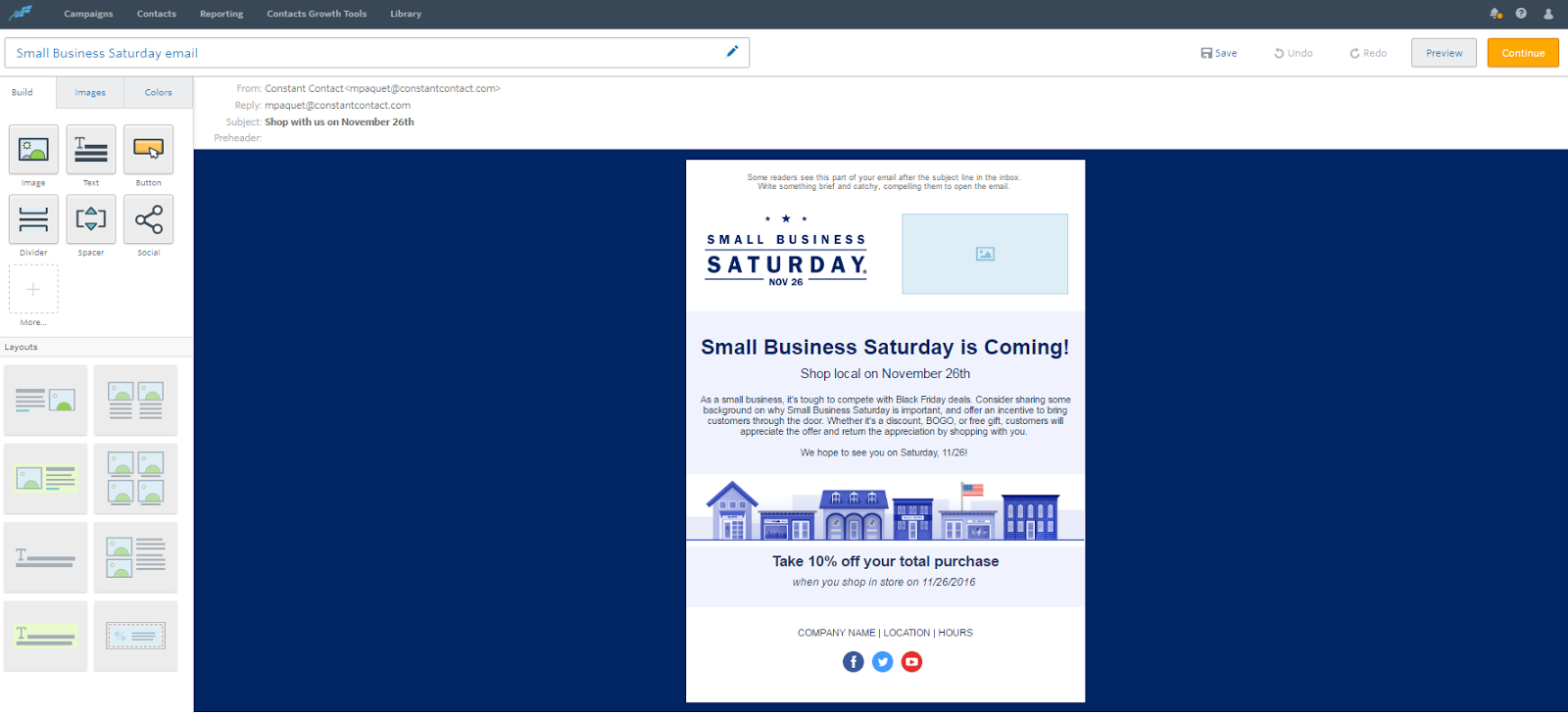
Our next-generation editor is designed to help small businesses and nonprofits easily create engaging and compelling emails that look professional on any device.

Balancing simplicity and power, we set out on a multi-year effort to create the best email editor available.


Here’s a look at our next-generation editor’s top features:

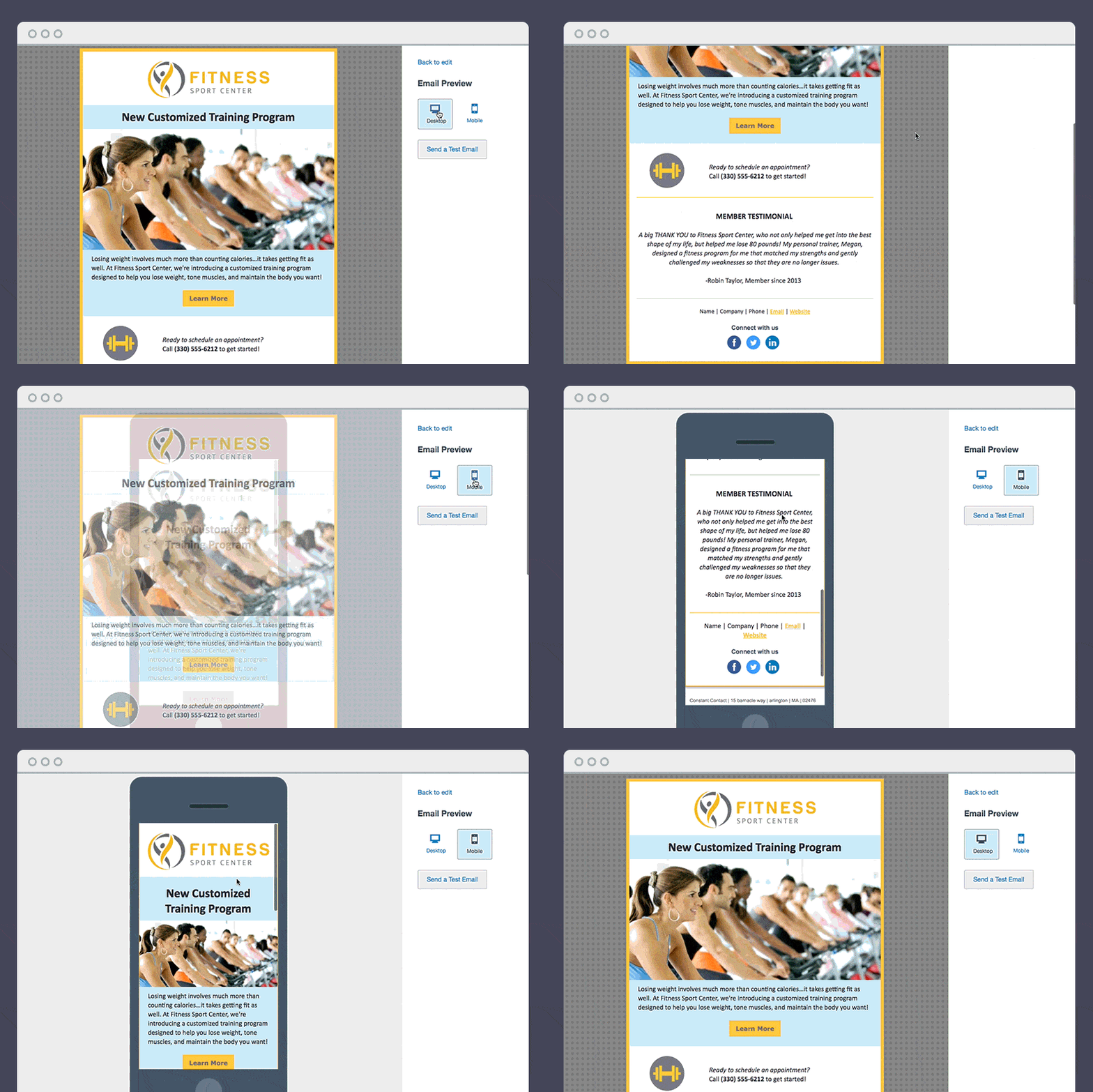
1. Mobile-responsive email templates
With over half of all emails now opened on a mobile device, it’s essential that your emails look great — no matter what device they’re viewed on.    

That’s why every email created using our new editor is mobile responsive. Choose from a full selection of mobile-responsive email templates that automatically adjust to the right size when viewed on a computer, tablet, or smartphone.


2. Intuitive drag-and-drop editing
You’re a baker. You’re a mechanic. You’re a CPA. You’re not a designer.

So when it comes time to send your next email, you need an editing experience that’s extremely easy to use.

Our editor’s smooth drag and drop experience makes creating an email faster and easier than ever. And our unique Smart Columns feature allows you the flexibility to fine tune column sizes.

Make a mistake? Our undo/redo feature remembers ALL edits in an active session.

3. Import PDF to Email
We want your email marketing to fit in seamlessly with the rest of your marketing efforts.

Say you have an existing promotional flyer for your business. With Constant Contact, you won’t have to recreate anything. Simply upload an already-designed PDF and we’ll convert it into an image for your email. You can then add buttons, columns, and functionality as needed.


These are just a few of the new features our next-generation editor has to offer.

Behind-the-scenes, we’re busy releasing new features and enhancements on a schedule of about every two weeks to ensure your business is always on top of the latest marketing trends and best practices.

You can stay updated on new product enhancements any time by visiting the Help Center in your Constant Contact account.

We look at data to see which features people are really using and which features are slowing people down. We’re proud to see that the send success rate is higher with our next-generation editor, particularly for new users.

That said, if there’s a feature you can’t live without, let our Support team know. Your feedback is tracked by our Voice of the Customer team, which helps us prioritize upcoming product improvements.

Ready to take your email marketing to the next level?

At this time, all new customers will receive our next-generation editor automatically. Not a customer yet? Test drive our new editor for free for 60 days! Sign up for your trial here.

Existing customers can gain access to the new editor by contacting our support team at toolkitsupport@constantcontact.com.


Source/Image Credit: https://blogs.constantcontact.com


ABOUT WNFP
Westchester Networking for Professionals (WNFP) is a business networking association dedicated to helping small businesses and entrepreneurs develop, expand and grow. We offer affordable opportunities to help create a positive impact and advancement in your business interests and personal quality of life to take you to the next level.
Stay Connected with WNFP!
Join WNFP Communities!

This 1 Habit Is the Foundation for Successful Work Relationships (and Costs Zero Dollars)

It's also the backbone for developing trust.


Take all the great leadership traits you've heard or read about that come to your mind. What floats to the top?

Typically we think exceptional communication skills, superb emotional intelligence, or the inspirational leader who enrolls followers to passionately pursue a vision.

But there's one trait I can bet you didn't think about. And I firmly believe this trait can be a difference maker. It's important for two reasons:

    1.    It's the foundation of healthy relationships, whether in business or even at home with spouses and kids.

    2.    Implementing this trait costs zero dollars!

And that is....transparency.

You see, transparency is the backbone of trust. Trust simply cannot happen without it. As a result, your people will work harder for you, respect you more, and you'll be able to solve problems much faster if you're being transparent.
 

The business case for transparency.

Warren Bennis, in Transparency: Creating a Culture of Candor, cites a 2005 study finding that a group of 27 U.S. companies noted as "most transparent" beat the S&P 500 by 11.3 percent.

Fortune magazine puts out their annual 100 Best Companies to Work For issue. The research behind what makes those companies get on that list is typically characterized by high levels of trust and transparency--especially employees' belief in the credibility of their leaders.


The one principle of transparency that will set your company apart.

I speak of sharing information. Information is power, and it's one of the best ways to build a sense of trust in people.

Sharing information sometimes means disclosing information that is considered sensitive or privileged, like future business plans and strategies, financial data, how your money is being spent, or the way your group activities contribute to organizational goals.

On the radical side of transparency would be Buffer: They publish pretty much everything, even salaries.

Providing your people with more complete information communicates trust and a sense of "hey, we're all in this together." Just exercise your best judgment with what can and cannot be disclosed, according to company policies and ethics.

A case study in transparency: HubSpot

HubSpot is a global digital marketing automation company, and they redefined what it means to be transparent in business. They are now being recognized as having one of the greatest company cultures.

One of the many things they do to embrace transparency is found in their public wiki, which anyone at any level inside the company's intranet can access to voice their opinion, ask questions, share concerns or ideas.

It has become a great platform for collaboration and encouraging communication between any employee and upper management, and HubSpot employees really value the accessibility of its management team. They've won awards for this.

A few years ago, HubSpot Co-Founder and Chief Technology Officer Dharmesh Shah published an article on their wiki called "Ask Dharmesh Anything."

And that's exactly what "HubSpotters" did -- engaging in a slew of discussions directly with their CTO about technology, strategy, product, marketing, startups, funding, or whatever.


Closing thoughts.

Transparency certainly doesn't work for every company or industry. But it is key in developing your culture in the new currency of openness and collaboration. What you share with one, you share with all. There's a sense of togetherness there. And it starts with leaders modeling the behaviors of trust and transparency.


Source: http://www.inc.com
Image Credit: Getty Images 

ABOUT WNFP
Westchester Networking for Professionals (WNFP) is a business networking association dedicated to helping small businesses and entrepreneurs develop, expand and grow. We offer affordable opportunities to help create a positive impact and advancement in your business interests and personal quality of life to take you to the next level.
Stay Connected with WNFP!
Join WNFP Communities!

Thursday, November 3, 2016

Perfectionism Can Stunt Business Growth: 5 Ways To 'Let It Go' And Grow


Have you noticed how some people seem to be proud to say that they are a perfectionist? Sometimes holding this up as a badge of honor, a flag to wave when trying to impress?

In actual fact, perfectionism is not something to be proud of because, if it gets out of hand, it can be a sign of mental illness, in extreme circumstances it’s a symptom of OCD.

To operate within the bounds of healthy perfectionism, normally you will have high standards but you will be happy to lower those standards if circumstances dictate, such as delegating to someone who does things differently to you. This is part of the profile of a high achiever and allows you to breathe with less angst, as long as the people you have delegated to are doing a good job in their own way.

If, however, you are never satisfied with the work others do or indeed your own, holding onto that piece of work or email until it’s “perfect,” you are stepping over the line into being a neurotic perfectionist.  Test yourself:

• Do you procrastinate and put off doing things because you are worried it won’t be perfect, only to find that you are tight up against a deadline and end up having to rush the job?

• Do you spend too much time thinking about what went wrong instead of what went right?

• Are you intolerant when people make mistakes or beat yourself up when you make mistakes?

These can be alarm warnings and a sign that perhaps you are not in as much control as you might wish.  If you recognise yourself here, these behaviors can even lead on to mental health problems such as depression, phobias, anxiety and even physical problems such as heart disease.

What is wrong with making mistakes anyway? That’s one of the ways we develop and grow and build a better business.

The reality is that no one will ever replicate exactly the way you do things; this would be ghastly in itself.  After all, their way may be better or at least different enough to make things interesting and progressive.

To do things well is always a goal. To develop and grow business is of course, a definite goal. To stay healthy both mentally and physically is an essential goal. So, taking some inspiration from the Disney film Frozen, here are five ways to “let it go”:

1. Don’t rush at hiring people. Wait for the right candidate for the role.  But don’t be put off if you think they may do things differently to you, but see this as a bonus as long as you don’t clash.

2. Realize that your way isn’t the only way. We all have flaws, accept it.

3. Mistakes are an opportunity for growth, embrace it.

4. Set realistic goals so that you and your people feel good about achieving them. If you have hired well, know that you are all good enough.

5. Focus on what went right and not what went wrong. Let it go.
It’s tough when you want to always do the best you possibly can, but don’t let it rule you. The important thing is to stay well and recognize that perfection is an illusion. Let it go.


Source: www.forbes.com
Image Credit: Shuttershock


ABOUT WNFP
Westchester Networking for Professionals (WNFP) is a business networking association dedicated to helping small businesses and entrepreneurs develop, expand and grow. We offer affordable opportunities to help create a positive impact and advancement in your business interests and personal quality of life to take you to the next level.
Stay Connected with WNFP!
Join WNFP Communities!

Wednesday, November 2, 2016

How to Spot Talent, Find Great Partners, and Build Long Term Business (and Personal) Relationships


Some things sound incredibly simple... and yet are extremely difficult to actually pull off.

Take the saying, "No one accomplishes anything worthwhile on their own." It's true -- but how do you find talented people to partner with? How do you build connections and partnerships that are not just mutually beneficial but allow a group of people to accomplish significantly more together than they ever would have as individuals?

That's the trick... and that's why I got advice from Scott Manson, Chief Operating Officer of SB Projects, the entertainment and media company that works with folks like Ariana Grande, Justin Bieber, Kanye, Usher...

Their business is based on finding talent, creating strategic partnerships, and spotting opportunities... just like yours.
(Note: I wrote the numbered headings that appear in bold; the text under each is what Scott told me.)

1. Building relationships and trust always comes first.

At a high level, the best partnerships happen when there's an opportunity neither side needs... but instead is something that both feel really makes sense to go for. (When one side really needs something, as opposed to wanting it, that can impact the partnership dynamic... and also make it harder to find and stay focused on common goals.)

But before that, any good partnership starts with building relationships and building trust. Our business moves really quickly, so in a short period of time we have to decide whether to make certain choices and take certain shots... and we're only willing to commit and put our reputations on the line if we can build great personal relationships and business relationships.
The goal should always be to win together and have fun while you do.

Find the right people to work with, and one plus one really does equal three. When you have complementary skills and non-overlapping partner value adds... something magical often happen.

2. Don't try to grab the watermelon; look for grapes.

Here's an example. We partnered with Universal Music Group, developing acts with them for three years.

We had a tremendous amount of success together. We were able to spot talent and bring our expertise to building their brands and rolling them out: styling, voice, music, brand, etc. UMG has tremendous resources and a worldwide staff. We were able to plug into that infrastructure in a way that both we and UMG had incentives to prioritize the relationship.

There are a lot of companies that try to partner with the music companies where they want to retain all the ownership and only give away a sliver of the economics. We don't work that way. We wanted to work with them... and we wanted to give them great reasons to want to work with us.

We're constantly looking for the next partnership to really drive culture and provide value, so we always try to cut fair deals. Think about it this way: you can ask for the watermelon, but if your partner doesn't have a reason to prioritize the relationship, that watermelon may have no value.

When you find the right partners and are both invested success, you both may only get grapes.... but you may both get a lot of grapes.

3. To find talent, get input... but also trust your instincts.

We're very fortunate in that we have a diverse network of friends and advisers in different industries. If we decide we want to partner in a particular sector, we know experts in that sector who can guide us to the people who can disrupt the industry in the most strategic way possible.

But honestly, when we're deciding who to represent or partner with, we have a very unscientific but proven system: the "Scooter (Scooter Braun, founder of SB Projects) Gut Check..

Scooter saw something in that YouTube video of Justin Bieber when he was 13... in Psy riding that invisible horse a few years ago... there's something magical about his instincts.

The Scooter Gut Check is not only the ultimate tie-breaker in deciding what we go for but the guiding light in what we follow. You will sometimes be wrong, but if you go with your gut and you're wrong, you will always learn a valuable lesson. If you go against your gut and you're wrong... that's an unforgivable offense.

As we keep scaling up the business and continue to grow in different industries like television, film, consumer products... it's impossible for us to have a hit rate of 100%.

You won't either, but never just think it's a number's game and take a scattershot approach: be very thoughtful and always try to protect your brand equity as you build it.

4. Knowing when to stop can be more important than knowing when to start.

Time is the most valuable asset we and our partners have. That means being decisive about when to shut something down, learn the lessons we need to learn, and apply them to the next venture is as important as deciding to get into a business in the first place.

If you don't, you find yourself in ventures that go stale, that distract you from more important aspects of your business, and that over time don't even fit with where you and your brand are going.

Don't be afraid to shut something down if it's not working. The only way you really fail is if you don't learn from what didn't work -- and if you don't apply what you've learned to whatever you do next.

5. Never try to control talented people.

We try to shape where the business goes. We're not the artists, but by providing artists with new influences, by opening creative conversations, finding ways for them to be inspired... we hope they will arrive at the same conclusions on the sound.

A good example is "Where are You Now," Justin Bieber's first single that was released in advance of his album "Purpose." Scooter was talking with Skrillex and Diplo and really felt Justin as a recognizable voice teaming up with those guys could create new a sound and would be refreshing and fill a void in the marketplace.

It was extremely successful, both critically and commercially, really helped establish Justin's sound going forward -- and he was very much a part of leading that creative process.

The takeaway is when you put super creative people together with other super creative people... they'll do great stuff. But you can't tell them what to do. The key is to put them in a position to succeed and then let them do what they do best.

6. If your industry is changing... stay as close to the talent as possible.

Like many industries, the business of music has changed dramatically. So as managers, we try to sit as close to the talent as possible.

Digital distribution and distribution in general is being disrupted, but the content and most sought-after, exclusive, and valuable content still comes from stars. So by helping them figure out how to release their music, position their music, cut the deals around their music as the business of the music keeps changing... then we're in a great seat, one that allows us to stay in front of the changes in the business instead of being forced to react.
Ultimately, the talented people in any industry will shape that industry -- so stay as close to them as you can.

7. No matter how big your reach, communicate as if it's one-to-one.

Especially where social media is concerned, one thing Scooter constantly impresses on all our artists and on our team is to always communicate in a one-on-one style.

People consume content and interact with your brand in an intimate way. Crack the person-to-person tone in an organic way and one-to-one natural becomes one-to-many as your community grows.

And don't try to control the social voices of your team. We aren't puppet masters who control every single social media outlet and mimic the voices of our talent. We want them to speak in their own voices.

What we want is authenticity and intimate and organic. Even if being authentic and organic sometimes is polarizing or leads to negative press, that's a teachable moment. We still want their real personalities to come across in social media.

That applies to everyone in our business, and should apply to everyone in yours. People don't build social relationships with companies. They build social relationships with people.

8. Never give up equity for celebrity promotion.

If a founder of an early-stage company is willing to give us a tremendous amount of their sweat equity to help with marketing and distribution... it's unlikely to work out unless they also have real resources behind them.

For example, often a startup founder will come to us and say, "I'll give you 25% of the company if (a particular artist) tweets about our product ten times..." but it doesn't work like that. Talent decides what they promote. Fans decide whether they believe it and whether it's worth a look...

The fans are incredibly smart. The FCC is trying to figure out how to manage sponsored posts on social media, proposing guidelines like #sponsored or #ad to let people know the artist is being paid to promote something... but that kind of thing is unnecessary.

Fans are smart. They can tell.


Source: www.inc.com
Image Credit: Scooter Braun via Instagram


ABOUT WNFP
Westchester Networking for Professionals (WNFP) is a business networking association dedicated to helping small businesses and entrepreneurs develop, expand and grow. We offer affordable opportunities to help create a positive impact and advancement in your business interests and personal quality of life to take you to the next level.
Stay Connected with WNFP!
Join WNFP Communities!

Tuesday, November 1, 2016

Dr. Ruth Mentors Cofounders On How To Better Their Business Relationships


Dr. Ruth Westheimer is best known as the tiny sex therapist you perhaps know from late-night cable from a decade or two ago. But once a year, at the FORBES Under 30 Summit, she moonlights as a business relationship therapist. “Some of the issues you are going to face are like with couples,” she said matter-of-factly in a recent session. “You have to be honest, and you have to trust each other.”

First up were Brittany Hodak and Kim Kaupe, cofounders of ZinePak. The two met in October of 2010 and incorporated their company in January 2011–giving them just 90 days in which to get to know each other. Then, this year, Hodak and her husband moved to Nashville. “We went from quickie marriage to now we’re in a long-distance relationship,” she said, delighting the good doctor.

“Do you have a fixed time that the two of you talk to each other?” Westheimer asked, and then echoed advice every romantic couple in a long-distance relationship hears: “Once a week to see each other on all of your wonderful technologies–once a week is not enough.”


“What worries me is I can’t tell you to hold hands,” Westheimer continued in the manner of any relationship counselor, “because you [Hodak] are in Nashville and you [Kaupe] are in New York. But what I want to emphasize is: You have to put in the time.” And like any good relationship counselor, she invited the partners back for a check-up in three months.

Westheimer’s second clients of the day were Adam and Ryan Goldstone, the twin cofounders of Athletic Propulsion Labs, a sneaker company. “Thank God that one has a beard,” Westheimer said of Adam.

They didn’t actually seem to be much in need of couple’s counseling. “If you’re on the same page, you’re striving for the same goals,” Ryan told Westheimer. ”We’ve gone through everything together, so Adam has my best interests at heart.” As for how they solve disagreements, Adam had a simple solution: ”Just go with what Ryan says.”

But lovely though things are now, Westheimer warned that there would one day be trouble in paradise. The brothers both insisted that nothing could come between them as business partners, because no matter what, the business would always come first. But what if one of them were to, say, meet a romantic partner who may take precedence over a brother?

“Business comes first, everything else comes second,” Adam insisted.

Said Westheimer, “You better find a partner who agrees with that!”

Perhaps Westheimer’s special sessions really do get at a deeper truth. Are business and romance really so different?


Image Credit: Uyen Cao


ABOUT WNFP
Westchester Networking for Professionals (WNFP) is a business networking association dedicated to helping small businesses and entrepreneurs develop, expand and grow. We offer affordable opportunities to help create a positive impact and advancement in your business interests and personal quality of life to take you to the next level.
Stay Connected with WNFP!
Join WNFP Communities!
Business blogs
Business Blogs - Blog Rankings