Wednesday, May 9, 2018

Now that Tax Season is Over, What’s Next? Time to Plan a Tax Strategy for Next Year - Elmsford, NY


Although tax season is over, you may have questions about your taxes or you may want to learn ways to avoid tax penalties and new strategies to reduce your tax liability for next year.

Attend Westchester Networking for Professionals Business Lunch & Learn Networking Event on Thursday, May 17, 2018 at 12:00 pm in Elmsford, NY.

You'll have an opportunity introduce your business to local professionals while enjoying lunch and getting some advice from our guest speaker on the topic of “Tax Planning for Your Small Business”.

Registration is now available online at a discount ticket rate, paying at the door will be more.

Interested? Click the link below for event and registration information.  05/17 Lunch & Learn Event 

Unable to attend, feel free to share the invite with others.


ABOUT WNFP
Westchester Networking for Professionals (WNFP) is a business organization focused on providing our members and guests with an extraordinary networking experience, bringing business professionals together for the sole purpose of generating new relationships and developing new business opportunities. Not a member, learn how you can become a member and join this awesome group of professionals to connect and grow your business.

Stay Connected with WNFP!
Join WNFP Communities!

3 Strategies for Smarter Advertising on Any Budget

Smarter advertising is needed … whether you’re managing a multi-million dollar marketing budget or scraping ad campaigns together with pennies.

Many of the pricey ads that appear in Times Square or during the Super Bowl get a lot of attention. However, their cost doesn’t determine their success.

By thinking creatively & taking advantage of advancing technology, smaller brands on limited budgets can enjoy the same positive results as bigger players.

Get inspired by smaller brand strategies below, and see how their ads compare to recent big-budget favorites.


1. Smarter Advertising By Thinking Outside Traditional Media


Not every ad campaign needs to air on TV during primetime hours.

To better promote the MiniCooper to unimpressed drivers in the United States in the early 2000s, Mini’s Let’s Motor campaign spent its $25 million budget less traditionally, with positive results.

The brand, which was trying to increase exposure in the US market, traded pricey TV ads for face-to-face interactions with their audience at malls & busy public places.

Instead of trying to beat already established brands on their home turf, Mini chose a new strategy.

In the end, the effort doubled brand awareness after one year. $25 million may still seem like a huge budget to a small brand, but with many automobile companies spending $2 to $3 billion dollars on advertising per year, the individual campaign was comparably affordable.

Don’t forget to consider new channels or places your dollar could go further, even if you’re alone among your competitors. Rather than getting stuck in a rut, you could find yourself ahead of the curve.

2. Partnering Wisely


The Art Institute of Chicago doesn’t have the deep pockets of a major corporation, but with a savvy idea for a partnership with Airbnb, the museum, working with Leo Burnett Chicago, took $500,000 and created their most visited exhibit ever—and a $2 million boost in revenue.

As the first US museum to ever exhibit all three paintings in Van Gogh’s “The Bedroom” series together, the Art Institute of Chicago wanted to raise awareness and ticket sales ahead of its historic opening.

To do it, the museum trusted Leo Burnett Chicago to build a replica of the bedroom depicted in the paintings. Then, each bedroom was made available for anyone to rent on Airbnb.

Talk about smarter advertising!

Rather than investing in routine or traditional advertising, Leo Burnett improved the brand’s reach drastically by choosing an unexpected platform.

Consider partnering with other brands for smarter advertising. Choose companies your target audience already trusts and pitch a partnership that could be mutually beneficial.

3. Get Inspired, then Scale


Lamenting the fact that you can’t afford to buy prime ad space?

Try taking inspiration from larger brands who can, and then scale down.

One 30 second ad in the Super Bowl cost $5 million dollars in 2018.

Facebook and Instagram, by contrast, have advertising options that fit a variety of budgets, and a newer Facebook feature called Flex Targeting allows you to send your ads out only to customers who match profiles you set up ahead of time.

This is a great way to make sure you’re spending efficiently by reaching the right people.

Even large brands are becoming more sensitive to where their ad dollars are going, with Proctor & Gamble as the latest big-name brand to improve its efficiency by slashing a bloated budget.

A few things large, expensive ad campaigns are often (though not always) good at? Beautiful imagery, effective messaging, and good laughs.

Even if your next ad campaign will look nothing like a Super Bowl ad, large-scale campaigns can serve as inspiration.

While being able to spend more may always remain a goal for you, it isn’t the ticket to effectively increasing brand awareness or your customer base.

Even established brands have to be realistic about what they can spend.

Smarter advertising is a constantly evolving strategy!

Smarter Advertising Is The Future


We’ve seen firsthand what happens with stale advertising. It takes daily optimization and innovation to keep conversions steady during your campaigns.

That, along with the new trends and “rules” of digital advertising, mean you need at least one person dedicated to your advertising efforts.

Lastly, pricing alone doesn’t dictate the success of your campaigns.

Even small budgets have seen big wins … and that’s truly what smarter advertising means!


Source: http://bsquared.media


ABOUT WNFP
Westchester Networking for Professionals (WNFP) is a business organization focused on providing our members and guests with an extraordinary networking experience, bringing business professionals together for the sole purpose of generating new relationships and developing new business opportunities. Not a member, learn how you can become a member and join this awesome group of professionals to connect and grow your business.

Stay Connected with WNFP!
Join WNFP Communities!

Tuesday, May 8, 2018

4 Easy and Effective Email Marketing Tips for Your Small Business


Email marketing allows you to reach a highly targeted audience at a low cost. In fact, experts at Campaign Monitor, an email marketing company, estimate that an effective email marketing message has the potential to result in $38 in revenue, for just $1 of marketing investment.

Here are some email marketing conversion tips all small businesses can use:


1. Include descriptive tags with your images.


Online publication MarketingCharts cites data revealing that the average person receives more than 400 commercial emails a month. Emails that include images can help your small business stand out in an already-crowded inbox, especially if you choose those that evoke an emotional response to a product, a promotional campaign concept or your brand.

However, email marketing now comes with a “catch 22,” given that at least half of all email messages are checked on a mobile device, according to experts at Litmus, an email analytics company. While mobile devices may positively boost response to time-sensitive messages, small screens aren’t always conducive to images. If a recipient opens your email only to see that images have been blocked, you could be banished to his or her spam box indefinitely. The more often that happens, the harder it is to form a reputation as a sender whose emails are recognized as legitimate: According to the experts at Sender Score, 28 percent of the email messages that are sent reach a user’s inbox.

Descriptive ATL tags can help you improve conversion, and decrease the risk of images in email marketing. Nonprofit organization WebAIM point out that ALT tag copy that is applicable in both context and functionality ensures the meaning of an image translates, even if the recipient can’t see the picture. Review the ALT tags for images on your site and in your email campaigns for relevancy, using descriptive words that will make the customer want to take action.

2. Don’t send messages that aren’t targeted.


While you may not have robust data on prospects, you can learn a little more about what they respond to with each message you send. Diligently track open and click-through rates with each campaign, including the optimal times to send messages based on response and headline tests. Place email recipients in segments based on your findings to build an effective drip campaign that is personalized and relevant based on their activity. Internet Retailer reports that retailer totes Isotoner improved its email marketing campaign revenue by a whopping 7,000 percent when it used analytics based on past email activity, site search history and past purchases to deliver highly targeted email messages.

3. Don’t ask for too much.


Segment your email marketing campaigns so that each recipient is served the most relevant offer based on his or her preferences, and that he or she is presented with one clear message, call to action and a seamless checkout experience -- whether on a desktop or mobile device. Prefill special offers the email message may include so customers aren’t required to key special discount codes that are part of your email offer at checkout. Partner with a reputable mobile payment provider for a secure and branded checkout experience to eliminate concerns with payment security, or require the customer to take additional steps to complete the transaction. For example, Mobile Commerce Daily reports that despite the popularity of PayPal by retailers in online sales, evidence suggests that it kills conversion by nearly 15 percent (particularly when consumers are shopping on a mobile device), because it requires additional steps to make a purchase.

4. Use emails to form a lasting relationship.


Email campaigns should build upon one another, and acknowledge what you know about the customer, based on his or her past activity. In fact, marketing firm Epsilon cites data indicating that “triggered” emails targeted based on a recipient’s engagement with past messages have open rates that are 76 percent higher than those with generic messaging. If you cannot convince your customers to click on your message, you can’t convert them, regardless of your pricing or product quality.

Email marketing is an affordable way to communicate with prospects and customers, gain valuable insights about their preferences and increase sales. However, it requires strategy to convert message recipients into buyers. Follow these steps to improve the ROI you realize from every email you send.


Source: https://www.entrepreneur.com
Image Credit: Shuttershock


ABOUT WNFP
Westchester Networking for Professionals (WNFP) is a business organization focused on providing our members and guests with an extraordinary networking experience, bringing business professionals together for the sole purpose of generating new relationships and developing new business opportunities. Not a member, learn how you can become a member and join this awesome group of professionals to connect and grow your business.

Stay Connected with WNFP!
Join WNFP Communities!

Monday, May 7, 2018

33 Questions to Help You Overcome Shyness--So You Can Be Awesome at Networking, Speed-Dating, Mingling or Schmoozing


I've got a confession to make: Inside this seemingly confident, frequent-public-speaking, supposedly outgoing CEO exterior is a very shy introvert.

As long as I've got a job to do (facilitate a planning session, advise a client), I'm perfectly comfortable in front of even a large group of people. But put me in an unstructured setting--like a networking event or a cocktail party--and I'd rather wash dirty plates than mingle.

Since my role requires me to put myself out there, I've adopted a technique that helps overcome my anxiety. That technique is simple: As soon as I'm introduced to someone, I ask one to three really good questions.

As readers of this column know, I'm a big fan of asking questions. After all, the Greek philosopher Socrates knew that questions are more engaging than providing information. And leadership coach Bill Bliss writes that "Questions allow us to learn and grow, connect with people, challenge our beliefs, improve the performance of our team, and develop better ideas."

But my secret reasons for using questions to break the ice are: A) Doing so is way more interesting than chit-chatting about the weather; B) Asking questions makes me confident that I am making an impression (and not just saying the same thing as everyone else); and C) Questions put the spotlight on the other person (which helps me manage my discomfort).

Want to try this technique? Here are 33 questions to choose from:


Blast from the past


1. What was your first job?

2. Who was your idol when you were growing up?

3. What your first experience with a theme or amusement park?

4. What was the first concert you went to?


All about you


5. How do you kick back and relax?

6. What's your most unique hobby?

7. What genre of music helps you do your best work?

8. Where's the most memorable place you've traveled to?

9. How do you most like to spend a free weekend?

10. What's something you bought recently that you're really happy with?


What's your favorite?


11. What's your favorite recent movie--and why?

12. What's your favorite color--and why?

13. What lunchtime meal would you prefer to eat--and why?

14. What's a flavor of ice cream you love but never order--and why?

15. What's a word that just makes you happy every time you hear it--and why?

16. What's your favorite song from a genre you don't usually listen to--and why?

17. What travel destination would you most like to visit next--and why?

18. What is your spirit animal--and why?


Professionally speaking


19. What achievement are you most proud of this year?

20. What's one important lesson you've learned since you've been in your current job?


21. What's one piece of advice would you give to someone who just joined your company or team?

22. What is the project you're most looking forward to working on this year?


Let's get personal


23. What gets you out of bed every morning?

24. What's one thing no one knows about you?

25. If you were to choose another profession, what would it be?

26. What scares you?

27. What can you do that most others can't?

28. What are three things you can't live without?


If. . .


29. If I could share dinner with anyone (alive or dead), who would it be?

30. You just found a genie. What's your first wish?

31. If you could live in another country, where would you live?

32. If you could live inside a television show, which would it be?

33. If you had only one day left on earth, what would you do first?


Source: https://www.inc.com
Image Credit: Getty Images


ABOUT WNFP
Westchester Networking for Professionals (WNFP) is a business organization focused on providing our members and guests with an extraordinary networking experience, bringing business professionals together for the sole purpose of generating new relationships and developing new business opportunities. Not a member, learn how you can become a member and join this awesome group of professionals to connect and grow your business.

Stay Connected with WNFP!
Join WNFP Communities!

Saturday, May 5, 2018

What is the Difference Between Advertising and Marketing?


The difference between small business advertising and marketing is that advertising is a paid media placement to promote your business, i.e. buying an ad. Advertising is a specific technique and one part of marketing. Marketing in small business is a much broader set of activities to promote your product or service.

Advertising might be a TV commercial, a radio spot, a quarter-page magazine ad, a newspaper classified, a billboard or an Internet display ad.

Marketing in small business includes social media, free business listings, strategic product pricing, publicity, email marketing, content marketing, search engine optimization and more. It also includes advertising.

While advertising shares similarities with some other forms of promotion, advertising is usually more within your control. Small business advertising may better drive the results you need. Small business advertising also amplifies the impact of other forms of marketing, by making sure more people see your messages.


Advertising and Marketing


Here are scenarios to illustrate the difference between small business advertising and marketing in a small business:


Advertising: You develop a creative advertisement about your new product. Then you pay to place that ad where you’d like it to appear. You have complete control over the message of your small business advertising. You also have control over where it appears.


PR and publicity: You announce a new product with the help of a publicity agency. A media outlet covers it. Unlike with small business advertising, you have no control over where or whether your story will appear. Nor do you have control over what they write in response to your press release and interview.


A sales event: You run a special sales promotion in your store for the new product. You carefully craft the promotion and pricing to make it seem like a good deal. But you still are faced with getting the message out about the special sales event. This is where small business advertising comes in — to better drive results. So you create ads that draw attention to the sale, to get people to the store to ask for your product. Without advertising to highlight your event, it may not be as successful.


Social media: You put the word out about your new product through your social channels such as Facebook, Instagram and Twitter. However, only your followers and a limited number of others see your social updates. Those who see the update love the authenticity and some buy the product.


Content marketing: You write and publish content on your blog or on other sites, as a method to develop thought leadership, develop a personal brand, highlight your company brand, improve your position in search engines and develop a dialogue with customers.


Marketing in Small Business


The above five scenarios are all part of marketing in small business.

Often it’s not a case of advertising OR marketing. Rather, you can get better results by combining advertising and other types of marketing for a one-two punch.

Here’s an example of how content marketing and social media combined with advertising will bring a bigger impact. You write an awesome blog post. You share it on social media to get visibility there. But sadly, only a handful see your social media update or blog post. So you decide to promote your social media post. You boost or promote your update (i.e., place a social media ad) to get your message more widely seen by thousands, get more social shares and drive more sales.

Small Business Advertising


Some refer to combining advertising with other content marketing techniques as a “POEM.” POEM stands for Paid, Owned and Earned Media. In a content marketing setting, owned media is the blog post you write. Paid media is the boost for the social media post. Earned media refers to the sharing others do after seeing your social media share more widely. See more examples of using Paid, Earned and Owned Media.

Do you now see the difference between advertising and marketing in small business? And do you see how small business advertising can amplify other marketing techniques?


Source: https://smallbiztrends.com
Image Credit: Shuttershock


ABOUT WNFP
Westchester Networking for Professionals (WNFP) is a business organization focused on providing our members and guests with an extraordinary networking experience, bringing business professionals together for the sole purpose of generating new relationships and developing new business opportunities. Not a member, learn how you can become a member and join this awesome group of professionals to connect and grow your business.

Stay Connected with WNFP!
Join WNFP Communities!

How Can Advertising Help Your Business?


Have you ever wondered, how can advertising help a business? In short, it helps your business grow.

Benefits of small business advertising include attracting new customers and helping you sell more products and services to existing customers. It can increase profitability, too, by helping increase order size.

What Does Advertising Do?


Advertising helps change outdated or negative perceptions of your business, if needed. Advertising can also increase visibility within your industry, helping you attract partners that can expand your business.

Indirectly, advertising helps you grow word of mouth referrals. The more new customers you gain through advertising, the more word of mouth those customers in turn will share with others.

To sum it up, when trying to answer the question “how can advertising help a business?” you can see how it brings in more top line revenue, and drops more to the bottom line.
The Benefits of Small Business Advertising

Let’s drill down to understand exactly how advertising can help a business, depending on your industry. But in reality, what does advertising do? Here are 18 benefits of small business advertising:

Increase Foot Traffic


For brick and mortar businesses, advertising in newspapers, magazines, television and radio can get more customers in the door.


Generate Leads


For B2B businesses, advertising can fill your sales funnel and help you get more leads for your sales force to follow up on.


Introduce New Products


For software or consumer manufacturing businesses, advertising can help launch products with a splash.

Highlight Product Enhancements


If your business has an existing product or service, advertising can make the public aware of improvements. Letting the public know about your innovation can boost sales.

Get Traffic to a Web Page


For online businesses, advertising can attract people to a landing page where you can convert the visitor into a customer.


Improve Brand Awareness


Advertising keeps your business top of mind so consumers think of it when they require a service. This is especially good for service businesses such as HVAC or pest control. But almost any kind of business can benefit.

Spread the Word about a Sale or Special Promotion


For any kind of retail business, advertising can make the public aware of a sale or promotion bringing in more customers in the process.

Drive Immediate Online Sales


For ecommerce businesses, advertising with pay-per-click ads can bring online sales almost immediately. PPC ads can move the buyer to act as soon as they see your add and click on it. It’s direct response!

Lift Brand Image


For businesses in industries suffering from an outdated or poor perception, advertising can transform public opinion creating a more favorable impression. For example, advertising can make people aware of expanded capabilities or offerings.

Boost thought Leadership or Industry Profile


If you are a consultant or run a tech company and want to be known for your expertise, advertising can help. Native ads can promote your content demonstrating your expertise and building your reputation as a thought leader. Sponsoring content that features expertise also raises your profile and helps attract industry partners.

Announce a Store Grand Opening


Use outdoor advertising, newspaper ads or mailers to publicize a new location. Get more foot traffic.

Get Seen by Local Searchers Online and in Phones


For local businesses, it’s critical to be seen in maps search and mobile search. That way you attract those searching for a restaurant, shop or other business right in your area. Start with a free Google My Businesspage and Bing Places for Business page. But don’t stop there. Get more visibility by promoting your business with Google or Bing ads.

Beyond the search engines, get listed in local directories. Use a listing service such as Yext to make sure your local business’s address, phone, hours and other information is accurately propagated across the web to as many directories as possible.

Stand Out from the Competition


For businesses in crowded markets, advertising can set your brand apart.

Convert Online “Window Shoppers” into Buyers


Retargeting or remarketing ads can remind visitors of your products after they leave your site. This technique is proven to convert more shoppers into buyers. Let’s say someone abandoned a shopping cart in your ecommerce store or simply didn’t buy for some other reason. With retargeted ads, they will be reminded of the product by seeing an ad days later.

Grow your email List or Social Following


If you want to get more email subscribers or more loyal social followers, then social media advertising may be useful to accomplish these and other marketing objectives. Once people consent to receiving email marketing messages from you, or choose to follow your social posts, you have more chances to get your messages in front of them.

Increase Order Value


Advertise special bundles and order size incentives to increase your customers’ average order value. Example: offer “threshold based” coupons, such as 10 percent off every order over $150.

Boost your Content Marketing Impact


Content marketing is a powerful marketing technique. But advertising can give it even more impact. Share your content on social media, and then boost the social media update. It will get your content seen more widely and you will get more click throughs and engagement on your content — which in turn can help improve your search engine position. Or opt for sponsored content on a popular site, so your content is seen more widely.

Expand the Power of Word of Mouth


Advertising can help jumpstart and amplify word of mouth. About 85 percent of small businesses report they get most of their customers through word of mouth, according to a study by Small Business Trends.

But what if you could drive the word of mouth sharing by your customers even higher? The more new customers you get through advertising, the more happy customers you will have to share word of mouth praise about your business!

The above list is not exhaustive. But it should help you answer the question “What does advertising do?” and get you thinking about how advertising can help a small business better achieve its goals.

How Can Advertising Help Your Business? A Tale of Two Owners


Let’s look at two case studies to better understand the strategic benefits of small business advertising. Our case studies focus on two mythical business owners, Joe and Mary.

Joe, the Restaurant Owner


Joe owns a local restaurant with awesome food.

Like the majority of small business owners, Joe gets most of his new customers from word of mouth spread by happy current customers. He’s been proud of the positive word of mouth, as he should be.

He’s always avoided advertising, thinking he didn’t need it. And he didn’t want to spend the money. But his attitude toward advertising is beginning to soften.

Recently, Joe has started to feel as if his business is stagnant. He’s tossed and turned a few nights, worrying.

Weekends are good, but weekdays are slow. He feels the number of customers has plateaued.

Joe also is worried about falling behind the competition. Another restaurant a half mile away has expanded into new premises. The competitor is now offering customers free WiFi, food tastings, outdoor seating on a 3-season patio and more.

Joe is profitable and is getting by, but just barely. Without some profit cushion he can’t invest in the kind of amenities his customers are asking about.

The restaurant is starting to look a bit worn. He can’t afford the new booths and chairs needed for a facelift — let alone a beautiful new patio like his competitor.

He also doesn’t have the money to invest in new technology. As a result, his business expends a lot of staff time grappling with an ageing point of sale system.

Aside from lack of growth, he’s beginning to worry about his business shrinking.

Mary, the Gift Shop Owner


Mary also owns a small business — a gift shop. Like Joe’s restaurant, her business gets customers through word of mouth. She too is proud of that.

But two years ago she realized she had to reach out beyond her business’s current circle of customers and their referrals. So Mary started to advertise her business.

Admittedly, her advertising budget is small — nothing huge. But through careful planning and clearly understanding her target market, she’s been able to attract new customers and accelerate growth.

Mary has a written advertising plan. She tracks ad expenditures against results to make sure her business gets a good return on investment (ROI). After all, she doesn’t have money to waste.

By taking a calculated spending risk, she’s been able to profitably grow her business in double digit percentages. In turn, she’s earned the money to expand inventory to sell trendy artwork and unique gifts, upgrade the building sign (thereby increasing foot traffic), hold more events with refreshments and invest in a new ecommerce website to grow online sales.

Here’s something she wasn’t expecting: by advertising her business, word of mouth also increased! The more new customers Mary attracts through advertising, the more those customers talk about her business. This attracts even more customers.

In other words, Mary increased word of mouth referrals by advertising.

Mary didn’t just get a one-for-one return for her advertising dollar — she got more.

Seeing the Value in Advertising a Small Business


Can you see the differences between Joe and Mary when it comes to advertising?

Joe isn’t exactly a high-growth kind of guy, but he is beginning to realize the world around him isn’t standing still. He may be a little late to the party, but he now knows he has to make changes just to avoid losing ground.

Advertising will help him take charge to find new customers. He won’t feel the situation is out of his control. Advertising will give him a way to attract more customers.

And advertising will help expand his circle of potential new customers much wider than word of mouth alone can do. The extra money brought in through more customers gained by advertising, will fund the improvements he needs to make in his facilities and technology.

The main difference between Joe and Mary is that Mary realized much earlier she needed to do something. And she also recognized that an initial modest investment in advertising could pay off.

It wasn’t long before new customers were funding her business growth far beyond the modest amount she spent on advertising. She still advertises today to keep a steady stream of new customers.

For Mary, advertising was the first step in her overall strategic plan to make her business stronger.

So the next time you wonder “how can advertising help my small business?” just think of Joe and Mary.


Source: https://smallbiztrends.com
Image Credit: Shuttershock


ABOUT WNFP
Westchester Networking for Professionals (WNFP) is a business organization focused on providing our members and guests with an extraordinary networking experience, bringing business professionals together for the sole purpose of generating new relationships and developing new business opportunities. Not a member, learn how you can become a member and join this awesome group of professionals to connect and grow your business.

Stay Connected with WNFP!
Join WNFP Communities!

Friday, May 4, 2018

How to Strengthen Your Client Relationships So Customers Stay With You for the Long Haul


A business is only as good as its customers. But how you interact with your customersafter they become customers is perhaps the most important part of the business-client relationship.

Sure, you want your customers to be happy and loyal, but so often we focus on getting a new customer, but don't have any real strategy on the customer services experience once that client is signed. The result: customers leave, and you are left with a lot of time invested without the benefit of the long-term potential revenue. How can you strengthen your relationship with your customer so it can grow and flourish for a long time into the future? Here are four steps that can help:


1. Watch and listen


If you haven't done this before, you need to have a deep understanding of your customers' needs and goals. Many times, we assume what they want, but we actually don't ask them.

Ask yourself and your customers "Why do they need you?" For example, in my yoga studio, we want to offer certain classes on the schedule. However, if people don't show up for them, the classes won't be successful. So before we offer new ones, we send surveys and engage with our most loyal customers in our private Facebook group to get their feedback on class format offerings, days and times. We then listen to what the customer wants and decide if that is the direction we can go.

We also observe their actual behavior--they may ask for a class and then never show up. We watch and observe to determine the reason why that occurs. You can do the same. This can help you see signs that your client doesn't and develop a strategy to help match your customer's goals.

2. Take a team approach--with an assigned leader.


Managing the customer relationship involves not just you, but everyone in your company. The most effective customer experience spans your entire team. It is what differentiates your company culture from other businesses when each person in your company is involved in some way.

We spend a great deal of time in our yoga studio to ensure that every touch point for a customer is a caring experience. I assign different people on my staff to lead different initiatives and programs in the studio. It becomes that person's job to communicate information back and forth from the customer to my entire team and for them to work together on getting the outcomes they want in each situation.

You can try this in your business, too. This way your customers have the confidence that no matter who they work with in your business, they will have a consistent experience.


3. Make Net Promoter Score your guiding light.


You always need to keep tabs on how your customers view your services. I use Net Promoter Score (NPS). The NPS rates how willing customers would recommend a company's products or services to others.

The score is calculated by how customers answer specific questions and range from minus 100 to 100. The NPS is great because it gives you unfiltered feedback where customers can outline possible flaws in customer service that they might not communicate with you.

It also doesn't take your customers a lot of time to respond, so it's easier to get responses. With the results from the survey in hand, you can make changes in how you and your team approach customer service or future offerings.

4. Make your customer experience exciting.


If your team is not excited about your services, your customer won't be either. In my studio, I meet with leaders of different programs to brainstorm what is going well, and not so well, at least once a month. We also create new ways to engage customers and get them engaged with the yoga community. When they are a part of the creation of ideas, that enthusiasm carries over to the customer during interactions in person.

When your customers see and hear how energetic you and your team are about your services, they are much more inclined to join you and best of all, recommend you to others.

Providing excellent customer service is perhaps the hardest part of business growth. But by having a customer service experience strategy in place early on, you'll be in a good position to secure customers who are happy, loyal, and complimentary about your services. A little effort in the right places can make all the difference in whether your clients stay or go.


Source: https://www.inc.com
Image Credit: Getty Images


ABOUT WNFP
Westchester Networking for Professionals (WNFP) is a business organization focused on providing our members and guests with an extraordinary networking experience, bringing business professionals together for the sole purpose of generating new relationships and developing new business opportunities. Not a member, learn how you can become a member and join this awesome group of professionals to connect and grow your business.

Stay Connected with WNFP!

Join WNFP Communities!

Thursday, May 3, 2018

How to Boost Deliverability and Win at Email Marketing


In my last piece for Entrepreneur.com, I went over the basics of email deliverability -- what it is, the key metrics to understand and some of the tools to use to understand how your deliverability is being scored by the major inbox providers. Hopefully, you have adopted the use of some of those tools and have fairly good insight into your deliverability rating. Now that you understand your goals for deliverability and how to measure the effectiveness of any of your efforts it is time to get into the actual tactics and actions you can take to improve your inbox placement.


The basics of list maintenance


There are hundreds of actions that may have an adverse impact on your deliverability -- particularly when you are accelerating your list growth through using tools like ReferralCandy to build incentive-based referral programs or DojoMojo to run giveaways and sweepstakes (full disclosure: I am a founder of DojoMojo), which are powerful growth engines but can also result in the acquisition of many less-qualified emails that require active maintenance.

Fortunately there are numerous methods you can adopt to improve your reputation. The key is to identify which of these efforts are likely to have the highest return on investment in the form of making sure that your emails get in front of your target audience. When confronted with our own list issues, these were some of the actions -- among the nearly countless ones we tried -- that yielded the highest return for us.


Prune your list regularly.


Think of your email list as a garden that requires constant nurturing. While many delicious fruits and vegetables may grow therein, weeds will also spring up from time to time. Left untended, the weeds will overrun your garden and ravage your otherwise healthy plants. But, if you actively prune those weeds so your vegetables and fruits have space and can grow, your garden will become more vibrant than ever.


In much the same way with email, you need to be diligent about removing unengaged users from your list. I hear all too often that brands are reluctant to remove users from their list in the vain hope that they will someday become engaged. Trust me: If someone has not opened an email from you in six months, he likely never will. Not only are you paying your email service provider (ESP) to have that person in your list but you are harming your ability to reach your already engaged existing audience. Worse yet, any future emails you acquire will as a result be even less likely to see your communications. Since success is defined as having an engaged email list, and not simply a massive one, it's important to be proactive about ridding your list of unengaged users regularly.


Make it incredibly easy for a user to unsubscribe.


This should go without saying but bears repeating. Ensure that each message you send includes a working unsubscribe within the email. Some ESPs like Mailchimp automatically generate these links and include them in the footer of each email, while others like Sendgrid do not. If you're using an ESP that doesn't include the link by default, be sure you add one in yourself, and make sure that it's simple and easy-to-see. You never want to thwart people who want to unsubscribe from your list by complicating the process, which is unsurprisingly one of the fastest ways to get into hot water with the inbox providers.


Don't include the words "click here" in an email.


"Click here" is a phrase that can often trigger spam filters. In fact, many unsubscribe links read as "Click here to unsubscribe from messages like this," which somewhat ironically can cause spam triggers. Be sure to use copy in unsubscribe links that avoids the spam-triggering terminology and utilizes alternate phrases and action words.


Make sure all images have an alt tag.


Alt tags allow the inbox providers to read images. Many senders will leave the alt tags blank, but that ultimately translates as an empty space to the inbox provider, prompting your message to end up in the spam folder since the content appears to be blank. Always add alt tags to each image that give a brief description of what the image is displaying. This not only allows the inbox providers to better understand what you are sending, but also displays this text if the images are unable to render properly in the user's inbox.


Perform list hygiene and verification.


There are a number of third-party services that, for a fee, will run emails through verification and hygiene filters to ensure that an email is both real and unassociated with any known spam traps, blacklists or other risky domains. While this method differs from the others on this list in that it comes with a monetary cost, using a third-party software can be incredibly powerful particularly in cases where your reputation is already damaged. There are a number of good providers to evaluate including companies like Webbula and BriteVerify.


Focus on communicating with engaged users.


While you may not want to immediately remove users who have not engaged with your last several emails from your list in the hopes that you can re-engage them in the near future, you should be careful not to target them in your communication, either. Instead, focus on messaging your engaged base to ensure your deliverability metrics remain well above industry averages. This of course signals to the inbox providers that you are a good sender, which will gradually improve your deliverability ratings. Then, when you are ready with a specific re-engagement campaign for dormant users still in your list, you can prepare very specific content with them in mind.


Low-hanging engineering fruit


There are quite a few best practices worth undertaking here, but as almost every business owner will attest, engineering hours are among the most precious resources. With that in mind, here are the most impactful initiatives that require the least amount of effort. Fortunately, most of these require a single set up and relatively little maintenance.

Email signing with Google apps. This ensures that your emails are electronically signed to legitimize emails in a way that can be verified by recipients using a public-key. A short overview of how to undertake this process can be found here.

Set up Sender Policy Framework (SPF). SPF configuration ensures that spammers cannot send from your domain.

Set up DomainKeys Identified Mail (DKIM).
DKIM allows an organization, as the handler of the message, to take responsibility for its message. Having DKIM set up validates the domain's identity through cryptographic authentication.


Domain-based Message Authentication, Reporting & Conformance (DMARC). DMARC aims to create a collaborative system fo senders and receivers to improve mail authentication practices and reject unauthenticated messages. The process for registering your domain with DMARC is fairly straightforward and easy.

Ensure that WHOIS information is up to date. WHOIS information identifies your domain as the sender. This is where you're able to assign a name and address to your domain through your hosting service (for instance a provider like Amazon Web Services). Even if this was already set up, you'll want to double check and make sure that the information isn't outdated.


[WATCH VIDEO]
One of Facebook's First Employees Explains Why Email Marketing Is Better Than Social Media Marketing


Deliverability is hardly something that can be improved overnight, especially if you've already damaged your reputation. By following these steps and staying disciplined in your sending practices and principles, however, it is possible to see positive changes in both your open and click-through rates after experiencing even the most drastic slip. The secret is to be as patient as you are diligent and proactive, and to give your efforts time to result in stronger deliverability, more engagement and, in the end, successful conversions. Your email list can and should be the most reliable and cost-effective user acquisition tool in your repertoire, so take advantage of these tips to make sure that that remains true for your business.


Source: https://www.entrepreneur.com
Image Credit: tolgart | Getty Images


ABOUT WNFP
Westchester Networking for Professionals (WNFP) is a business organization focused on providing our members and guests with an extraordinary networking experience, bringing business professionals together for the sole purpose of generating new relationships and developing new business opportunities. Not a member, learn how you can become a member and join this awesome group of professionals to connect and grow your business.

Stay Connected with WNFP!
Join WNFP Communities!

Wednesday, May 2, 2018

The Best Tool to Plan Your Email Marketing Automation


Imagine this: Your best marketing content is delivered automatically to your audience at the perfect time. You don’t need to lift a finger. You watch revenue flow into your bank account. Your business grows. You optimize your automation. More revenue flows into your bank account each month. Now, you’re saving hours and making more money . . . and it’s automatic. That’s the power of marketing automation. However, there’s one hurdle which often prevents people from using automation –– the fear that it’ll be too difficult to get started. In fact, 50% of marketers think it’s difficult to implement marketing automation, according to the market research firms Three Deep and Ascend 2. After all, automation can get pretty complex. But, there’s a tool that can make it much more simple –– an automation map.

What is an automation map?


An automation map is a visual representation of your automation flow. Just like a map, it can give you direction, and help you plan ahead and avoid missteps as you create an automated series. Email automation can have a lot of moving pieces. Your automation map will help you take all of that into account and plan ahead. Plus, you can build upon your map as you add more emails and complexity to your automation. 


They help us review the flow and content of simple series and plan every step of complex, branching automation series. By glancing at an automation map, I can quickly see whether or not my email automation leads subscribers all the way through the marketing funnel. I can determine whether or not my series contains dead ends. And I can see if I’m segmenting my audience in the best way possible. Whether you’re just getting started with automation or an expert, an automation map can provide guidance and level up your efforts.

How to map your series


Before you start mapping, you should decide what tools you’d like to use to map your series. I recommend either hand drawing your series with a pencil and paper or planning your series out digitally with a tool like Google Draw. Which you choose all depends on your preferences. Once you’ve chosen your preferred tool, you’re ready to map your series. Every automation map is comprised of 4 simple elements:

1. The emails in the series


You might have a 4-email automation series or a 20-email automation series. Either way, the goal of the emails within your series is to lead your subscribers through the marketing funnel or persuade them to take a certain action. You can review your automation map to see if your content and emails will accomplish this.

2. Time delays between those emails


Whether it’s minutes, hours, days, or weeks, you should include a time delay between nearly every email. Time delays will deliver your emails at the perfect time, rather than all at once. So, what is the perfect time? That depends on your audience and the expectations you set on your sign up form and welcome email. If you’re unsure, survey your audience to ask them what they prefer. Or, test different time delays to see what works best for your audience.

3. Tags or labels you’ll use to segment your subscribers


Most email marketing and automation platforms can apply tags or labels to your subscribers when they perform certain actions, receive an email, or subscribe to a list. These tags can help you segment your audience into groups based off their tags. You can then send automated emails to those groups specifically. For example, let’s say you set up your email marketing platform to apply a tag to a subscriber when they click on a survey link in one of your automated emails. You could then resend the survey email to anyone who does not have that tag. That way, you could give non-responders another chance to answer your survey without sending an irrelevant email to those who already responded to your survey.

4. The various paths or journeys your subscribers might take


Action-based or behavioral email automation is when you send automated emails to people based off their actions. If you’re using action-based automation in your automated series, your subscribers will go down different paths or journeys depending on what they do. A subscriber who clicks one email may receive another email targeted to them. While a subscriber who opens a different email, may receive a 3-part email series based off that open. Your automation map should outline the different paths your subscriber could possibly take. This way, you can avoid sending too many emails to the same subscriber on the same day. And, you can preview your subscriber’s possible experiences. An automation map becomes extremely important when you start using action-based automation. You might think you have a brilliant idea for an action-based automation series. But, once you map it out, you might discover it would lead to a terrible experience for a particular segment of subscribers –– like getting 3 emails on one day.

An automation map in action


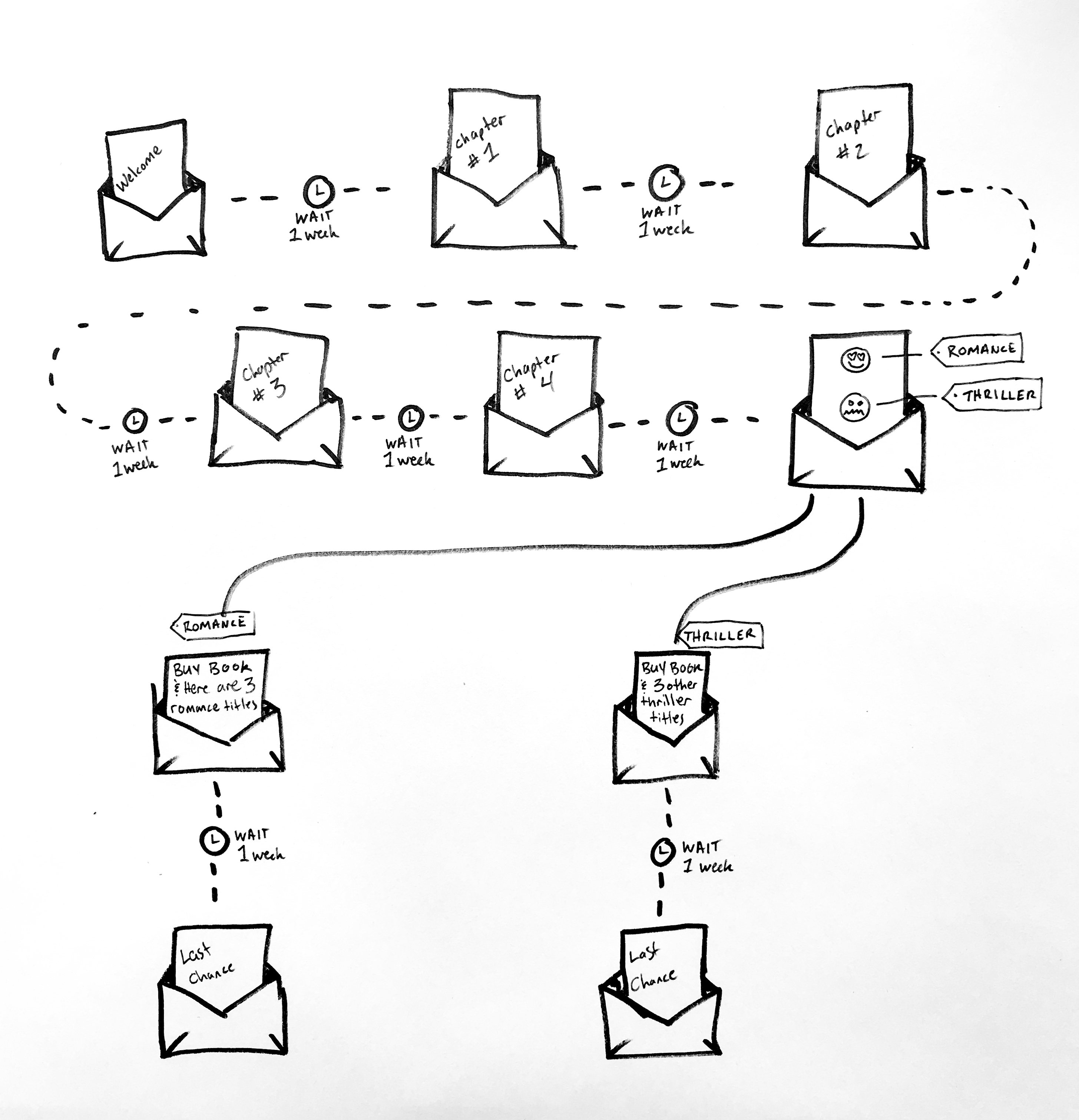
To help you see how automation maps work, we’re going to look at an example. Let’s say you’re an author who wants to promote his brand-new novel through automation. You decide to send a chapter every week for four weeks to your subscribers. At the end of the four-week automated campaign, you’ll promote a link to buy your entire novel. If you were hand drawing it, your automation flow might be mapped out something like this:


The same automation map created in Google Draw might look like this:


Pretty simple, right? But with this map, you know exactly what your time delays are, and you know exactly which emails will launch and to whom they’ll send. Now, let’s say you want to take it a step further with action-based automation. You’ll still offer your novel for purchase after you sends the fourth chapter, but you’ll also ask a question of your audience. Which genre do they prefer? Romance or Thriller. Depending on which option the subscriber clicks on, they are automatically tagged with either “Romance” or “Thriller.” You’ve now segmented your audience into two groups, and you can target those segments with his other book titles that fall in those particular genres. You could then send 2 different automated series to those segments. For those who chose “Romance,” you could ask them to buy your new romance book. For those who chose “Thriller,” you can promote your new thriller book. Here’s an example of what your automation map might look like for this action-based series:


As you map your own series, ask yourself these questions:


Should you apply a tag at the beginning and/or end of your series? (Doing so can help you identify who is currently within a series and who has finished a series.)


What’s the right time delay between each email? Am I sending too many emails? Am I sending too few?


Which emails slot into the different stages of the marketing funnel (awareness, consideration, conversion, loyalty, and advocacy)?


Is there an email I can add to the series that’ll make my user more likely to convert?


Not sure what to write in your automated emails? This free course will help.

Before you can launch an automated series, you need to write your emails. If you have writer’s block or need direction, our free “What to Write in Your Emails” course can help.


Source: https://www.business2community.com


ABOUT WNFP
Westchester Networking for Professionals (WNFP) is a business organization focused on providing our members and guests with an extraordinary networking experience, bringing business professionals together for the sole purpose of generating new relationships and developing new business opportunities. Not a member, learn how you can become a member and join this awesome group of professionals to connect and grow your business.

Stay Connected with WNFP!
Join WNFP Communities!

Tuesday, May 1, 2018

4 Tips to Spruce Up Your Email Marketing Efforts This Spring


It may not feel like spring just yet (especially if you’re based in the northeast U.S.), but it’s still a good time to do some email marketing spring cleaning.

Not only will you feel a sense of accomplishment but making even small changes can have a big impact on your results. And getting these tasks out of the way now will pay off later by ensuring you’ll have time to relax this summer.

With that in mind, here are four suggestions for this your on-the-job spring cleaning:


1. Scrub your mailing lists


If you haven’t paid attention to your lists over the long winter, start with this.

“Clean email lists produce fewer bounces, which improves your sender reputation because it signals to ISPs that you’re committed to respecting recipients’ inboxes instead of spamming them,” writes Jeff Cox at SendInBlue. “This translates to improved deliverability across your entire subscriber base.”

Laura Buxton, at Braze, writes that a list-cleaning effort begins by identifying customers from whom you haven’t heard for half a year. “Users that haven’t opened an email from you in the last six months should be removed from your email list,” she writes. “You can still target these users with re-engagement campaigns but be mindful that continuing to target them can indicate to ISPs that your emails don’t deserve to be in recipient inboxes. So, make sure you’ve got a really compelling pitch before you send them that last-chance email.”


2. Dust off some compelling new subject lines


Subject lines drive open rates, which means you can’t just recycle a few of your all-time favorites and expect to get the results you want. This is a great time of year to determine which of your subject lines performed best, learn from them and come up with new ones that will perform better.

“No matter what they say, people do judge emails by their subject lines,” writes Olivia Allen on the Hubspot blog. “In fact, 47% of email recipients decide whether or not to open an email based on subject line alone. That’s why it’s so important to craft subject lines that are compelling enough to get people to click through.”

Allen provides 17 tips for creating high-impact subject lines, a list that includes using action-orientated verbs and posing compelling questions and using numbers – and don’t forget to test!


3. Polish your writing’s ‘urgency quotient’


Every word in every message needs to play a role in getting recipients to click on your CTA. Review some of your recent messages – does your body copy tell a compelling story? Does the wording of your CTAs themselves convey urgency? Are you doing everything you can with your writing to drive action?

If a sense of urgency is doing anything less than absolutely popping off the screen, now’s the perfect time to see what you can do to inject some FOMO into your writing.

“While web writing is generally passive, email content should be straightforward and drive action,” writes Joanna Milliken at Marketing Land. “Apply this approach when you’re trying to get someone to click on an offer or register for an event, and when you’re trying to deliver more value to a consumer over email. The call to action for a reader is particularly important. Removing articles, such as ‘the’ or ‘a,’ can drive your message home: ‘Read e-book’ or ‘Buy jeans’ sounds more pressing than “Read the e-book” or ‘Buy the jeans.’”


4. Sharpen your content’s mobile-readiness


“Without question, the emails your company sends will be read on mobile devices,” writes Gabriel Shaoolian at Forbes. “This is true even for B2B companies that target users in the workplace. One of the number-one activities people use their phones for is email, and we all know that today’s modern workers check email at all hours, even long after they’ve left the office. Users won’t be forgiving of lackluster mobile email performance — they’ll trash your message and move on.”

We certainly don’t want that! Fortunately, we can prevent it.

“It isn’t difficult to make sure your emails are optimized for mobile and, in fact, many email marketing services offer responsive templates that make the job easy,” Shaoolian writes. “Remember that what looks like a short paragraph on desktop will take up considerably more screen space on mobile. Use a stacked layout, which is far easier for mobile readers to follow than a column layout. Don’t forget that CTAs should be easy to click with a mouse and a thumb.”


Source: https://www.business2community.com


ABOUT WNFP
Westchester Networking for Professionals (WNFP) is a business organization focused on providing our members and guests with an extraordinary networking experience, bringing business professionals together for the sole purpose of generating new relationships and developing new business opportunities. Not a member, learn how you can become a member and join this awesome group of professionals to connect and grow your business.

Stay Connected with WNFP!
Join WNFP Communities!

Improve Your Email Marketing Deliverability

I’ve expressed in a past article that one out of five emails never makes it to the inbox. So the question is, what do we do about this? There are many things you can do so I’ve decided to focus this article on the top three. 

Here they are:

1. The most important thing you can do to maximize the deliverability of any email campaign
is sending your content to people who want to receive it. Seth Godin calls it “permission marketing.” One of my favorite quotes from Seth is, “when someone chooses to pay attention they are actually paying you with something precious.” I think marketers sometimes forget this. But for email marketers, we can pretty much guarantee that we’re sending to people that want our content. The way to make this happen is by getting them to opt into our database. Either collect their email addresses at a tradeshow or create a sign-up sheet on our website to invite people to receive our content, etc. Do not continually send to people who don’t want your content. How’s that for a double negative?


2. Create an engaged segment within your database. This is a fundamental tactic we use to make sure we’re not sending content to people who will be unhappy to receive it. Most email marketing platforms can create triggered segments based on behavior. For every client, we use this capability to identify people who are engaged in the campaign. If somebody opens an email, this tells us something. They didn’t delete the email. They didn’t complain about spam. And they didn’t opt out of the campaign. This behavior shows they are engaged and can be treated as an opt-in. These people receive emails every time we send something out. Then we are very careful not to send to the rest of the list every single time. One thing you can do is break up the remaining list into three or four segments and then only send to one of those sub-segments each time an email goes out. This will increase your open rates and definitely improve deliverability.


3. Set up authentication. This should be done when you very first set up a new email campaign for a new client or a new company. Most email marketing platforms will insist this be done. But it’s critical you understand DKIM, SPF, and DMARC authentication practices. Explaining these goes much deeper than the intended scope of this article. But the critical thing to understand is that these tactics identify you as an authentic person or company and not as a robot or a spammer. These authentication practices not only improve the deliverability of your emails, but they protect your IP address and domain reputation on the Internet. So my main point here is if you are doing email marketing make sure you do a deep dive into this topic, so you fully understand authentication and how to implement it.


This article originally appeared on the So-Mark Blog and has been republished with permission.

Source: https://www.business2community.com


ABOUT WNFP
Westchester Networking for Professionals (WNFP) is a business organization focused on providing our members and guests with an extraordinary networking experience, bringing business professionals together for the sole purpose of generating new relationships and developing new business opportunities. Not a member, learn how you can become a member and join this awesome group of professionals to connect and grow your business.

Stay Connected with WNFP!
Join WNFP Communities!

eCommerce Has Changed The Way We Shop. Here's 3 Reasons Why Your Online Business Isn't Growing


With the world at our fingertips, many of us may take for granted how easy it is to buy and receive on demand. Online shopping has left an indelible footprint on society that goes far beyond the ability to buy an item at midnight while in our pajamas. Here are three of the biggest effects eCommerce has had on consumer lives and how businesses operate. If you're selling product online (and not taking this into account) - growth may be harder for you.


You're Not Social Or Digital First


There have been significant changes in how companies reach customers. The brand-consumer interaction is no longer solely through mass media. Digital marketing campaigns have the ability to target people where they spend the most time - online. We can no longer read email, check social media, play online games, use apps or even catch up on the news without being exposed to ads that are tailored to our specific interests and buying habits.

Shopping itself also has become a different social interaction. Rather than a single conversation in a store, people share their opinions with multitudes of friends and followers via social media and online review sites. This immediate access to other customers' experience can be beneficial if your brand is receiving particularly good service or your advocates enjoy your brand's products.

Online retail has also created a new shopping event - the unboxing. People watch videos of someone - often a complete stranger - open a package and express their joy or disappointment. These vloggers and web personalities are influencers, and depending on their popularity and reach, can become valued marketing partners for a brand who wishes to reach a specific audience. 


You're Not Leveraging New Digital Economy Opportunities


With the power of the Internet, smaller businesses now have the ability to reach consumers on a national and even global scale. At the same time - they also have the ability to reach highly-niches audiences. This ability to leverage digital to reach a large group of a particular niche audience is one of the powers of online business.


With e-retailers becoming more prominent, ancillary businesses that specialize in key functions, such as fulfillment, logistics, and warehousing, have grown to create their own sub-industry. The rise of fulfillment centers has contributed to the 355,000 jobs created in the eCommerce sector since 2007. This now the time to find where you fit in in this eCommerce game. If you aren't adapting to the host of new industries and sub-industries created - you may be missing out on ways to grow new revenue streams and create your unique legacy in the field.


You're Not Leveraging Data To Personalize The Customer Experience


With convenience playing a defining role in how shoppers make a decision, companies can now connect with consumers via purchase and browsing history, interests and even location. Using this data, brands can target product suggestions and promotional deals, for a greater customer experience and increased sales.

A personal customer experience extends to allowing consumers to shop and interact however they prefer via an omnichannel experience. With the combination of online, physical and mobile channels, today's shoppers are free to mix and match outlets based on their needs, such as buy online and pick up or return in store.

These are but three ways eCommerce has changed the way people shop and how businesses operate. As online buying continues to grow, your business should be constantly thinking of ways to stay aware of the trends and ahead of the curve.


Source: https://www.inc.com
Image Credit: Getty Images


ABOUT WNFP
Westchester Networking for Professionals (WNFP) is a business organization focused on providing our members and guests with an extraordinary networking experience, bringing business professionals together for the sole purpose of generating new relationships and developing new business opportunities. Not a member, learn how you can become a member and join this awesome group of professionals to connect and grow your business.

Stay Connected with WNFP!
Join WNFP Communities!
Business blogs
Business Blogs - Blog Rankings